

It was also observed that when o-chlorotoluene is used as the aryl halide, P3HT is
produced only when PPh 3 is the ligand (but not with dppf), whereas p-chlorotoluene
could not produce any polymer (with either of PPh 3 or dppf as the ligands). Doubina
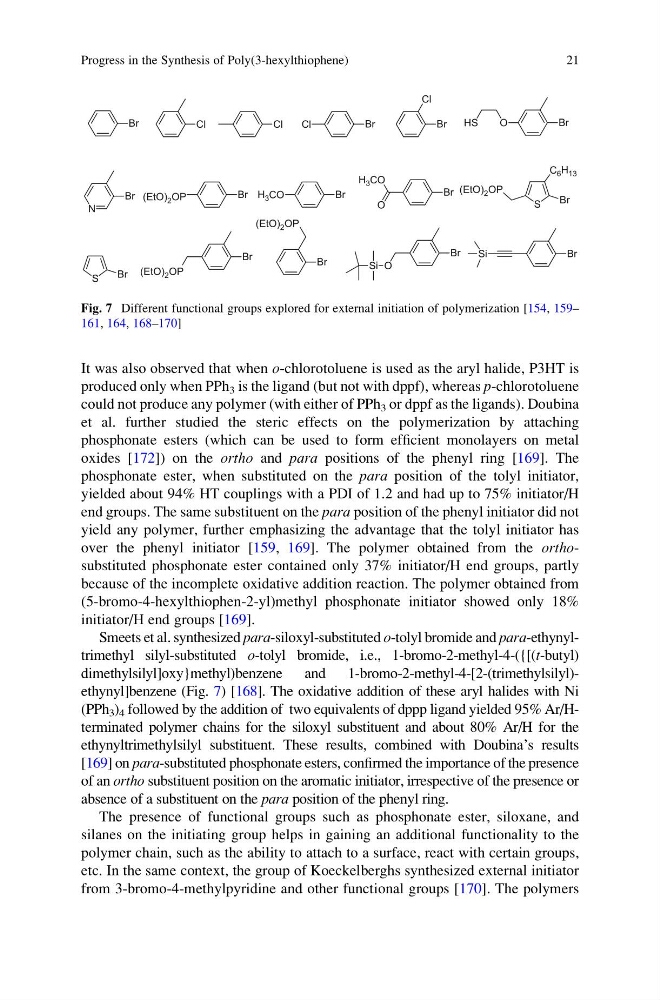
et al. further studied the steric effects on the polymerization by attaching
phosphonate esters (which can be used to form efficient monolayers on metal
oxides [172]) on the ortho and para positions of the phenyl ring [169]. The
phosphonate ester, when substituted on the para position of the tolyl initiator,
yielded about 94% HT couplings with a PDI of 1.2 and had up to 75% initiator/H
end groups. The same substituent on the para position of the phenyl initiator did not
yield any polymer, further emphasizing the advantage that the tolyl initiator has
over the phenyl initiator [159, 169]. The polymer obtained from the orthosubstituted phosphonate ester contained only 37% initiator/H end groups, partly
because of the incomplete oxidative addition reaction. The polymer obtained from
(5-bromo-4-hexylthiophen-2-yl)methyl phosphonate initiator showed only 18%
initiator/H end groups [169].
Smeets et al. synthesized para-siloxyl-substituted o-tolyl bromide and para-ethynyltrimethyl silyl-substituted o-tolyl bromide, i.e., 1-bromo-2-methyl-4-({[(t-butyl)
dimethylsilyl]oxy}methyl)benzene and 1-bromo-2-methyl-4-[2-(trimethylsilyl)ethynyl]benzene (Fig. 7) [168]. The oxidative addition of these aryl halides with Ni
(PPh 3 ) 4 followed by the addition of two equivalents of dppp ligand yielded 95% Ar/Hterminated polymer chains for the siloxyl substituent and about 80% Ar/H for the
ethynyltrimethylsilyl substituent. These results, combined with Doubina’s results
[169] on para-substituted phosphonate esters, confirmed the importance of the presence
of an ortho substituent position on the aromatic initiator, irrespective of the presence or
absence of a substituent on the para position of the phenyl ring.
The presence of functional groups such as phosphonate ester, siloxane, and
silanes on the initiating group helps in gaining an additional functionality to the
polymer chain, such as the ability to attach to a surface, react with certain groups,
etc. In the same context, the group of Koeckelberghs synthesized external initiator
from 3-bromo-4-methylpyridine and other functional groups [170]. The polymers
Br
S
Br
Br
O
H 3 CO
Br
H 3 CO
Cl
Br
Br
Cl
Br
(EtO) 2 OP
(EtO) 2 OP
Br
Cl
Cl
Br
Si
Br
O
Si
S
Br
(EtO) 2 OP
C 6 H 13
Br
(EtO) 2 OP
N
Br
Br
O
HS
Fig. 7 Different functional groups explored for external initiation of polymerization [154, 159–
161, 164, 168–170]
Progress in the Synthesis of Poly(3-hexylthiophene)
21
produced only when PPh 3 is the ligand (but not with dppf), whereas p-chlorotoluene
could not produce any polymer (with either of PPh 3 or dppf as the ligands). Doubina
et al. further studied the steric effects on the polymerization by attaching
phosphonate esters (which can be used to form efficient monolayers on metal
oxides [172]) on the ortho and para positions of the phenyl ring [169]. The
phosphonate ester, when substituted on the para position of the tolyl initiator,
yielded about 94% HT couplings with a PDI of 1.2 and had up to 75% initiator/H
end groups. The same substituent on the para position of the phenyl initiator did not
yield any polymer, further emphasizing the advantage that the tolyl initiator has
over the phenyl initiator [159, 169]. The polymer obtained from the orthosubstituted phosphonate ester contained only 37% initiator/H end groups, partly
because of the incomplete oxidative addition reaction. The polymer obtained from
(5-bromo-4-hexylthiophen-2-yl)methyl phosphonate initiator showed only 18%
initiator/H end groups [169].
Smeets et al. synthesized para-siloxyl-substituted o-tolyl bromide and para-ethynyltrimethyl silyl-substituted o-tolyl bromide, i.e., 1-bromo-2-methyl-4-({[(t-butyl)
dimethylsilyl]oxy}methyl)benzene and 1-bromo-2-methyl-4-[2-(trimethylsilyl)ethynyl]benzene (Fig. 7) [168]. The oxidative addition of these aryl halides with Ni
(PPh 3 ) 4 followed by the addition of two equivalents of dppp ligand yielded 95% Ar/Hterminated polymer chains for the siloxyl substituent and about 80% Ar/H for the
ethynyltrimethylsilyl substituent. These results, combined with Doubina’s results
[169] on para-substituted phosphonate esters, confirmed the importance of the presence
of an ortho substituent position on the aromatic initiator, irrespective of the presence or
absence of a substituent on the para position of the phenyl ring.
The presence of functional groups such as phosphonate ester, siloxane, and
silanes on the initiating group helps in gaining an additional functionality to the
polymer chain, such as the ability to attach to a surface, react with certain groups,
etc. In the same context, the group of Koeckelberghs synthesized external initiator
from 3-bromo-4-methylpyridine and other functional groups [170]. The polymers
Br
S
Br
Br
O
H 3 CO
Br
H 3 CO
Cl
Br
Br
Cl
Br
(EtO) 2 OP
(EtO) 2 OP
Br
Cl
Cl
Br
Si
Br
O
Si
S
Br
(EtO) 2 OP
C 6 H 13
Br
(EtO) 2 OP
N
Br
Br
O
HS
Fig. 7 Different functional groups explored for external initiation of polymerization [154, 159–
161, 164, 168–170]
Progress in the Synthesis of Poly(3-hexylthiophene)
21