

The Nesterov group used a one-step method for the synthesis of the initiator.
They reacted aryl halide with Ni(dppp) 2 to obtain the initiator Ar-Ni(dppp)-Cl in
reasonably good yields (45–55%) [165]. Their method not only involved the
one-step synthesis of Ar-Ni(dppp)-Cl initiator, but it also prevented the undesired
presence of PPh 3 ligand, which may reduce the efficiency of the catalyst, promote
disproportionation of the initiator, and also promote undesired aryl–aryl coupling.
The authors claim that this procedure yields polymers that are defect-free and with
100% regioregularity. However, the polydispersities reported varied between 1.16
and 2.00.
5.1 Variation of Functional Groups That Can be Attached
to the External Initiator
Efficient external initiation can pave the way to further functionalization and to
varied polymer architectures. External initiation was attempted by different
research groups with various functionalizations of the phenyl group (Fig. 7).
Doubina et al. prepared a series of initiators by the addition of electron-donating
and electron-withdrawing substituents on the phenyl ring to change the reactivity of
oxidative addition reaction [159]. Although the rate and efficacy of the oxidative
addition reaction is higher in the presence of an electron-withdrawing substituent
[171], it was observed that the polymerization reaction is not very efficient. Very
low amounts of initiator/H end groups have been observed for polymers synthesized from initiators with electron-withdrawing substituents on the phenyl ring,
indicating a large number of chain transfer reactions. Similarly, the polymer
obtained from 4-bromo anisole also displays very low amounts of initator/H end
groups. Thus, it can be inferred that the polymerization of P3HT is more efficient on
unfunctionalized phenyl rings in Ph-Ni(PPh 3 ) 2 -Cl than on substituted phenyl rings.
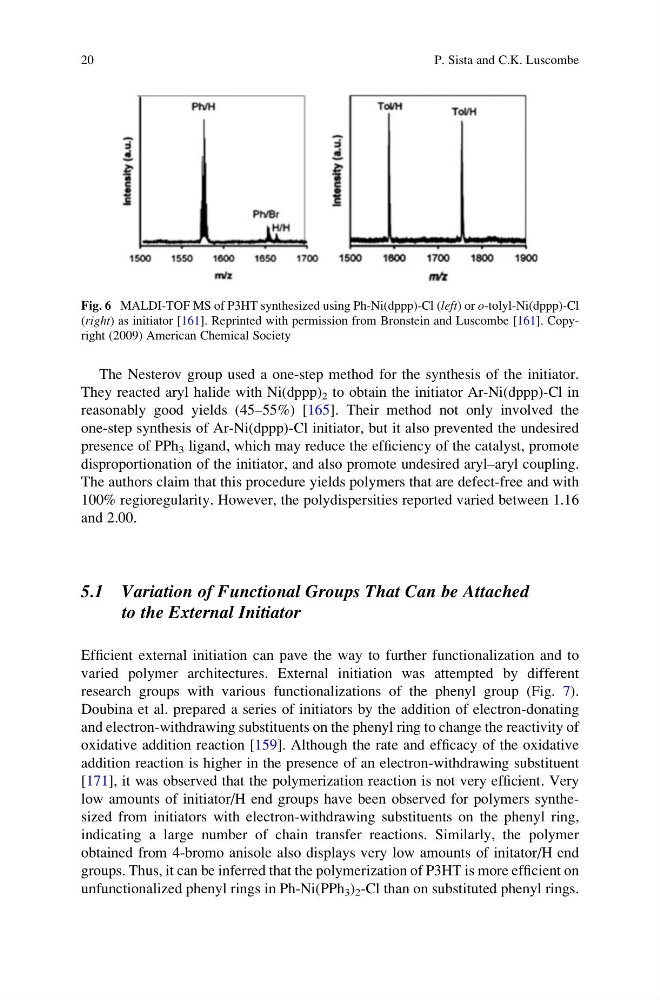
Fig. 6 MALDI-TOF MS of P3HT synthesized using Ph-Ni(dppp)-Cl (left) or o-tolyl-Ni(dppp)-Cl
(right) as initiator [161]. Reprinted with permission from Bronstein and Luscombe [161]. Copyright (2009) American Chemical Society
20
P. Sista and C.K. Luscombe
They reacted aryl halide with Ni(dppp) 2 to obtain the initiator Ar-Ni(dppp)-Cl in
reasonably good yields (45–55%) [165]. Their method not only involved the
one-step synthesis of Ar-Ni(dppp)-Cl initiator, but it also prevented the undesired
presence of PPh 3 ligand, which may reduce the efficiency of the catalyst, promote
disproportionation of the initiator, and also promote undesired aryl–aryl coupling.
The authors claim that this procedure yields polymers that are defect-free and with
100% regioregularity. However, the polydispersities reported varied between 1.16
and 2.00.
5.1 Variation of Functional Groups That Can be Attached
to the External Initiator
Efficient external initiation can pave the way to further functionalization and to
varied polymer architectures. External initiation was attempted by different
research groups with various functionalizations of the phenyl group (Fig. 7).
Doubina et al. prepared a series of initiators by the addition of electron-donating
and electron-withdrawing substituents on the phenyl ring to change the reactivity of
oxidative addition reaction [159]. Although the rate and efficacy of the oxidative
addition reaction is higher in the presence of an electron-withdrawing substituent
[171], it was observed that the polymerization reaction is not very efficient. Very
low amounts of initiator/H end groups have been observed for polymers synthesized from initiators with electron-withdrawing substituents on the phenyl ring,
indicating a large number of chain transfer reactions. Similarly, the polymer
obtained from 4-bromo anisole also displays very low amounts of initator/H end
groups. Thus, it can be inferred that the polymerization of P3HT is more efficient on
unfunctionalized phenyl rings in Ph-Ni(PPh 3 ) 2 -Cl than on substituted phenyl rings.
Fig. 6 MALDI-TOF MS of P3HT synthesized using Ph-Ni(dppp)-Cl (left) or o-tolyl-Ni(dppp)-Cl
(right) as initiator [161]. Reprinted with permission from Bronstein and Luscombe [161]. Copyright (2009) American Chemical Society
20
P. Sista and C.K. Luscombe