

kinetics and energetics of the proposed process in greater detail [182]. For longrange transfer, the electron transfer rate k ET scales approximately like k ET (R) ¼ k 0
exp(ÀβR) with distance R, where β is an attenuation factor. It is shown that
tunneling through conjugated chains results in values of β as small as 0.2 Å
À1 .
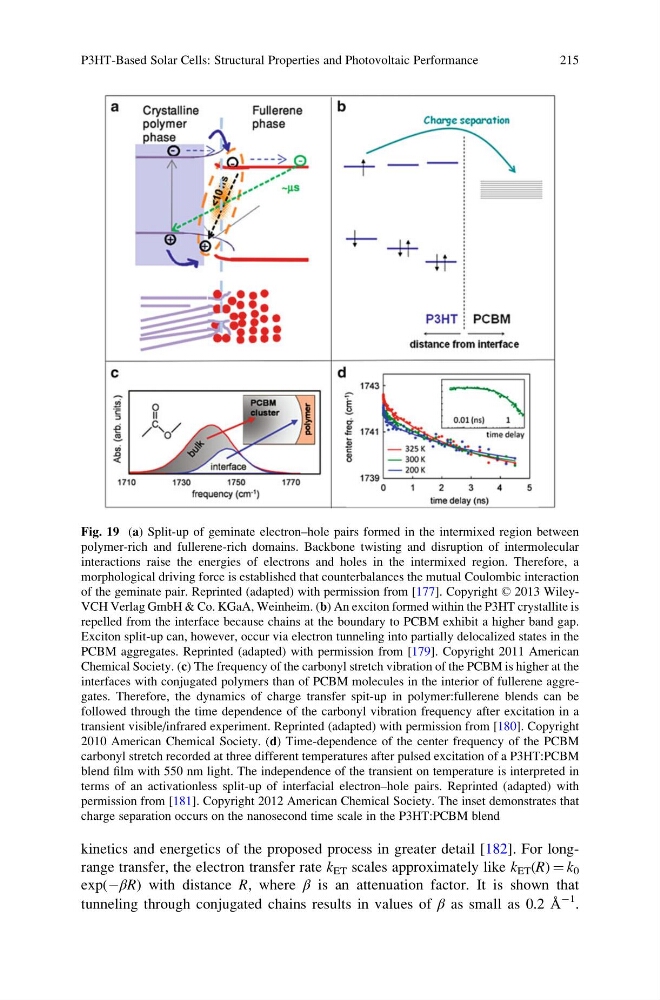
Fig. 19 (a) Split-up of geminate electron–hole pairs formed in the intermixed region between
polymer-rich and fullerene-rich domains. Backbone twisting and disruption of intermolecular
interactions raise the energies of electrons and holes in the intermixed region. Therefore, a
morphological driving force is established that counterbalances the mutual Coulombic interaction
of the geminate pair. Reprinted (adapted) with permission from [177]. Copyright © 2013 WileyVCH Verlag GmbH & Co. KGaA, Weinheim. (b) An exciton formed within the P3HT crystallite is
repelled from the interface because chains at the boundary to PCBM exhibit a higher band gap.
Exciton split-up can, however, occur via electron tunneling into partially delocalized states in the
PCBM aggregates. Reprinted (adapted) with permission from [179]. Copyright 2011 American
Chemical Society. (c) The frequency of the carbonyl stretch vibration of the PCBM is higher at the
interfaces with conjugated polymers than of PCBM molecules in the interior of fullerene aggregates. Therefore, the dynamics of charge transfer spit-up in polymer:fullerene blends can be
followed through the time dependence of the carbonyl vibration frequency after excitation in a
transient visible/infrared experiment. Reprinted (adapted) with permission from [180]. Copyright
2010 American Chemical Society. (d) Time-dependence of the center frequency of the PCBM
carbonyl stretch recorded at three different temperatures after pulsed excitation of a P3HT:PCBM
blend film with 550 nm light. The independence of the transient on temperature is interpreted in
terms of an activationless split-up of interfacial electron–hole pairs. Reprinted (adapted) with
permission from [181]. Copyright 2012 American Chemical Society. The inset demonstrates that
charge separation occurs on the nanosecond time scale in the P3HT:PCBM blend
P3HT-Based Solar Cells: Structural Properties and Photovoltaic Performance
215
exp(ÀβR) with distance R, where β is an attenuation factor. It is shown that
tunneling through conjugated chains results in values of β as small as 0.2 Å
À1 .
Fig. 19 (a) Split-up of geminate electron–hole pairs formed in the intermixed region between
polymer-rich and fullerene-rich domains. Backbone twisting and disruption of intermolecular
interactions raise the energies of electrons and holes in the intermixed region. Therefore, a
morphological driving force is established that counterbalances the mutual Coulombic interaction
of the geminate pair. Reprinted (adapted) with permission from [177]. Copyright © 2013 WileyVCH Verlag GmbH & Co. KGaA, Weinheim. (b) An exciton formed within the P3HT crystallite is
repelled from the interface because chains at the boundary to PCBM exhibit a higher band gap.
Exciton split-up can, however, occur via electron tunneling into partially delocalized states in the
PCBM aggregates. Reprinted (adapted) with permission from [179]. Copyright 2011 American
Chemical Society. (c) The frequency of the carbonyl stretch vibration of the PCBM is higher at the
interfaces with conjugated polymers than of PCBM molecules in the interior of fullerene aggregates. Therefore, the dynamics of charge transfer spit-up in polymer:fullerene blends can be
followed through the time dependence of the carbonyl vibration frequency after excitation in a
transient visible/infrared experiment. Reprinted (adapted) with permission from [180]. Copyright
2010 American Chemical Society. (d) Time-dependence of the center frequency of the PCBM
carbonyl stretch recorded at three different temperatures after pulsed excitation of a P3HT:PCBM
blend film with 550 nm light. The independence of the transient on temperature is interpreted in
terms of an activationless split-up of interfacial electron–hole pairs. Reprinted (adapted) with
permission from [181]. Copyright 2012 American Chemical Society. The inset demonstrates that
charge separation occurs on the nanosecond time scale in the P3HT:PCBM blend
P3HT-Based Solar Cells: Structural Properties and Photovoltaic Performance
215