

molecules. P3HT chains within the mixed domains are believed to exhibit a twisted
conformation, similar to chains in solution or in a solid sample of regiorandom
P3HT. As these twisted chains exhibit lower HOMO energies than those in crystallites of planar P3HT [176], an energy gradient is established that drives holes out
of the intermixed regions [177]. Similarly, Jamieson et al. pointed out recently that
the larger electron affinity of PCBM molecules in pure fullerene aggregates compared to the intermixed domain assists free charge generation [178]. Polaron pairs
generated in the intermixed regions are therefore prone to rapid dissociation into
spatially separated charges, with the hole and electron residing on domains of the
pure donor and acceptor, respectively (Fig. 19a). This model of a morphologyrelated driving force is consistent with the observation of efficient dissociation of
even relaxed CT states, and it also provides a reasonable explanation for the
inefficient non-geminate recombination of electrons and holes in annealed P3HT:
PCBM blends.
The situation is different when considering excitons that are formed within
ordered P3HT domains. Troisi and coworkers pointed out that because of the
lower band gap of chain segments within the crystallites, these excitons are repelled
by the more disordered donor–acceptor interface [179]. The authors therefore
proposed that these excitons split via tunneling of the electron through layers of
more distorted polymer chains at the interface into higher and partially delocalized
states on the PCBM aggregates (see Fig. 19b). This long-range exciton dissociation
results in a spatially separated electron–hole pair, stabilized by a more disordered
interfacial region. In a subsequent publication, Caruso and Troisi considered the
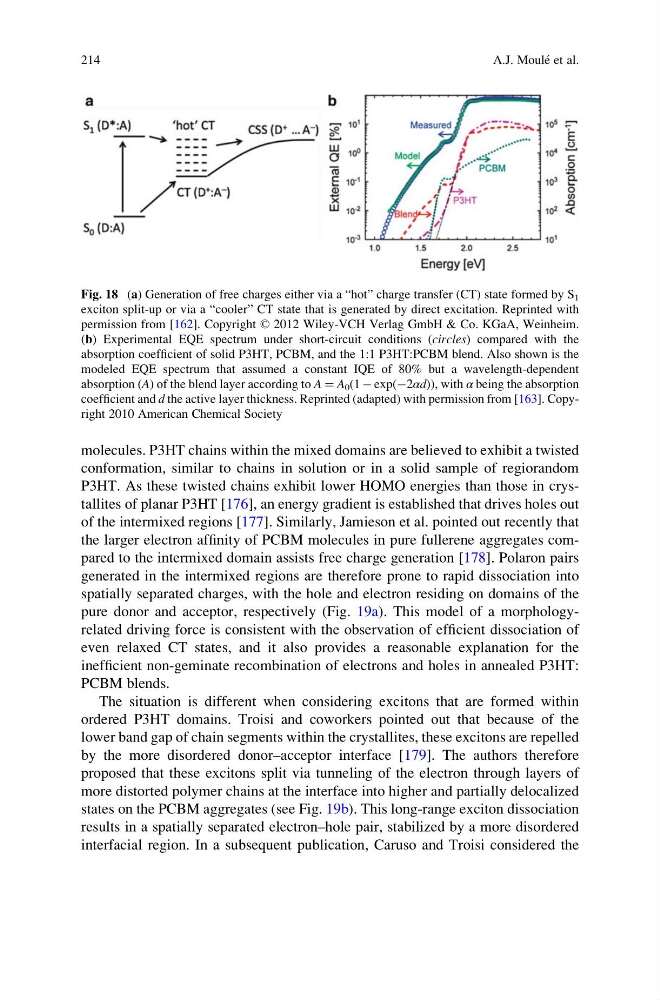
Fig. 18 (a) Generation of free charges either via a “hot” charge transfer (CT) state formed by S 1
exciton split-up or via a “cooler” CT state that is generated by direct excitation. Reprinted with
permission from [162]. Copyright © 2012 Wiley-VCH Verlag GmbH & Co. KGaA, Weinheim.
(b) Experimental EQE spectrum under short-circuit conditions (circles) compared with the
absorption coefficient of solid P3HT, PCBM, and the 1:1 P3HT:PCBM blend. Also shown is the
modeled EQE spectrum that assumed a constant IQE of 80% but a wavelength-dependent
absorption (A) of the blend layer according to A ¼ A 0 (1 À exp(À2αd)), with α being the absorption
coefficient and d the active layer thickness. Reprinted (adapted) with permission from [163]. Copyright 2010 American Chemical Society
214
A.J. Moule ´ et al.
conformation, similar to chains in solution or in a solid sample of regiorandom
P3HT. As these twisted chains exhibit lower HOMO energies than those in crystallites of planar P3HT [176], an energy gradient is established that drives holes out
of the intermixed regions [177]. Similarly, Jamieson et al. pointed out recently that
the larger electron affinity of PCBM molecules in pure fullerene aggregates compared to the intermixed domain assists free charge generation [178]. Polaron pairs
generated in the intermixed regions are therefore prone to rapid dissociation into
spatially separated charges, with the hole and electron residing on domains of the
pure donor and acceptor, respectively (Fig. 19a). This model of a morphologyrelated driving force is consistent with the observation of efficient dissociation of
even relaxed CT states, and it also provides a reasonable explanation for the
inefficient non-geminate recombination of electrons and holes in annealed P3HT:
PCBM blends.
The situation is different when considering excitons that are formed within
ordered P3HT domains. Troisi and coworkers pointed out that because of the
lower band gap of chain segments within the crystallites, these excitons are repelled
by the more disordered donor–acceptor interface [179]. The authors therefore
proposed that these excitons split via tunneling of the electron through layers of
more distorted polymer chains at the interface into higher and partially delocalized
states on the PCBM aggregates (see Fig. 19b). This long-range exciton dissociation
results in a spatially separated electron–hole pair, stabilized by a more disordered
interfacial region. In a subsequent publication, Caruso and Troisi considered the
Fig. 18 (a) Generation of free charges either via a “hot” charge transfer (CT) state formed by S 1
exciton split-up or via a “cooler” CT state that is generated by direct excitation. Reprinted with
permission from [162]. Copyright © 2012 Wiley-VCH Verlag GmbH & Co. KGaA, Weinheim.
(b) Experimental EQE spectrum under short-circuit conditions (circles) compared with the
absorption coefficient of solid P3HT, PCBM, and the 1:1 P3HT:PCBM blend. Also shown is the
modeled EQE spectrum that assumed a constant IQE of 80% but a wavelength-dependent
absorption (A) of the blend layer according to A ¼ A 0 (1 À exp(À2αd)), with α being the absorption
coefficient and d the active layer thickness. Reprinted (adapted) with permission from [163]. Copyright 2010 American Chemical Society
214
A.J. Moule ´ et al.