

annealing) and thermal annealing was used to create the optimized morphology
film [142].
All of the experiments described above were designed to create more crystalline
P3HT domains, and the domain size was controlled by the self-assembly of the
P3HT fibers. An alternative need is to control the domain size between two
noncrystalline polymers. In this case, the domain size can be set by fabricating
polymer nanoparticles in solution [143]. One strategy for fabrication of mixed
polymer nanoparticles is shown in Fig. 11. Here the polymer concentration, surfactant concentration, and surfactant strength all affect the size of the final polymer
domain [143].
3 Optical Properties
One remarkable feature of solid P3HT:PCBM blends is that their optical properties
depend largely on the preparation conditions [73, 144, 145]. Because absorption
and emission spectra are easier to record than, for example, X-ray scans and TEM
images, the quantitative analysis of optical data with regard to morphology is of
great interest. Figure 12 shows exemplary optical absorption spectra of as-prepared
and annealed P3HT:PCBM measured at room temperature, together with the
corresponding J/V device characteristics. Here, the films were cast from chloroform, a low-boiling point solvent, and were annealed at the given temperatures for
10 min each. With annealing at higher temperatures, the long wavelength features
at 560 and 610 nm attributed to absorption of planarized P3HT chains in polymer
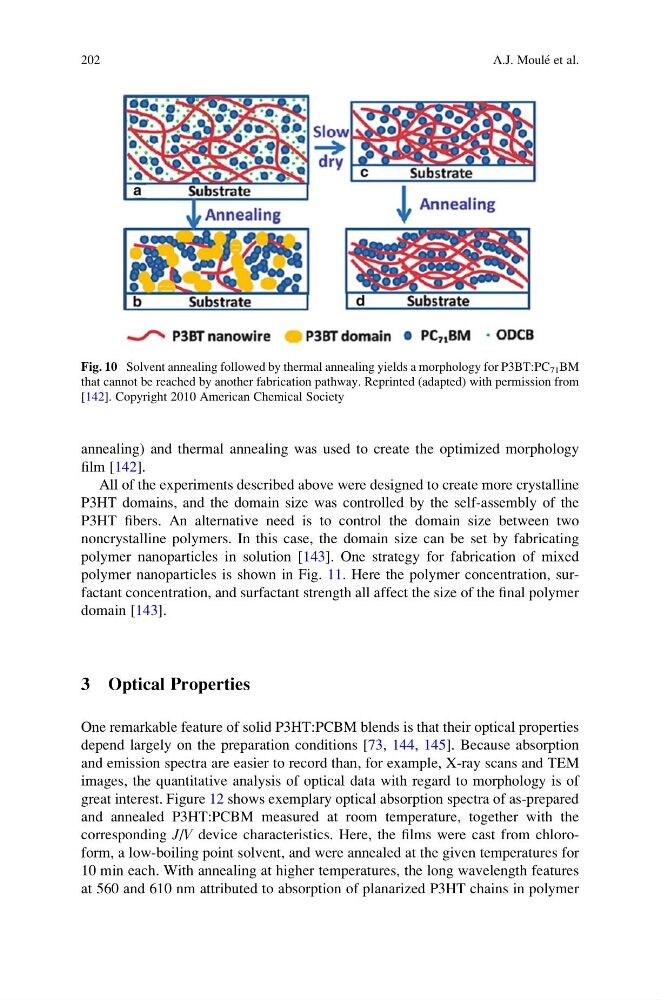
Fig. 10 Solvent annealing followed by thermal annealing yields a morphology for P3BT:PC 71 BM
that cannot be reached by another fabrication pathway. Reprinted (adapted) with permission from
[142]. Copyright 2010 American Chemical Society
202
A.J. Moule ´ et al.
film [142].
All of the experiments described above were designed to create more crystalline
P3HT domains, and the domain size was controlled by the self-assembly of the
P3HT fibers. An alternative need is to control the domain size between two
noncrystalline polymers. In this case, the domain size can be set by fabricating
polymer nanoparticles in solution [143]. One strategy for fabrication of mixed
polymer nanoparticles is shown in Fig. 11. Here the polymer concentration, surfactant concentration, and surfactant strength all affect the size of the final polymer
domain [143].
3 Optical Properties
One remarkable feature of solid P3HT:PCBM blends is that their optical properties
depend largely on the preparation conditions [73, 144, 145]. Because absorption
and emission spectra are easier to record than, for example, X-ray scans and TEM
images, the quantitative analysis of optical data with regard to morphology is of
great interest. Figure 12 shows exemplary optical absorption spectra of as-prepared
and annealed P3HT:PCBM measured at room temperature, together with the
corresponding J/V device characteristics. Here, the films were cast from chloroform, a low-boiling point solvent, and were annealed at the given temperatures for
10 min each. With annealing at higher temperatures, the long wavelength features
at 560 and 610 nm attributed to absorption of planarized P3HT chains in polymer
Fig. 10 Solvent annealing followed by thermal annealing yields a morphology for P3BT:PC 71 BM
that cannot be reached by another fabrication pathway. Reprinted (adapted) with permission from
[142]. Copyright 2010 American Chemical Society
202
A.J. Moule ´ et al.