

2.2.3 Co-solvent Additives
Examining solvent and thermal annealing as industrial processes showed that there
were clear disadvantages to both post-deposition annealing methods. Solvent
annealing utilizes long times with partially solvent-swollen films to allow the
morphology to develop towards a more equilibrium-like configuration. By more
equilibrium-like we mean a more crystalline, more phase-separated, and more
relaxed structure. However, long annealing times and long solvent removal times
are incompatible with rapid reel-to-reel coating.
There are also disadvantages to thermal annealing as a process in OPV manufacture. Thermal annealing also allows the BHJ layer morphology to develop
towards a more equilibrium-like configuration. However, because the whole substrate must be heated, there is a possibility that other layers are affected. For
example, it was shown that with heating to 150
C, P3HT reacts with PEDOT:
PSS to make a mixed doped layer via the following reaction [89]:
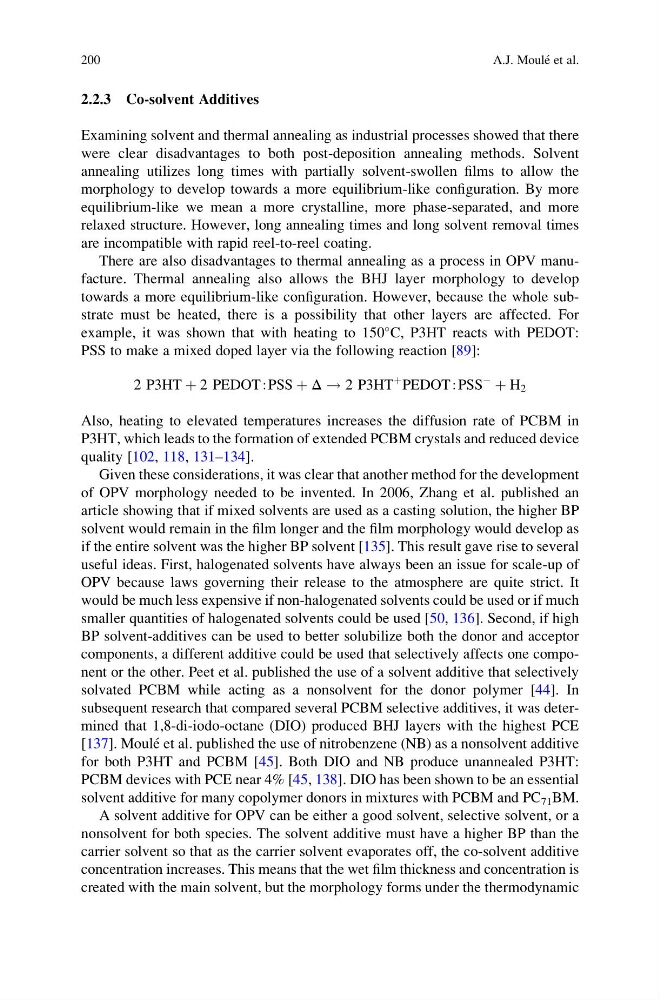
2 P3HT þ 2 PEDOT : PSS þ Δ ! 2 P3HT
þ PEDOT : PSS
À
þ H 2
Also, heating to elevated temperatures increases the diffusion rate of PCBM in
P3HT, which leads to the formation of extended PCBM crystals and reduced device
quality [102, 118, 131–134].
Given these considerations, it was clear that another method for the development
of OPV morphology needed to be invented. In 2006, Zhang et al. published an
article showing that if mixed solvents are used as a casting solution, the higher BP
solvent would remain in the film longer and the film morphology would develop as
if the entire solvent was the higher BP solvent [135]. This result gave rise to several
useful ideas. First, halogenated solvents have always been an issue for scale-up of
OPV because laws governing their release to the atmosphere are quite strict. It
would be much less expensive if non-halogenated solvents could be used or if much
smaller quantities of halogenated solvents could be used [50, 136]. Second, if high
BP solvent-additives can be used to better solubilize both the donor and acceptor
components, a different additive could be used that selectively affects one component or the other. Peet et al. published the use of a solvent additive that selectively
solvated PCBM while acting as a nonsolvent for the donor polymer [44]. In
subsequent research that compared several PCBM selective additives, it was determined that 1,8-di-iodo-octane (DIO) produced BHJ layers with the highest PCE
[137]. Moule ´ et al. published the use of nitrobenzene (NB) as a nonsolvent additive
for both P3HT and PCBM [45]. Both DIO and NB produce unannealed P3HT:
PCBM devices with PCE near 4% [45, 138]. DIO has been shown to be an essential
solvent additive for many copolymer donors in mixtures with PCBM and PC 71 BM.
A solvent additive for OPV can be either a good solvent, selective solvent, or a
nonsolvent for both species. The solvent additive must have a higher BP than the
carrier solvent so that as the carrier solvent evaporates off, the co-solvent additive
concentration increases. This means that the wet film thickness and concentration is
created with the main solvent, but the morphology forms under the thermodynamic
200
A.J. Moule ´ et al.
Examining solvent and thermal annealing as industrial processes showed that there
were clear disadvantages to both post-deposition annealing methods. Solvent
annealing utilizes long times with partially solvent-swollen films to allow the
morphology to develop towards a more equilibrium-like configuration. By more
equilibrium-like we mean a more crystalline, more phase-separated, and more
relaxed structure. However, long annealing times and long solvent removal times
are incompatible with rapid reel-to-reel coating.
There are also disadvantages to thermal annealing as a process in OPV manufacture. Thermal annealing also allows the BHJ layer morphology to develop
towards a more equilibrium-like configuration. However, because the whole substrate must be heated, there is a possibility that other layers are affected. For
example, it was shown that with heating to 150
C, P3HT reacts with PEDOT:
PSS to make a mixed doped layer via the following reaction [89]:
2 P3HT þ 2 PEDOT : PSS þ Δ ! 2 P3HT
þ PEDOT : PSS
À
þ H 2
Also, heating to elevated temperatures increases the diffusion rate of PCBM in
P3HT, which leads to the formation of extended PCBM crystals and reduced device
quality [102, 118, 131–134].
Given these considerations, it was clear that another method for the development
of OPV morphology needed to be invented. In 2006, Zhang et al. published an
article showing that if mixed solvents are used as a casting solution, the higher BP
solvent would remain in the film longer and the film morphology would develop as
if the entire solvent was the higher BP solvent [135]. This result gave rise to several
useful ideas. First, halogenated solvents have always been an issue for scale-up of
OPV because laws governing their release to the atmosphere are quite strict. It
would be much less expensive if non-halogenated solvents could be used or if much
smaller quantities of halogenated solvents could be used [50, 136]. Second, if high
BP solvent-additives can be used to better solubilize both the donor and acceptor
components, a different additive could be used that selectively affects one component or the other. Peet et al. published the use of a solvent additive that selectively
solvated PCBM while acting as a nonsolvent for the donor polymer [44]. In
subsequent research that compared several PCBM selective additives, it was determined that 1,8-di-iodo-octane (DIO) produced BHJ layers with the highest PCE
[137]. Moule ´ et al. published the use of nitrobenzene (NB) as a nonsolvent additive
for both P3HT and PCBM [45]. Both DIO and NB produce unannealed P3HT:
PCBM devices with PCE near 4% [45, 138]. DIO has been shown to be an essential
solvent additive for many copolymer donors in mixtures with PCBM and PC 71 BM.
A solvent additive for OPV can be either a good solvent, selective solvent, or a
nonsolvent for both species. The solvent additive must have a higher BP than the
carrier solvent so that as the carrier solvent evaporates off, the co-solvent additive
concentration increases. This means that the wet film thickness and concentration is
created with the main solvent, but the morphology forms under the thermodynamic
200
A.J. Moule ´ et al.