

phase separation occurs. In addition, it has been widely reported that with heating,
PCBM diffuses through the P3HT and forms extended crystals that are detrimental
to OPV device function [118, 121, 123–125]. Some recent attempts have been made
to generate fullerenes that do not crystallize in order to improve the device
longevity [126].
Although thermal analysis can show the mixing ratio of P3HT:PCBM in a
volume and the melting temperatures of crystals in the melt, it does not specify
the miscibility between the amorphous P3HT and PCBM. Recent bilayer device
investigations [127], neutron reflectometry [65, 128, 129], soft X-ray spectroscopy
[95, 125], and 3D electron tomography images of P3HT:fullerene [96] have
revealed that a mixed domain always exists between P3HT-rich and fullerenerich domains. This means that P3HT:PCBM forms four separate domain types:
P3HT and PCBM can each crystallize to form pure domains, P3HT and PCBM mix
in a ~3:7 ratio in a mixed amorphous P3HT:PCBM domain, and amorphous PCBM
with ~10% amorphous P3HT is also commonly found [130]. Spin-coating results in
the rapid formation of a film and the most common phase is the mixed 3:7
amorphous domain type. With either solvent annealing or a short period of thermal
annealing, the mixed domain phase separates into pure P3HT domains and amorphous PCBM domains with low P3HT content. With thermal annealing for longer
times, PCBM seed crystals form and Oswald ripening occurs, which leads to
increasingly large pure PCBM domains. Large PCBM domains result in a reduction
of OPV device quality.
300
250
T / ºC
50
PC 61 BM
P3HT
100
80
P3HT wt%
10
20
40
60
100
L
T
L + S P3HT
L + S PC61BM
S PC61BM + S P3HT
150
200
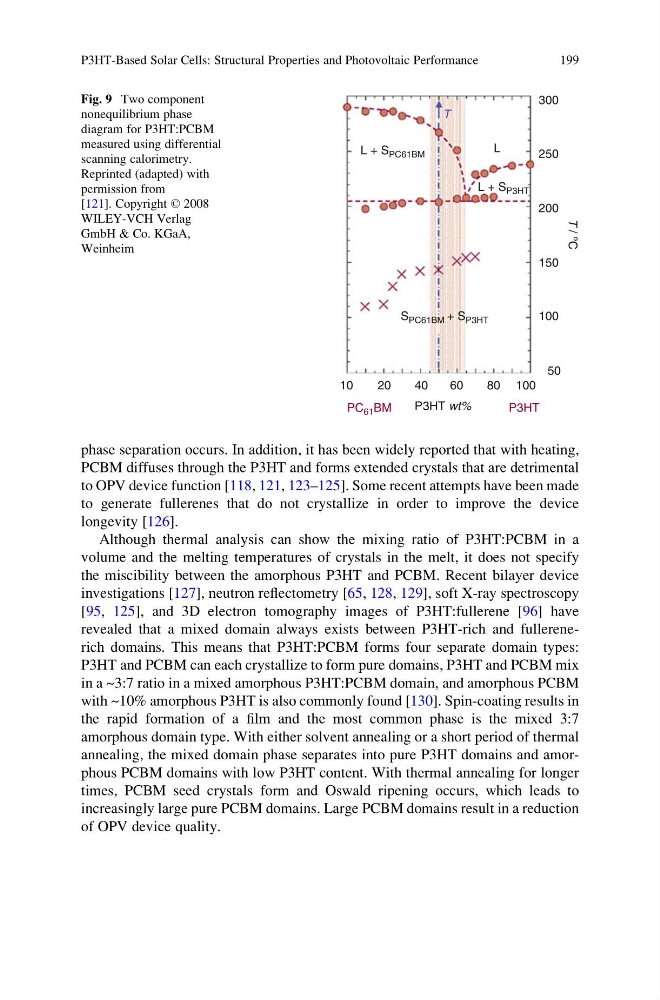
Fig. 9 Two component
nonequilibrium phase
diagram for P3HT:PCBM
measured using differential
scanning calorimetry.
Reprinted (adapted) with
permission from
[121]. Copyright © 2008
WILEY-VCH Verlag
GmbH & Co. KGaA,
Weinheim
P3HT-Based Solar Cells: Structural Properties and Photovoltaic Performance
199
PCBM diffuses through the P3HT and forms extended crystals that are detrimental
to OPV device function [118, 121, 123–125]. Some recent attempts have been made
to generate fullerenes that do not crystallize in order to improve the device
longevity [126].
Although thermal analysis can show the mixing ratio of P3HT:PCBM in a
volume and the melting temperatures of crystals in the melt, it does not specify
the miscibility between the amorphous P3HT and PCBM. Recent bilayer device
investigations [127], neutron reflectometry [65, 128, 129], soft X-ray spectroscopy
[95, 125], and 3D electron tomography images of P3HT:fullerene [96] have
revealed that a mixed domain always exists between P3HT-rich and fullerenerich domains. This means that P3HT:PCBM forms four separate domain types:
P3HT and PCBM can each crystallize to form pure domains, P3HT and PCBM mix
in a ~3:7 ratio in a mixed amorphous P3HT:PCBM domain, and amorphous PCBM
with ~10% amorphous P3HT is also commonly found [130]. Spin-coating results in
the rapid formation of a film and the most common phase is the mixed 3:7
amorphous domain type. With either solvent annealing or a short period of thermal
annealing, the mixed domain phase separates into pure P3HT domains and amorphous PCBM domains with low P3HT content. With thermal annealing for longer
times, PCBM seed crystals form and Oswald ripening occurs, which leads to
increasingly large pure PCBM domains. Large PCBM domains result in a reduction
of OPV device quality.
300
250
T / ºC
50
PC 61 BM
P3HT
100
80
P3HT wt%
10
20
40
60
100
L
T
L + S P3HT
L + S PC61BM
S PC61BM + S P3HT
150
200
Fig. 9 Two component
nonequilibrium phase
diagram for P3HT:PCBM
measured using differential
scanning calorimetry.
Reprinted (adapted) with
permission from
[121]. Copyright © 2008
WILEY-VCH Verlag
GmbH & Co. KGaA,
Weinheim
P3HT-Based Solar Cells: Structural Properties and Photovoltaic Performance
199