

As discussed above, high BP solvents evaporate slowly (10 s–10 h), leaving the
polymer a long time to relax into unstrained and, depending on the polymer,
crystalline domains. In contrast, low BP solvents evaporate quickly (<10 s), leaving the polymer in an amorphous form with strain that can cause dewetting.
In the OPV field, the drying time for a film was not purposefully controlled until
solvent annealing experiments were published by the Yang group in 2005 [43]. The
process of solvent annealing involves covering the wet film (with a petri dish or
other cover), which keeps the atmosphere above the sample rich in solvent and
prevents evaporation. In this way, the sample can be allowed to relax over hours
instead of seconds [88, 92]. Solvent annealing for OPV blends has been widely
reported. The Yang group also showed that the solvent annealing effect could be
realized with any solvent if a high solvent partial pressure above the sample could
be maintained [92]. A simple method for doing this is to spin-coat a wet film and
then to cover the wet film and substrate with an up-turned petri dish. Assuming
negligible mass transfer of solvent to outside of the petri dish, the film remains
solvent-swollen for an arbitrary time period. Several review articles have detailed
the change in morphology with solvent annealing [87, 88, 92]. In general, the longer
relaxation times afforded by high boiling point solvents leads to increased crystallinity in P3HT films [88]. The crystallization of P3HT forces PCBM out into a
1.2
1.0
0.8
0.6
0.4
0.0
1000
100
10
4
Spinning Time [sec]
Chlorobenzene
P3HT:PCBM
GIWAXS
a
b
c
d
GISAXS
10%
Dt formation
t onset
90%
6
8
2
Thickness [nm]
Norm. Peak Int. [arb. units]
10000
0.2
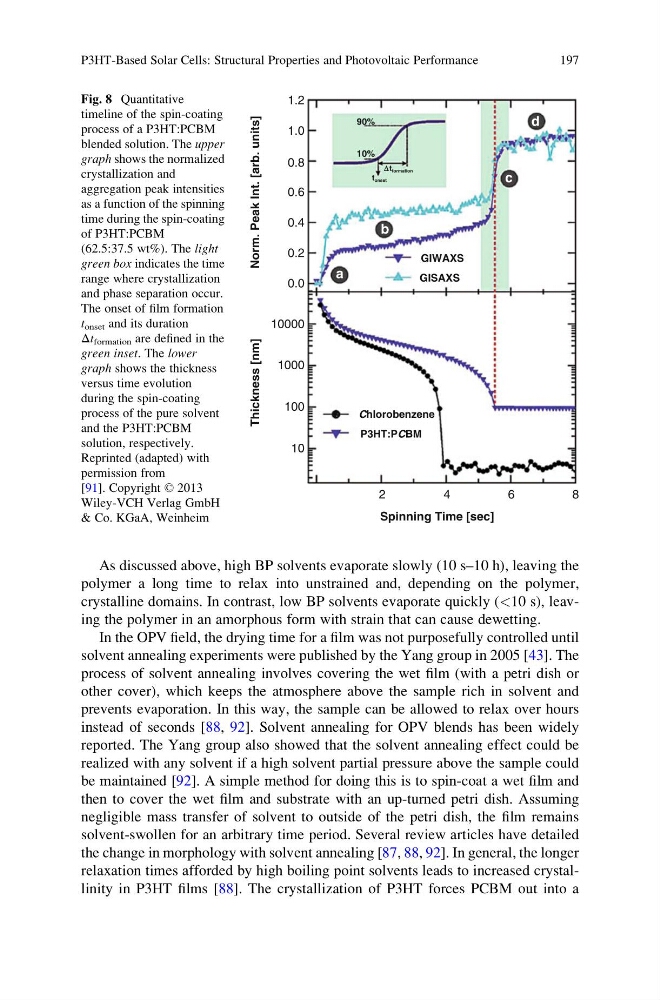
Fig. 8 Quantitative
timeline of the spin-coating
process of a P3HT:PCBM
blended solution. The upper
graph shows the normalized
crystallization and
aggregation peak intensities
as a function of the spinning
time during the spin-coating
of P3HT:PCBM
(62.5:37.5 wt%). The light
green box indicates the time
range where crystallization
and phase separation occur.
The onset of film formation
t onset and its duration
Δt formation are defined in the
green inset. The lower
graph shows the thickness
versus time evolution
during the spin-coating
process of the pure solvent
and the P3HT:PCBM
solution, respectively.
Reprinted (adapted) with
permission from
[91]. Copyright © 2013
Wiley-VCH Verlag GmbH
& Co. KGaA, Weinheim
P3HT-Based Solar Cells: Structural Properties and Photovoltaic Performance
197
polymer a long time to relax into unstrained and, depending on the polymer,
crystalline domains. In contrast, low BP solvents evaporate quickly (<10 s), leaving the polymer in an amorphous form with strain that can cause dewetting.
In the OPV field, the drying time for a film was not purposefully controlled until
solvent annealing experiments were published by the Yang group in 2005 [43]. The
process of solvent annealing involves covering the wet film (with a petri dish or
other cover), which keeps the atmosphere above the sample rich in solvent and
prevents evaporation. In this way, the sample can be allowed to relax over hours
instead of seconds [88, 92]. Solvent annealing for OPV blends has been widely
reported. The Yang group also showed that the solvent annealing effect could be
realized with any solvent if a high solvent partial pressure above the sample could
be maintained [92]. A simple method for doing this is to spin-coat a wet film and
then to cover the wet film and substrate with an up-turned petri dish. Assuming
negligible mass transfer of solvent to outside of the petri dish, the film remains
solvent-swollen for an arbitrary time period. Several review articles have detailed
the change in morphology with solvent annealing [87, 88, 92]. In general, the longer
relaxation times afforded by high boiling point solvents leads to increased crystallinity in P3HT films [88]. The crystallization of P3HT forces PCBM out into a
1.2
1.0
0.8
0.6
0.4
0.0
1000
100
10
4
Spinning Time [sec]
Chlorobenzene
P3HT:PCBM
GIWAXS
a
b
c
d
GISAXS
10%
Dt formation
t onset
90%
6
8
2
Thickness [nm]
Norm. Peak Int. [arb. units]
10000
0.2
Fig. 8 Quantitative
timeline of the spin-coating
process of a P3HT:PCBM
blended solution. The upper
graph shows the normalized
crystallization and
aggregation peak intensities
as a function of the spinning
time during the spin-coating
of P3HT:PCBM
(62.5:37.5 wt%). The light
green box indicates the time
range where crystallization
and phase separation occur.
The onset of film formation
t onset and its duration
Δt formation are defined in the
green inset. The lower
graph shows the thickness
versus time evolution
during the spin-coating
process of the pure solvent
and the P3HT:PCBM
solution, respectively.
Reprinted (adapted) with
permission from
[91]. Copyright © 2013
Wiley-VCH Verlag GmbH
& Co. KGaA, Weinheim
P3HT-Based Solar Cells: Structural Properties and Photovoltaic Performance
197