

The idea to increase crystallinity of the P3HT with slower solvent evaporation was
used by Li et al. to achieve the first record PCE over 4% for OPV [43].
With the introduction of semicrystalline polymers like P3HT, it became clear
that the solvent could affect the formation of P3HT aggregated or crystalline
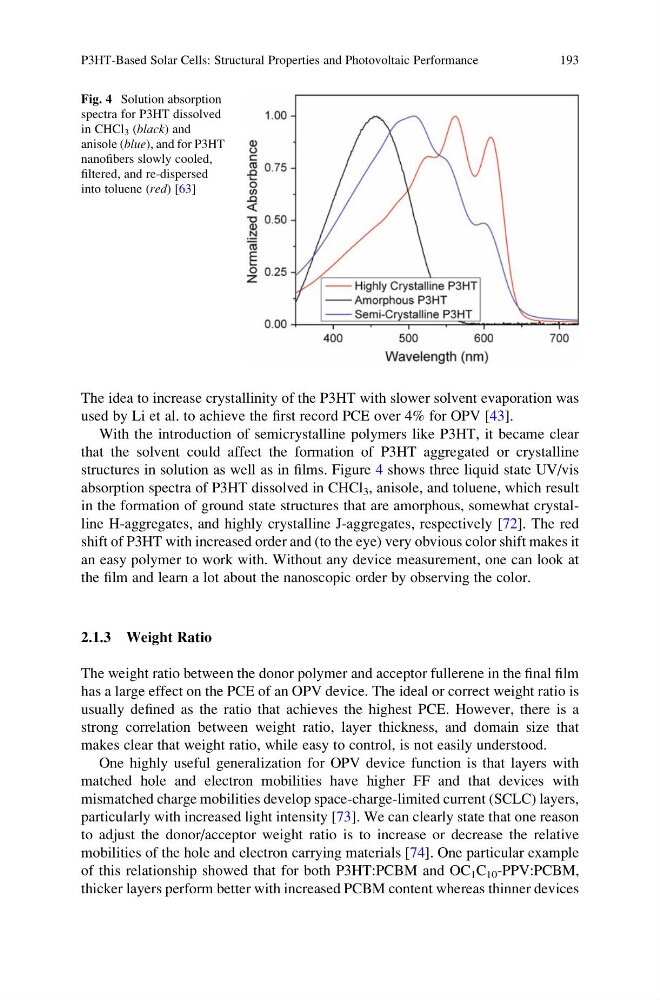
structures in solution as well as in films. Figure 4 shows three liquid state UV/vis
absorption spectra of P3HT dissolved in CHCl 3 , anisole, and toluene, which result
in the formation of ground state structures that are amorphous, somewhat crystalline H-aggregates, and highly crystalline J-aggregates, respectively [72]. The red
shift of P3HT with increased order and (to the eye) very obvious color shift makes it
an easy polymer to work with. Without any device measurement, one can look at
the film and learn a lot about the nanoscopic order by observing the color.
2.1.3 Weight Ratio
The weight ratio between the donor polymer and acceptor fullerene in the final film
has a large effect on the PCE of an OPV device. The ideal or correct weight ratio is
usually defined as the ratio that achieves the highest PCE. However, there is a
strong correlation between weight ratio, layer thickness, and domain size that
makes clear that weight ratio, while easy to control, is not easily understood.
One highly useful generalization for OPV device function is that layers with
matched hole and electron mobilities have higher FF and that devices with
mismatched charge mobilities develop space-charge-limited current (SCLC) layers,
particularly with increased light intensity [73]. We can clearly state that one reason
to adjust the donor/acceptor weight ratio is to increase or decrease the relative
mobilities of the hole and electron carrying materials [74]. One particular example
of this relationship showed that for both P3HT:PCBM and OC 1 C 10 -PPV:PCBM,
thicker layers perform better with increased PCBM content whereas thinner devices
Fig. 4 Solution absorption
spectra for P3HT dissolved
in CHCl 3 (black) and
anisole (blue), and for P3HT
nanofibers slowly cooled,
filtered, and re-dispersed
into toluene (red) [63]
P3HT-Based Solar Cells: Structural Properties and Photovoltaic Performance
193
used by Li et al. to achieve the first record PCE over 4% for OPV [43].
With the introduction of semicrystalline polymers like P3HT, it became clear
that the solvent could affect the formation of P3HT aggregated or crystalline
structures in solution as well as in films. Figure 4 shows three liquid state UV/vis
absorption spectra of P3HT dissolved in CHCl 3 , anisole, and toluene, which result
in the formation of ground state structures that are amorphous, somewhat crystalline H-aggregates, and highly crystalline J-aggregates, respectively [72]. The red
shift of P3HT with increased order and (to the eye) very obvious color shift makes it
an easy polymer to work with. Without any device measurement, one can look at
the film and learn a lot about the nanoscopic order by observing the color.
2.1.3 Weight Ratio
The weight ratio between the donor polymer and acceptor fullerene in the final film
has a large effect on the PCE of an OPV device. The ideal or correct weight ratio is
usually defined as the ratio that achieves the highest PCE. However, there is a
strong correlation between weight ratio, layer thickness, and domain size that
makes clear that weight ratio, while easy to control, is not easily understood.
One highly useful generalization for OPV device function is that layers with
matched hole and electron mobilities have higher FF and that devices with
mismatched charge mobilities develop space-charge-limited current (SCLC) layers,
particularly with increased light intensity [73]. We can clearly state that one reason
to adjust the donor/acceptor weight ratio is to increase or decrease the relative
mobilities of the hole and electron carrying materials [74]. One particular example
of this relationship showed that for both P3HT:PCBM and OC 1 C 10 -PPV:PCBM,
thicker layers perform better with increased PCBM content whereas thinner devices
Fig. 4 Solution absorption
spectra for P3HT dissolved
in CHCl 3 (black) and
anisole (blue), and for P3HT
nanofibers slowly cooled,
filtered, and re-dispersed
into toluene (red) [63]
P3HT-Based Solar Cells: Structural Properties and Photovoltaic Performance
193