

CA-100. Notably, gliding-type paracrystallinity, measured along the c axis, does
not strongly affect the electrostatic interactions between charged conjugated planes.
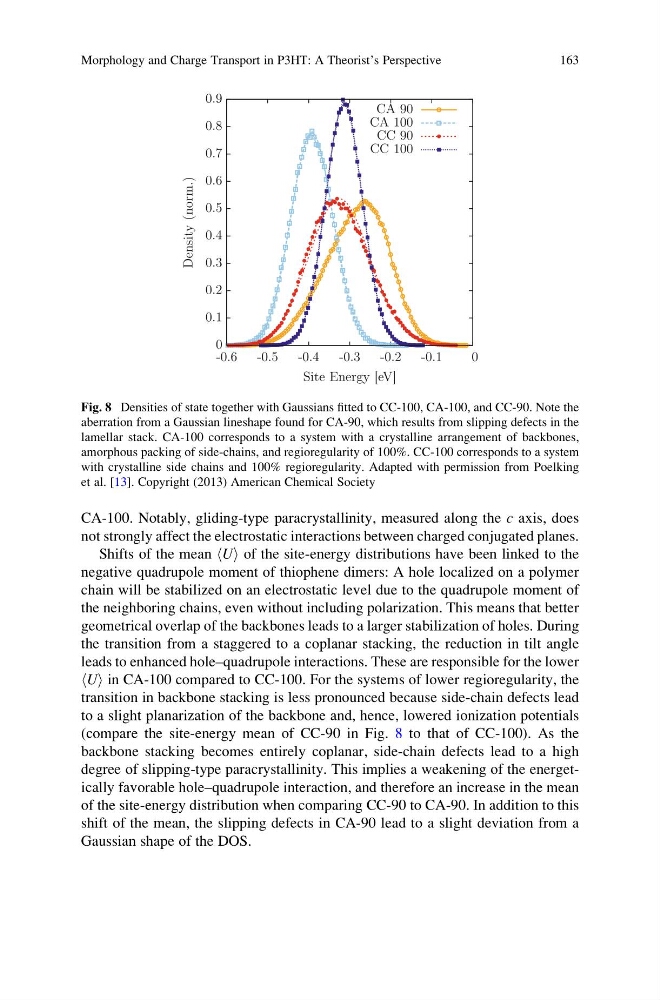
Shifts of the mean hUi of the site-energy distributions have been linked to the
negative quadrupole moment of thiophene dimers: A hole localized on a polymer
chain will be stabilized on an electrostatic level due to the quadrupole moment of
the neighboring chains, even without including polarization. This means that better
geometrical overlap of the backbones leads to a larger stabilization of holes. During
the transition from a staggered to a coplanar stacking, the reduction in tilt angle
leads to enhanced hole–quadrupole interactions. These are responsible for the lower
hUi in CA-100 compared to CC-100. For the systems of lower regioregularity, the
transition in backbone stacking is less pronounced because side-chain defects lead
to a slight planarization of the backbone and, hence, lowered ionization potentials
(compare the site-energy mean of CC-90 in Fig. 8 to that of CC-100). As the
backbone stacking becomes entirely coplanar, side-chain defects lead to a high
degree of slipping-type paracrystallinity. This implies a weakening of the energetically favorable hole–quadrupole interaction, and therefore an increase in the mean
of the site-energy distribution when comparing CC-90 to CA-90. In addition to this
shift of the mean, the slipping defects in CA-90 lead to a slight deviation from a
Gaussian shape of the DOS.
Fig. 8 Densities of state together with Gaussians fitted to CC-100, CA-100, and CC-90. Note the
aberration from a Gaussian lineshape found for CA-90, which results from slipping defects in the
lamellar stack. CA-100 corresponds to a system with a crystalline arrangement of backbones,
amorphous packing of side-chains, and regioregularity of 100%. CC-100 corresponds to a system
with crystalline side chains and 100% regioregularity. Adapted with permission from Poelking
et al. [13]. Copyright (2013) American Chemical Society
Morphology and Charge Transport in P3HT: A Theorist’s Perspective
163
not strongly affect the electrostatic interactions between charged conjugated planes.
Shifts of the mean hUi of the site-energy distributions have been linked to the
negative quadrupole moment of thiophene dimers: A hole localized on a polymer
chain will be stabilized on an electrostatic level due to the quadrupole moment of
the neighboring chains, even without including polarization. This means that better
geometrical overlap of the backbones leads to a larger stabilization of holes. During
the transition from a staggered to a coplanar stacking, the reduction in tilt angle
leads to enhanced hole–quadrupole interactions. These are responsible for the lower
hUi in CA-100 compared to CC-100. For the systems of lower regioregularity, the
transition in backbone stacking is less pronounced because side-chain defects lead
to a slight planarization of the backbone and, hence, lowered ionization potentials
(compare the site-energy mean of CC-90 in Fig. 8 to that of CC-100). As the
backbone stacking becomes entirely coplanar, side-chain defects lead to a high
degree of slipping-type paracrystallinity. This implies a weakening of the energetically favorable hole–quadrupole interaction, and therefore an increase in the mean
of the site-energy distribution when comparing CC-90 to CA-90. In addition to this
shift of the mean, the slipping defects in CA-90 lead to a slight deviation from a
Gaussian shape of the DOS.
Fig. 8 Densities of state together with Gaussians fitted to CC-100, CA-100, and CC-90. Note the
aberration from a Gaussian lineshape found for CA-90, which results from slipping defects in the
lamellar stack. CA-100 corresponds to a system with a crystalline arrangement of backbones,
amorphous packing of side-chains, and regioregularity of 100%. CC-100 corresponds to a system
with crystalline side chains and 100% regioregularity. Adapted with permission from Poelking
et al. [13]. Copyright (2013) American Chemical Society
Morphology and Charge Transport in P3HT: A Theorist’s Perspective
163