

polymer network [21] or smaller intrachain ring torsions present in high molecular
weight molecules [22].
Transistor hole mobilities have even been reported for individual P3HT
nanofibers [14, 23, 24]. Along the fiber, this mobility was as high as 0.06 cm
2
/V s.
An energetic disorder of 108 meV was extracted from temperature-dependent
measurements.
Stimulated by this multitude of experimental investigations, a number of theoretical studies have been conducted to rationalize the wide spectrum of mobilities
obtained for a single compound and link the transport characteristics to the selfassembly properties, morphology, and electronic structure of P3HT. The controversy started when examining conformations of a single isolated chain: the thiophene dimer was reported to adopt a twisted backbone conformation [25], whereas
increasing the oligomer length resulted in a planarized backbone. The situation with
oligomer assemblies is even more involved; indeed, we still do not know the order
of crystalline polymorphs on the energy axis, cannot quantify the density of defects
in a crystalline morphology, or quantify the relative volume fractions of crystalline
and amorphous phases. We do not really understand what exactly limits charge
transport in ordered lamellar systems: is it large energetic disorder or small electronic couplings? Why is the hole transport strongly dispersive even though the
reported energetic disorder is moderate? How does regioregularity contribute to
morphological ordering, density of states, and electronic couplings? In which ways
does molecular weight impact mobility? Our goal is to summarize approaches and
answers to some of these questions from a theoretical perspective and to provide an
outlook for the remaining questions.
a
b
α = β = 90
◦
γ = 86.17
◦
a = 15.09 ˚ A
b = 8.06 ˚ A
c = 7.89 ˚ A
a = 16.18 ˚ A
γ = 86.16
◦
α = β = 90
◦
b = 7.72 ˚ A
c = 7.89 ˚ A
b
2c
2c
a
b
a
polymorph I, CA-100
polymorph I’,CC-100
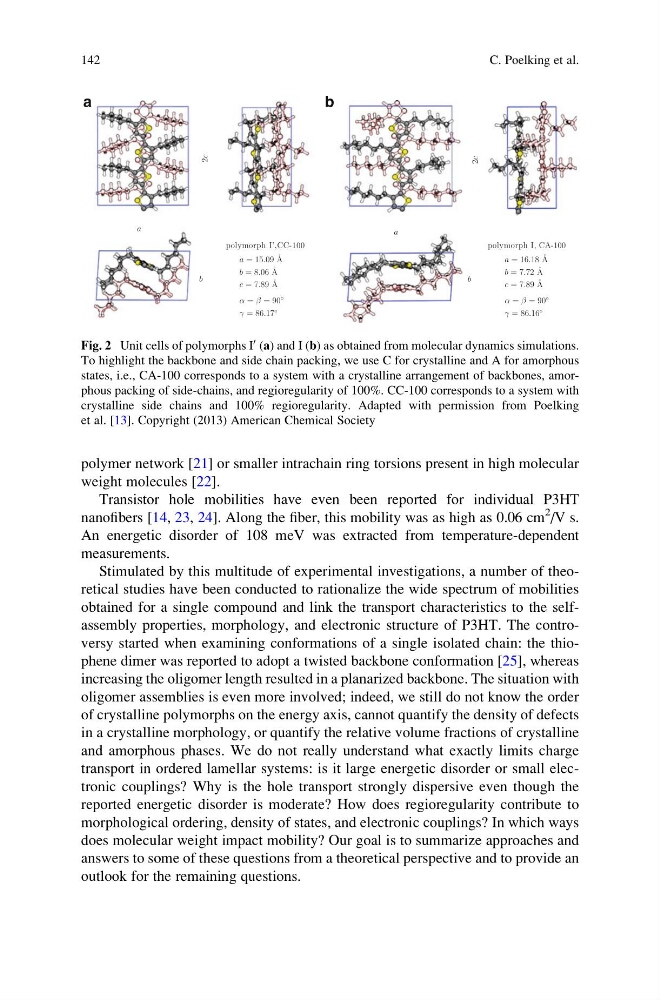
Fig. 2 Unit cells of polymorphs I
0 (a) and I (b) as obtained from molecular dynamics simulations.
To highlight the backbone and side chain packing, we use C for crystalline and A for amorphous
states, i.e., CA-100 corresponds to a system with a crystalline arrangement of backbones, amorphous packing of side-chains, and regioregularity of 100%. CC-100 corresponds to a system with
crystalline side chains and 100% regioregularity. Adapted with permission from Poelking
et al. [13]. Copyright (2013) American Chemical Society
142
C. Poelking et al.
weight molecules [22].
Transistor hole mobilities have even been reported for individual P3HT
nanofibers [14, 23, 24]. Along the fiber, this mobility was as high as 0.06 cm
2
/V s.
An energetic disorder of 108 meV was extracted from temperature-dependent
measurements.
Stimulated by this multitude of experimental investigations, a number of theoretical studies have been conducted to rationalize the wide spectrum of mobilities
obtained for a single compound and link the transport characteristics to the selfassembly properties, morphology, and electronic structure of P3HT. The controversy started when examining conformations of a single isolated chain: the thiophene dimer was reported to adopt a twisted backbone conformation [25], whereas
increasing the oligomer length resulted in a planarized backbone. The situation with
oligomer assemblies is even more involved; indeed, we still do not know the order
of crystalline polymorphs on the energy axis, cannot quantify the density of defects
in a crystalline morphology, or quantify the relative volume fractions of crystalline
and amorphous phases. We do not really understand what exactly limits charge
transport in ordered lamellar systems: is it large energetic disorder or small electronic couplings? Why is the hole transport strongly dispersive even though the
reported energetic disorder is moderate? How does regioregularity contribute to
morphological ordering, density of states, and electronic couplings? In which ways
does molecular weight impact mobility? Our goal is to summarize approaches and
answers to some of these questions from a theoretical perspective and to provide an
outlook for the remaining questions.
a
b
α = β = 90
◦
γ = 86.17
◦
a = 15.09 ˚ A
b = 8.06 ˚ A
c = 7.89 ˚ A
a = 16.18 ˚ A
γ = 86.16
◦
α = β = 90
◦
b = 7.72 ˚ A
c = 7.89 ˚ A
b
2c
2c
a
b
a
polymorph I, CA-100
polymorph I’,CC-100
Fig. 2 Unit cells of polymorphs I
0 (a) and I (b) as obtained from molecular dynamics simulations.
To highlight the backbone and side chain packing, we use C for crystalline and A for amorphous
states, i.e., CA-100 corresponds to a system with a crystalline arrangement of backbones, amorphous packing of side-chains, and regioregularity of 100%. CC-100 corresponds to a system with
crystalline side chains and 100% regioregularity. Adapted with permission from Poelking
et al. [13]. Copyright (2013) American Chemical Society
142
C. Poelking et al.