

encountered in most studies dealing with OFETs and OPVs. It has a monoclinic
unit-cell (for bulk P3HT samples X-ray diffraction, XRD, provides a ¼ 1.60 nm,
b ¼ 0.78 nm, and c ¼ 0.78 nm [10]). Polymorph II has been found to have a
significantly smaller unit cell dimension along the a-axis and has thus been assumed
to have interdigitated alkyl groups [8], which distinguishes it from form I. Upon
heating, form II irreversibly transforms into form I. This phase transition is accompanied by a change in unit-cell dimensions, with interlayer spacings increasing and
intrastack distances decreasing. A similar first-order phase transition has been
described recently in a combined infrared-spectroscopy and wide-angle XRD
study for a non-interdigitated metastable polymorph that transforms into the stable
form I, hence establishing a third polymorph, I
0 [11, 12]. Simulated unit cells of
polymorphs I and I
0 are shown in Fig. 2.
On a mesoscale, crystallization from supercooled solutions in poor solvents can
lead to the formation of secondary structures, notably nanofibers, with a width of
tens of nanometers and length of several micrometers [14].
Charge transport in P3HT has been studied with the aim of relating
regioregularity, molecular weight and, hence, morphology to hole mobility, and
thus to the efficiency of P3HT/methanofullerene (PCBM) bulk heterojunction solar
cells, for which the power conversion efficiency was reported to be 4.4% as early as
2005 [15]. Hole mobilities of 10
À5 cm
2 /V s (10
À4 cm
2 /V s) were measured for 94%
(98%) regioregular P3HT using the time-of-flight (TOF) technique [16]. Dispersive
transients of the regiorandom P3HT indicated that the polymer is conductive, yet its
mobility could not be extracted from TOF measurements due to sizeable disorder.
The mobility temperature dependence, analyzed using the Gaussian disorder model
(GDM), suggested an energetic disorder of around 50–60 meV. Both hole and
electron TOF mobilities were reported to be independent of the molecular weight
up to 20 kDa, and then decreased by an order of magnitude as molecular weight
increased to 120 kDa [17]. The reported zero-field mobilities for shorter chains
were of the order of 10
À4 cm
2 /V s. A GDM-fitted energetic disorder of 71(54) meV
was extracted for short (long) chains.
Meanwhile, field-effect mobilities ranging around μ ~10
À5 cm
2
/V s were
reported for the very first OFET device that used polythiophene for the semiconducting channel [18]. By choosing rr-P3HT, μ could be increased by three orders of
magnitude [19]. OFET mobilities of ~0.1 cm
2 /V s were measured as a function of
the molecular weight after spin-casting from higher boiling point solvents [20]. The
field-effect mobility was found to increase with molecular weight in spite of
reduced crystallinity. This was attributed to either better interconnectivity of the
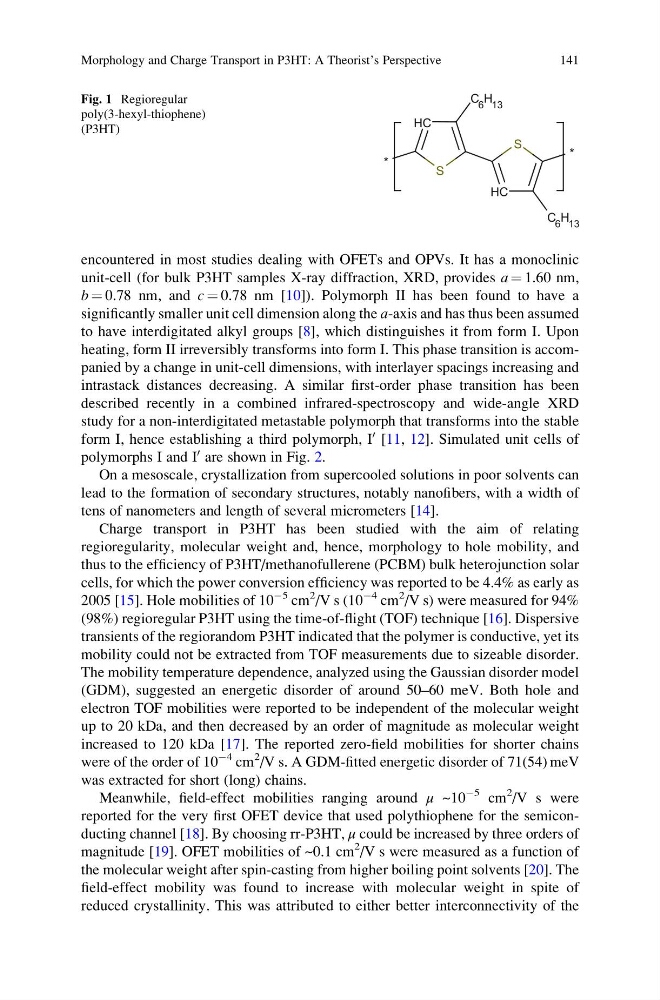
Fig. 1 Regioregular
poly(3-hexyl-thiophene)
(P3HT)
Morphology and Charge Transport in P3HT: A Theorist’s Perspective
141
unit-cell (for bulk P3HT samples X-ray diffraction, XRD, provides a ¼ 1.60 nm,
b ¼ 0.78 nm, and c ¼ 0.78 nm [10]). Polymorph II has been found to have a
significantly smaller unit cell dimension along the a-axis and has thus been assumed
to have interdigitated alkyl groups [8], which distinguishes it from form I. Upon
heating, form II irreversibly transforms into form I. This phase transition is accompanied by a change in unit-cell dimensions, with interlayer spacings increasing and
intrastack distances decreasing. A similar first-order phase transition has been
described recently in a combined infrared-spectroscopy and wide-angle XRD
study for a non-interdigitated metastable polymorph that transforms into the stable
form I, hence establishing a third polymorph, I
0 [11, 12]. Simulated unit cells of
polymorphs I and I
0 are shown in Fig. 2.
On a mesoscale, crystallization from supercooled solutions in poor solvents can
lead to the formation of secondary structures, notably nanofibers, with a width of
tens of nanometers and length of several micrometers [14].
Charge transport in P3HT has been studied with the aim of relating
regioregularity, molecular weight and, hence, morphology to hole mobility, and
thus to the efficiency of P3HT/methanofullerene (PCBM) bulk heterojunction solar
cells, for which the power conversion efficiency was reported to be 4.4% as early as
2005 [15]. Hole mobilities of 10
À5 cm
2 /V s (10
À4 cm
2 /V s) were measured for 94%
(98%) regioregular P3HT using the time-of-flight (TOF) technique [16]. Dispersive
transients of the regiorandom P3HT indicated that the polymer is conductive, yet its
mobility could not be extracted from TOF measurements due to sizeable disorder.
The mobility temperature dependence, analyzed using the Gaussian disorder model
(GDM), suggested an energetic disorder of around 50–60 meV. Both hole and
electron TOF mobilities were reported to be independent of the molecular weight
up to 20 kDa, and then decreased by an order of magnitude as molecular weight
increased to 120 kDa [17]. The reported zero-field mobilities for shorter chains
were of the order of 10
À4 cm
2 /V s. A GDM-fitted energetic disorder of 71(54) meV
was extracted for short (long) chains.
Meanwhile, field-effect mobilities ranging around μ ~10
À5 cm
2
/V s were
reported for the very first OFET device that used polythiophene for the semiconducting channel [18]. By choosing rr-P3HT, μ could be increased by three orders of
magnitude [19]. OFET mobilities of ~0.1 cm
2 /V s were measured as a function of
the molecular weight after spin-casting from higher boiling point solvents [20]. The
field-effect mobility was found to increase with molecular weight in spite of
reduced crystallinity. This was attributed to either better interconnectivity of the
Fig. 1 Regioregular
poly(3-hexyl-thiophene)
(P3HT)
Morphology and Charge Transport in P3HT: A Theorist’s Perspective
141