

polythiophene to increase the ionization potential, as in the dialkylated
quaterthiophene PQT (P1 in Fig. 11). Another method is self-encapsulation, as
shown in Fig. 9 [99, 104]. For self-encapsulation, the P3HT is mixed with another
polymer (e.g., polymethylmethacrylate, PMMA) in solution and phase separates
vertically during spincoating on octyltrichlorosilane-treated substrates. The PMMA
forms an encapsulation layer on top, which enables stable operation of P3HT-FETs
with high on/off ratios in air as well as additional encapsulation with inorganic layers
without damaging the semiconductor. Here also, blends of P3HT and insulating
polymers may solve both mobility and stability issues and thus enable future application in circuits that have to operate in ambient conditions over long periods of time.
3.8 Electrochemical Doping
Electrolyte gating allows for the accumulation of very high charge carrier densities in
organic FETs and operation at very low voltages. As shown by Tanase et al., the carrier
mobility in polymers depends strongly on the induced charge carrier density. This is
commonly found for P3HT as well [9]. By using electrolyte gating Xia et al. examined
the hole mobility in P3HT for carrier densities up to 4 Â 10
14 cm
À2 [18]. They found
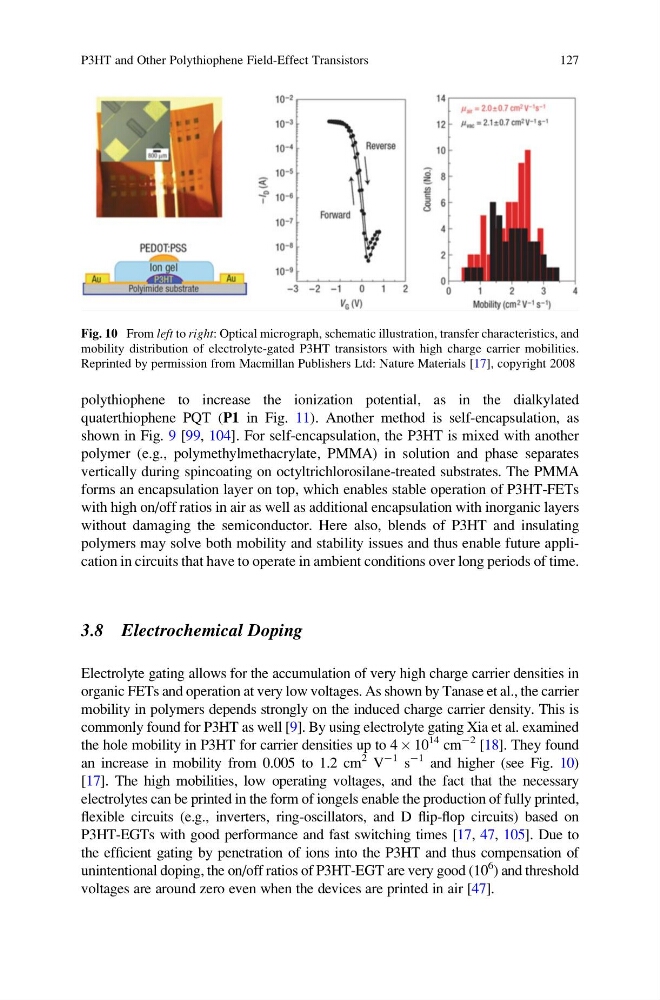
an increase in mobility from 0.005 to 1.2 cm
2 V
À1 s
À1 and higher (see Fig. 10)
[17]. The high mobilities, low operating voltages, and the fact that the necessary
electrolytes can be printed in the form of iongels enable the production of fully printed,
flexible circuits (e.g., inverters, ring-oscillators, and D flip-flop circuits) based on
P3HT-EGTs with good performance and fast switching times [17, 47, 105]. Due to
the efficient gating by penetration of ions into the P3HT and thus compensation of
unintentional doping, the on/off ratios of P3HT-EGT are very good (10
6
) and threshold
voltages are around zero even when the devices are printed in air [47].
Fig. 10 From left to right: Optical micrograph, schematic illustration, transfer characteristics, and
mobility distribution of electrolyte-gated P3HT transistors with high charge carrier mobilities.
Reprinted by permission from Macmillan Publishers Ltd: Nature Materials [17], copyright 2008
P3HT and Other Polythiophene Field-Effect Transistors
127
quaterthiophene PQT (P1 in Fig. 11). Another method is self-encapsulation, as
shown in Fig. 9 [99, 104]. For self-encapsulation, the P3HT is mixed with another
polymer (e.g., polymethylmethacrylate, PMMA) in solution and phase separates
vertically during spincoating on octyltrichlorosilane-treated substrates. The PMMA
forms an encapsulation layer on top, which enables stable operation of P3HT-FETs
with high on/off ratios in air as well as additional encapsulation with inorganic layers
without damaging the semiconductor. Here also, blends of P3HT and insulating
polymers may solve both mobility and stability issues and thus enable future application in circuits that have to operate in ambient conditions over long periods of time.
3.8 Electrochemical Doping
Electrolyte gating allows for the accumulation of very high charge carrier densities in
organic FETs and operation at very low voltages. As shown by Tanase et al., the carrier
mobility in polymers depends strongly on the induced charge carrier density. This is
commonly found for P3HT as well [9]. By using electrolyte gating Xia et al. examined
the hole mobility in P3HT for carrier densities up to 4 Â 10
14 cm
À2 [18]. They found
an increase in mobility from 0.005 to 1.2 cm
2 V
À1 s
À1 and higher (see Fig. 10)
[17]. The high mobilities, low operating voltages, and the fact that the necessary
electrolytes can be printed in the form of iongels enable the production of fully printed,
flexible circuits (e.g., inverters, ring-oscillators, and D flip-flop circuits) based on
P3HT-EGTs with good performance and fast switching times [17, 47, 105]. Due to
the efficient gating by penetration of ions into the P3HT and thus compensation of
unintentional doping, the on/off ratios of P3HT-EGT are very good (10
6
) and threshold
voltages are around zero even when the devices are printed in air [47].
Fig. 10 From left to right: Optical micrograph, schematic illustration, transfer characteristics, and
mobility distribution of electrolyte-gated P3HT transistors with high charge carrier mobilities.
Reprinted by permission from Macmillan Publishers Ltd: Nature Materials [17], copyright 2008
P3HT and Other Polythiophene Field-Effect Transistors
127