

is very slow in the dark even under atmospheric oxygen pressure but very fast when
accompanied by illumination with near-infrared or visible light. Liao
et al. investigated the kinetics of doping and de-doping of P3HT under various
conditions [101]. They found that even in a moderate vacuum with very low oxygen
background pressure doping occurs within minutes under illumination. Because it is
very difficult to exclude all oxygen during commercial fabrication processes, this
would pose a significant problem for the application of P3HT in any commercial
devices, although de-doping in the dark and under vacuum is possible. At room
temperature this is a slow process, but can be significantly enhanced by annealing
close to the glass transition temperature of P3HT in a vacuum. The type of
substrate/dielectric and the porosity of the P3HT film also play a role [102]. Nonpolar interfaces are preferable in order to slow down doping.
Sperlich et al. investigated the species formed during exposure of P3HT to
oxygen and light using electron paramagnetic resonance (EPR), photoluminescence
(PL), and PL-detected magnetic resonance (PLDMR) [103]. They confirmed the
formation of a positive polaron and a negative charge transfer complex after
excitation of the P3HT to the first excited singlet state, which then reacts with
oxygen. This process is fast compared to the same reaction in the dark. However,
the authors also found irreversible photooxidation, which is the result of the
reaction of the excited P3HT triplet with oxygen. This process only occurs under
intense visible light illumination or UV exposure and leads to degradation of the
P3HT. This photooxidation cannot be reversed by applying a vacuum.
Although the unintentional p-doping of P3HT is mostly reversible, it constitutes a
problem for device operation and several approaches to make FETs less sensitive to
oxygen have been pursued. One way is to modify the chemical structure of the
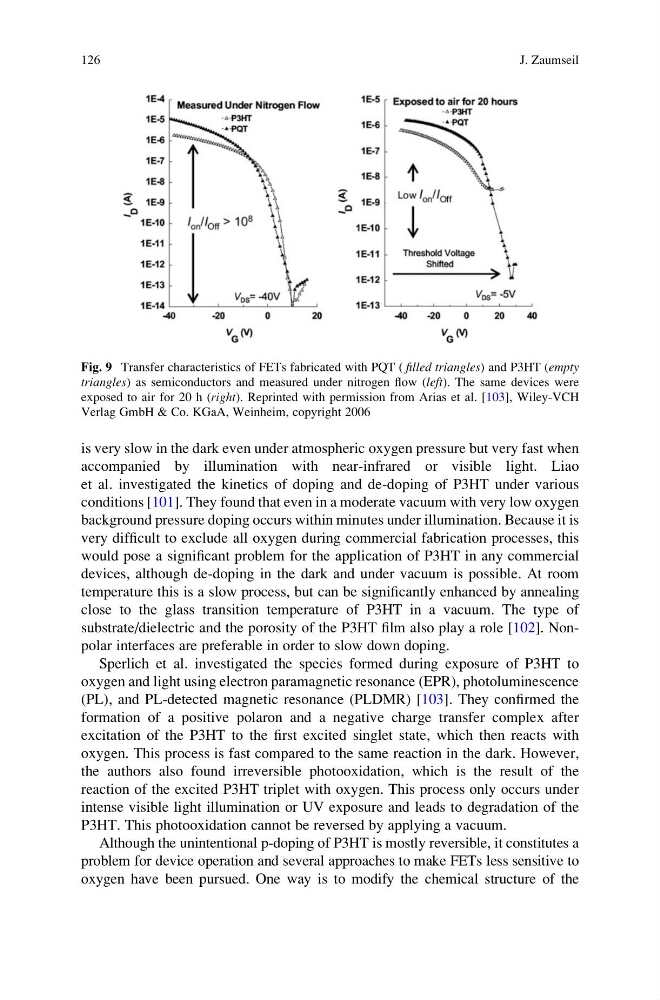
Fig. 9 Transfer characteristics of FETs fabricated with PQT ( filled triangles) and P3HT (empty
triangles) as semiconductors and measured under nitrogen flow (left). The same devices were
exposed to air for 20 h (right). Reprinted with permission from Arias et al. [103], Wiley-VCH
Verlag GmbH & Co. KGaA, Weinheim, copyright 2006
126
J. Zaumseil
accompanied by illumination with near-infrared or visible light. Liao
et al. investigated the kinetics of doping and de-doping of P3HT under various
conditions [101]. They found that even in a moderate vacuum with very low oxygen
background pressure doping occurs within minutes under illumination. Because it is
very difficult to exclude all oxygen during commercial fabrication processes, this
would pose a significant problem for the application of P3HT in any commercial
devices, although de-doping in the dark and under vacuum is possible. At room
temperature this is a slow process, but can be significantly enhanced by annealing
close to the glass transition temperature of P3HT in a vacuum. The type of
substrate/dielectric and the porosity of the P3HT film also play a role [102]. Nonpolar interfaces are preferable in order to slow down doping.
Sperlich et al. investigated the species formed during exposure of P3HT to
oxygen and light using electron paramagnetic resonance (EPR), photoluminescence
(PL), and PL-detected magnetic resonance (PLDMR) [103]. They confirmed the
formation of a positive polaron and a negative charge transfer complex after
excitation of the P3HT to the first excited singlet state, which then reacts with
oxygen. This process is fast compared to the same reaction in the dark. However,
the authors also found irreversible photooxidation, which is the result of the
reaction of the excited P3HT triplet with oxygen. This process only occurs under
intense visible light illumination or UV exposure and leads to degradation of the
P3HT. This photooxidation cannot be reversed by applying a vacuum.
Although the unintentional p-doping of P3HT is mostly reversible, it constitutes a
problem for device operation and several approaches to make FETs less sensitive to
oxygen have been pursued. One way is to modify the chemical structure of the
Fig. 9 Transfer characteristics of FETs fabricated with PQT ( filled triangles) and P3HT (empty
triangles) as semiconductors and measured under nitrogen flow (left). The same devices were
exposed to air for 20 h (right). Reprinted with permission from Arias et al. [103], Wiley-VCH
Verlag GmbH & Co. KGaA, Weinheim, copyright 2006
126
J. Zaumseil