

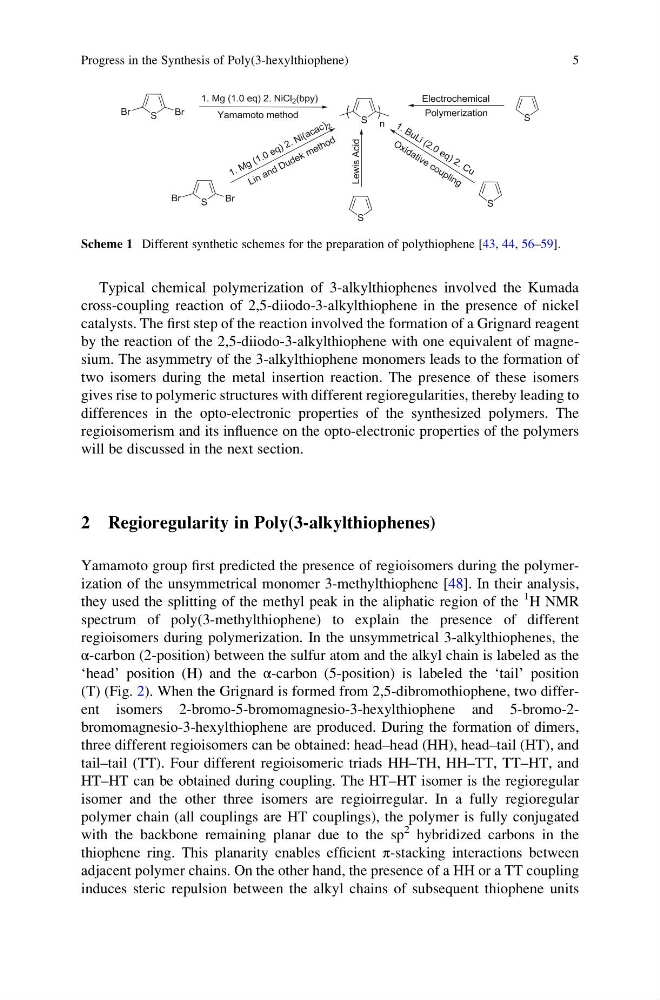
Typical chemical polymerization of 3-alkylthiophenes involved the Kumada
cross-coupling reaction of 2,5-diiodo-3-alkylthiophene in the presence of nickel
catalysts. The first step of the reaction involved the formation of a Grignard reagent
by the reaction of the 2,5-diiodo-3-alkylthiophene with one equivalent of magnesium. The asymmetry of the 3-alkylthiophene monomers leads to the formation of
two isomers during the metal insertion reaction. The presence of these isomers
gives rise to polymeric structures with different regioregularities, thereby leading to
differences in the opto-electronic properties of the synthesized polymers. The
regioisomerism and its influence on the opto-electronic properties of the polymers
will be discussed in the next section.
2 Regioregularity in Poly(3-alkylthiophenes)
Yamamoto group first predicted the presence of regioisomers during the polymerization of the unsymmetrical monomer 3-methylthiophene [48]. In their analysis,
they used the splitting of the methyl peak in the aliphatic region of the
1 H NMR
spectrum of poly(3-methylthiophene) to explain the presence of different
regioisomers during polymerization. In the unsymmetrical 3-alkylthiophenes, the
α-carbon (2-position) between the sulfur atom and the alkyl chain is labeled as the
‘head’ position (H) and the α-carbon (5-position) is labeled the ‘tail’ position
(T) (Fig. 2). When the Grignard is formed from 2,5-dibromothiophene, two different isomers 2-bromo-5-bromomagnesio-3-hexylthiophene and 5-bromo-2bromomagnesio-3-hexylthiophene are produced. During the formation of dimers,
three different regioisomers can be obtained: head–head (HH), head–tail (HT), and
tail–tail (TT). Four different regioisomeric triads HH–TH, HH–TT, TT–HT, and
HT–HT can be obtained during coupling. The HT–HT isomer is the regioregular
isomer and the other three isomers are regioirregular. In a fully regioregular
polymer chain (all couplings are HT couplings), the polymer is fully conjugated
with the backbone remaining planar due to the sp
2 hybridized carbons in the
thiophene ring. This planarity enables efficient π-stacking interactions between
adjacent polymer chains. On the other hand, the presence of a HH or a TT coupling
induces steric repulsion between the alkyl chains of subsequent thiophene units
Scheme 1 Different synthetic schemes for the preparation of polythiophene [43, 44, 56–59].
Progress in the Synthesis of Poly(3-hexylthiophene)
5
cross-coupling reaction of 2,5-diiodo-3-alkylthiophene in the presence of nickel
catalysts. The first step of the reaction involved the formation of a Grignard reagent
by the reaction of the 2,5-diiodo-3-alkylthiophene with one equivalent of magnesium. The asymmetry of the 3-alkylthiophene monomers leads to the formation of
two isomers during the metal insertion reaction. The presence of these isomers
gives rise to polymeric structures with different regioregularities, thereby leading to
differences in the opto-electronic properties of the synthesized polymers. The
regioisomerism and its influence on the opto-electronic properties of the polymers
will be discussed in the next section.
2 Regioregularity in Poly(3-alkylthiophenes)
Yamamoto group first predicted the presence of regioisomers during the polymerization of the unsymmetrical monomer 3-methylthiophene [48]. In their analysis,
they used the splitting of the methyl peak in the aliphatic region of the
1 H NMR
spectrum of poly(3-methylthiophene) to explain the presence of different
regioisomers during polymerization. In the unsymmetrical 3-alkylthiophenes, the
α-carbon (2-position) between the sulfur atom and the alkyl chain is labeled as the
‘head’ position (H) and the α-carbon (5-position) is labeled the ‘tail’ position
(T) (Fig. 2). When the Grignard is formed from 2,5-dibromothiophene, two different isomers 2-bromo-5-bromomagnesio-3-hexylthiophene and 5-bromo-2bromomagnesio-3-hexylthiophene are produced. During the formation of dimers,
three different regioisomers can be obtained: head–head (HH), head–tail (HT), and
tail–tail (TT). Four different regioisomeric triads HH–TH, HH–TT, TT–HT, and
HT–HT can be obtained during coupling. The HT–HT isomer is the regioregular
isomer and the other three isomers are regioirregular. In a fully regioregular
polymer chain (all couplings are HT couplings), the polymer is fully conjugated
with the backbone remaining planar due to the sp
2 hybridized carbons in the
thiophene ring. This planarity enables efficient π-stacking interactions between
adjacent polymer chains. On the other hand, the presence of a HH or a TT coupling
induces steric repulsion between the alkyl chains of subsequent thiophene units
Scheme 1 Different synthetic schemes for the preparation of polythiophene [43, 44, 56–59].
Progress in the Synthesis of Poly(3-hexylthiophene)
5