

molecular weight (M n ¼ 1,370 g/mol) than polymers from previous attempts by
other groups. However, a major fraction of the polymer was insoluble. The Dudek
group also followed a similar procedure using the more soluble Ni(acac) 2 , with a
similar result [44]. The Kumada cross-coupling reaction [45–47] adopted in both
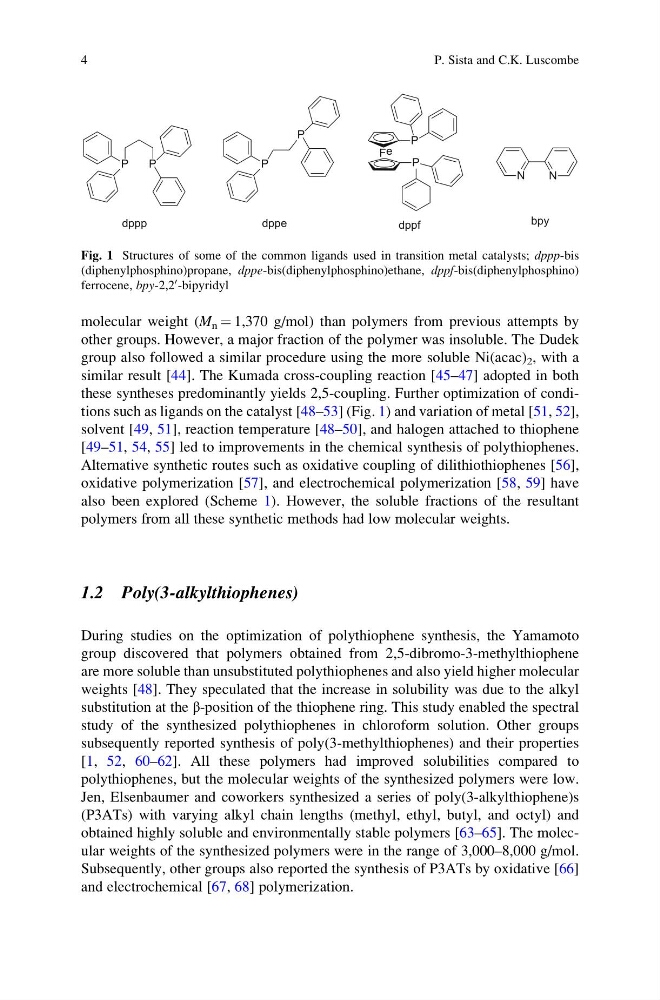
these syntheses predominantly yields 2,5-coupling. Further optimization of conditions such as ligands on the catalyst [48–53] (Fig. 1) and variation of metal [51, 52],
solvent [49, 51], reaction temperature [48–50], and halogen attached to thiophene
[49–51, 54, 55] led to improvements in the chemical synthesis of polythiophenes.
Alternative synthetic routes such as oxidative coupling of dilithiothiophenes [56],
oxidative polymerization [57], and electrochemical polymerization [58, 59] have
also been explored (Scheme 1). However, the soluble fractions of the resultant
polymers from all these synthetic methods had low molecular weights.
1.2 Poly(3-alkylthiophenes)
During studies on the optimization of polythiophene synthesis, the Yamamoto
group discovered that polymers obtained from 2,5-dibromo-3-methylthiophene
are more soluble than unsubstituted polythiophenes and also yield higher molecular
weights [48]. They speculated that the increase in solubility was due to the alkyl
substitution at the β-position of the thiophene ring. This study enabled the spectral
study of the synthesized polythiophenes in chloroform solution. Other groups
subsequently reported synthesis of poly(3-methylthiophenes) and their properties
[1, 52, 60–62]. All these polymers had improved solubilities compared to
polythiophenes, but the molecular weights of the synthesized polymers were low.
Jen, Elsenbaumer and coworkers synthesized a series of poly(3-alkylthiophene)s
(P3ATs) with varying alkyl chain lengths (methyl, ethyl, butyl, and octyl) and
obtained highly soluble and environmentally stable polymers [63–65]. The molecular weights of the synthesized polymers were in the range of 3,000–8,000 g/mol.
Subsequently, other groups also reported the synthesis of P3ATs by oxidative [66]
and electrochemical [67, 68] polymerization.
P
P
dppp
P
P
dppe
F e
P
P
dppf
N
N
bpy
Fig. 1 Structures of some of the common ligands used in transition metal catalysts; dppp-bis
(diphenylphosphino)propane, dppe-bis(diphenylphosphino)ethane, dppf-bis(diphenylphosphino)
ferrocene, bpy-2,2
0 -bipyridyl
4
P. Sista and C.K. Luscombe
other groups. However, a major fraction of the polymer was insoluble. The Dudek
group also followed a similar procedure using the more soluble Ni(acac) 2 , with a
similar result [44]. The Kumada cross-coupling reaction [45–47] adopted in both
these syntheses predominantly yields 2,5-coupling. Further optimization of conditions such as ligands on the catalyst [48–53] (Fig. 1) and variation of metal [51, 52],
solvent [49, 51], reaction temperature [48–50], and halogen attached to thiophene
[49–51, 54, 55] led to improvements in the chemical synthesis of polythiophenes.
Alternative synthetic routes such as oxidative coupling of dilithiothiophenes [56],
oxidative polymerization [57], and electrochemical polymerization [58, 59] have
also been explored (Scheme 1). However, the soluble fractions of the resultant
polymers from all these synthetic methods had low molecular weights.
1.2 Poly(3-alkylthiophenes)
During studies on the optimization of polythiophene synthesis, the Yamamoto
group discovered that polymers obtained from 2,5-dibromo-3-methylthiophene
are more soluble than unsubstituted polythiophenes and also yield higher molecular
weights [48]. They speculated that the increase in solubility was due to the alkyl
substitution at the β-position of the thiophene ring. This study enabled the spectral
study of the synthesized polythiophenes in chloroform solution. Other groups
subsequently reported synthesis of poly(3-methylthiophenes) and their properties
[1, 52, 60–62]. All these polymers had improved solubilities compared to
polythiophenes, but the molecular weights of the synthesized polymers were low.
Jen, Elsenbaumer and coworkers synthesized a series of poly(3-alkylthiophene)s
(P3ATs) with varying alkyl chain lengths (methyl, ethyl, butyl, and octyl) and
obtained highly soluble and environmentally stable polymers [63–65]. The molecular weights of the synthesized polymers were in the range of 3,000–8,000 g/mol.
Subsequently, other groups also reported the synthesis of P3ATs by oxidative [66]
and electrochemical [67, 68] polymerization.
P
P
dppp
P
P
dppe
F e
P
P
dppf
N
N
bpy
Fig. 1 Structures of some of the common ligands used in transition metal catalysts; dppp-bis
(diphenylphosphino)propane, dppe-bis(diphenylphosphino)ethane, dppf-bis(diphenylphosphino)
ferrocene, bpy-2,2
0 -bipyridyl
4
P. Sista and C.K. Luscombe