

with organic functional groups makes it possible to obtain silica-polymer
nanocomposites based on many matrices [16, 19, 20]. One of the most useful
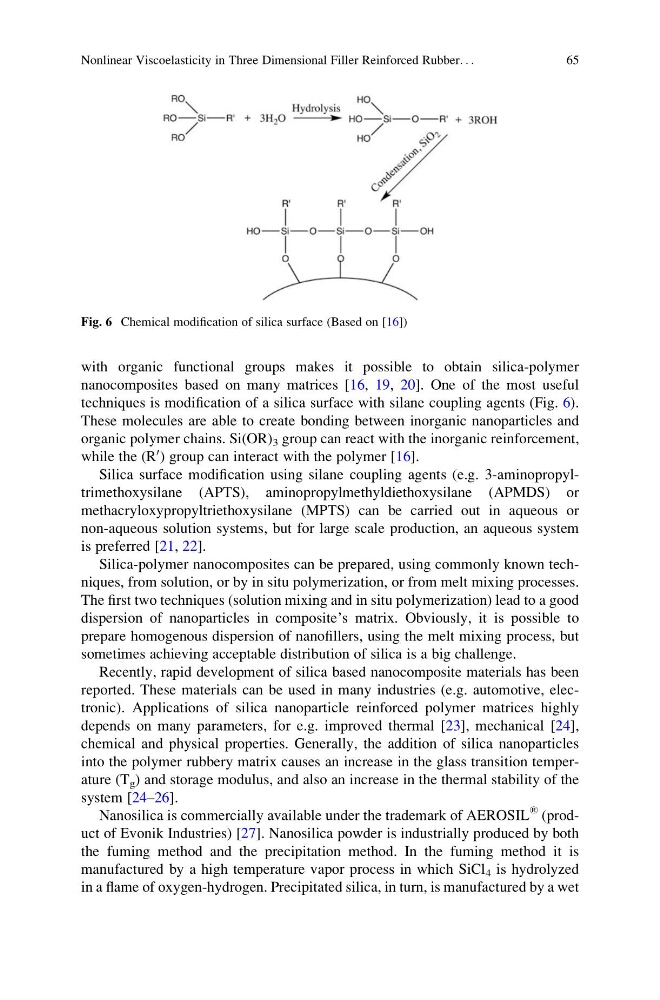
techniques is modification of a silica surface with silane coupling agents (Fig. 6).
These molecules are able to create bonding between inorganic nanoparticles and
organic polymer chains. Si(OR) 3 group can react with the inorganic reinforcement,
while the (R
0 ) group can interact with the polymer [16].
Silica surface modification using silane coupling agents (e.g. 3-aminopropyltrimethoxysilane (APTS), aminopropylmethyldiethoxysilane (APMDS) or
methacryloxypropyltriethoxysilane (MPTS) can be carried out in aqueous or
non-aqueous solution systems, but for large scale production, an aqueous system
is preferred [21, 22].
Silica-polymer nanocomposites can be prepared, using commonly known techniques, from solution, or by in situ polymerization, or from melt mixing processes.
The first two techniques (solution mixing and in situ polymerization) lead to a good
dispersion of nanoparticles in composite’s matrix. Obviously, it is possible to
prepare homogenous dispersion of nanofillers, using the melt mixing process, but
sometimes achieving acceptable distribution of silica is a big challenge.
Recently, rapid development of silica based nanocomposite materials has been
reported. These materials can be used in many industries (e.g. automotive, electronic). Applications of silica nanoparticle reinforced polymer matrices highly
depends on many parameters, for e.g. improved thermal [23], mechanical [24],
chemical and physical properties. Generally, the addition of silica nanoparticles
into the polymer rubbery matrix causes an increase in the glass transition temperature (T g ) and storage modulus, and also an increase in the thermal stability of the
system [24–26].
Nanosilica is commercially available under the trademark of AEROSIL
® (product of Evonik Industries) [27]. Nanosilica powder is industrially produced by both
the fuming method and the precipitation method. In the fuming method it is
manufactured by a high temperature vapor process in which SiCl 4 is hydrolyzed
in a flame of oxygen-hydrogen. Precipitated silica, in turn, is manufactured by a wet
Fig. 6 Chemical modification of silica surface (Based on [16])
Nonlinear Viscoelasticity in Three Dimensional Filler Reinforced Rubber. . .
65
nanocomposites based on many matrices [16, 19, 20]. One of the most useful
techniques is modification of a silica surface with silane coupling agents (Fig. 6).
These molecules are able to create bonding between inorganic nanoparticles and
organic polymer chains. Si(OR) 3 group can react with the inorganic reinforcement,
while the (R
0 ) group can interact with the polymer [16].
Silica surface modification using silane coupling agents (e.g. 3-aminopropyltrimethoxysilane (APTS), aminopropylmethyldiethoxysilane (APMDS) or
methacryloxypropyltriethoxysilane (MPTS) can be carried out in aqueous or
non-aqueous solution systems, but for large scale production, an aqueous system
is preferred [21, 22].
Silica-polymer nanocomposites can be prepared, using commonly known techniques, from solution, or by in situ polymerization, or from melt mixing processes.
The first two techniques (solution mixing and in situ polymerization) lead to a good
dispersion of nanoparticles in composite’s matrix. Obviously, it is possible to
prepare homogenous dispersion of nanofillers, using the melt mixing process, but
sometimes achieving acceptable distribution of silica is a big challenge.
Recently, rapid development of silica based nanocomposite materials has been
reported. These materials can be used in many industries (e.g. automotive, electronic). Applications of silica nanoparticle reinforced polymer matrices highly
depends on many parameters, for e.g. improved thermal [23], mechanical [24],
chemical and physical properties. Generally, the addition of silica nanoparticles
into the polymer rubbery matrix causes an increase in the glass transition temperature (T g ) and storage modulus, and also an increase in the thermal stability of the
system [24–26].
Nanosilica is commercially available under the trademark of AEROSIL
® (product of Evonik Industries) [27]. Nanosilica powder is industrially produced by both
the fuming method and the precipitation method. In the fuming method it is
manufactured by a high temperature vapor process in which SiCl 4 is hydrolyzed
in a flame of oxygen-hydrogen. Precipitated silica, in turn, is manufactured by a wet
Fig. 6 Chemical modification of silica surface (Based on [16])
Nonlinear Viscoelasticity in Three Dimensional Filler Reinforced Rubber. . .
65