

ability to create higher dimensionality, through aggregation of crystals of the POSS
particles in the polymer matrix [14].
POSS have been used to develop modern reinforced thermoplastic and thermosetting polymers. These materials are commercially manufactured by Hybrid Plastic, Inc. [15]. The company offers POSS-based nanofillers and polymers, which are
nano reinforced (e.g. PPE, PEEK, PEI, PP, PA6). Nanostructured POSS chemicals
can be used not only in plastics industry applications, but also in the whole
technological area. These nanostructures have shown significant promising usage
as catalyst supports and in biomedical applications [7].
2.3 Silicon Dioxide (SiO 2 )
Sol–gel processing is one of the methods that has been widely implemented for
manufacturing three-dimensional nanoparticles, which can be used for polymer
modification. In the 1950s the Degussa process (Eq. 1) became the method for
preparation of nanoparticles based on SiO 2 , TiO 2 or Al 2 O 3 [13].
Si OC 2 H 5
ð
Þ 4 þ 2H 2 O ! SiO 2 þ 4C 2 H 5 OH
ð1Þ
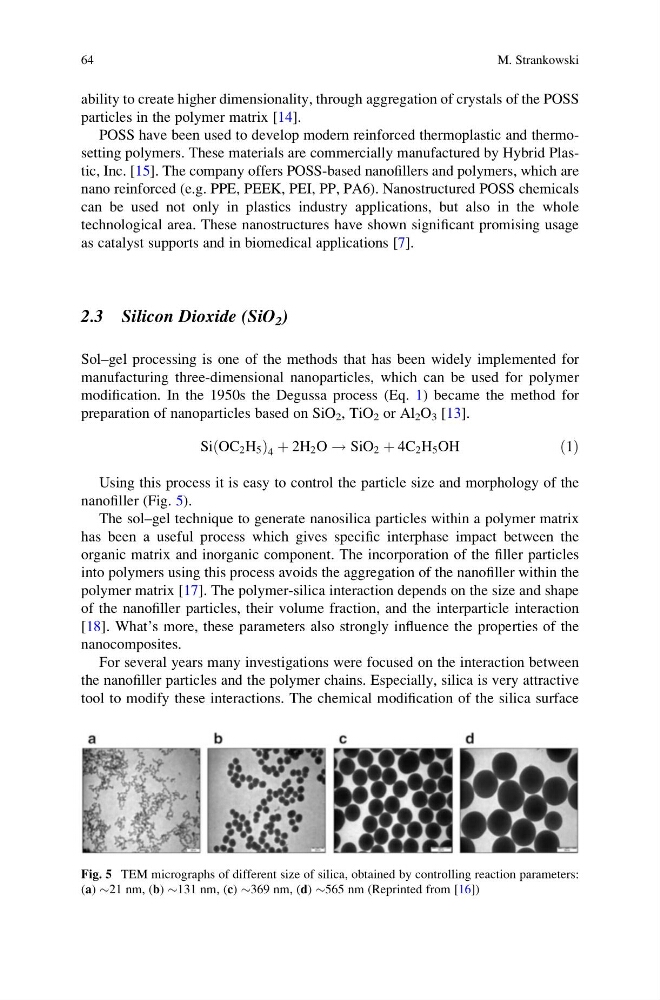
Using this process it is easy to control the particle size and morphology of the
nanofiller (Fig. 5).
The sol–gel technique to generate nanosilica particles within a polymer matrix
has been a useful process which gives specific interphase impact between the
organic matrix and inorganic component. The incorporation of the filler particles
into polymers using this process avoids the aggregation of the nanofiller within the
polymer matrix [17]. The polymer-silica interaction depends on the size and shape
of the nanofiller particles, their volume fraction, and the interparticle interaction
[18]. What’s more, these parameters also strongly influence the properties of the
nanocomposites.
For several years many investigations were focused on the interaction between
the nanofiller particles and the polymer chains. Especially, silica is very attractive
tool to modify these interactions. The chemical modification of the silica surface
Fig. 5 TEM micrographs of different size of silica, obtained by controlling reaction parameters:
(a) $21 nm, (b) $131 nm, (c) $369 nm, (d) $565 nm (Reprinted from [16])
64
M. Strankowski
particles in the polymer matrix [14].
POSS have been used to develop modern reinforced thermoplastic and thermosetting polymers. These materials are commercially manufactured by Hybrid Plastic, Inc. [15]. The company offers POSS-based nanofillers and polymers, which are
nano reinforced (e.g. PPE, PEEK, PEI, PP, PA6). Nanostructured POSS chemicals
can be used not only in plastics industry applications, but also in the whole
technological area. These nanostructures have shown significant promising usage
as catalyst supports and in biomedical applications [7].
2.3 Silicon Dioxide (SiO 2 )
Sol–gel processing is one of the methods that has been widely implemented for
manufacturing three-dimensional nanoparticles, which can be used for polymer
modification. In the 1950s the Degussa process (Eq. 1) became the method for
preparation of nanoparticles based on SiO 2 , TiO 2 or Al 2 O 3 [13].
Si OC 2 H 5
ð
Þ 4 þ 2H 2 O ! SiO 2 þ 4C 2 H 5 OH
ð1Þ
Using this process it is easy to control the particle size and morphology of the
nanofiller (Fig. 5).
The sol–gel technique to generate nanosilica particles within a polymer matrix
has been a useful process which gives specific interphase impact between the
organic matrix and inorganic component. The incorporation of the filler particles
into polymers using this process avoids the aggregation of the nanofiller within the
polymer matrix [17]. The polymer-silica interaction depends on the size and shape
of the nanofiller particles, their volume fraction, and the interparticle interaction
[18]. What’s more, these parameters also strongly influence the properties of the
nanocomposites.
For several years many investigations were focused on the interaction between
the nanofiller particles and the polymer chains. Especially, silica is very attractive
tool to modify these interactions. The chemical modification of the silica surface
Fig. 5 TEM micrographs of different size of silica, obtained by controlling reaction parameters:
(a) $21 nm, (b) $131 nm, (c) $369 nm, (d) $565 nm (Reprinted from [16])
64
M. Strankowski