

material-engineering scientists. However, by selection of the proper method of
rubber nanocomposite preparation (selection of nanofiller and rubber matrix), it is
possible to obtain systems with designed properties.
2.2 Polyhedral Oligomeric Silsesquioxane
Polyhedral oligomeric silsesquioxane (POSS) is one of the innovative inorganic–
organic nanofillers, which—depending on the application—can be synthesized and
modified in many ways. The POSS exist in a variety of structures and possess
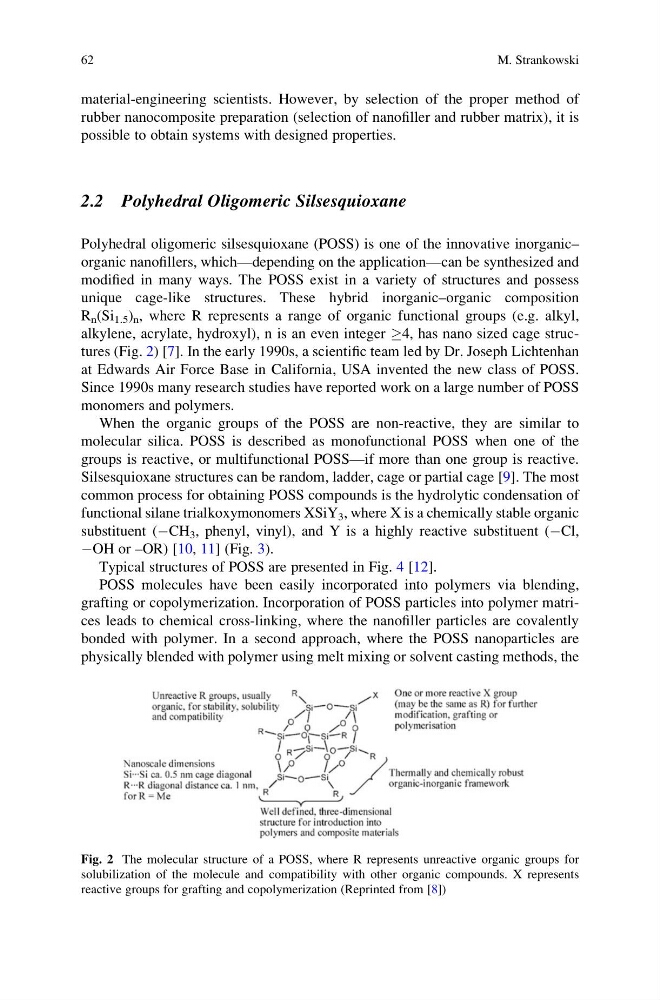
unique cage-like structures. These hybrid inorganic–organic composition
R n (Si 1.5 ) n , where R represents a range of organic functional groups (e.g. alkyl,
alkylene, acrylate, hydroxyl), n is an even integer !4, has nano sized cage structures (Fig. 2) [7]. In the early 1990s, a scientific team led by Dr. Joseph Lichtenhan
at Edwards Air Force Base in California, USA invented the new class of POSS.
Since 1990s many research studies have reported work on a large number of POSS
monomers and polymers.
When the organic groups of the POSS are non-reactive, they are similar to
molecular silica. POSS is described as monofunctional POSS when one of the
groups is reactive, or multifunctional POSS—if more than one group is reactive.
Silsesquioxane structures can be random, ladder, cage or partial cage [9]. The most
common process for obtaining POSS compounds is the hydrolytic condensation of
functional silane trialkoxymonomers XSiY 3 , where X is a chemically stable organic
substituent (ÀCH 3 , phenyl, vinyl), and Y is a highly reactive substituent (ÀCl,
ÀOH or –OR) [10, 11] (Fig. 3).
Typical structures of POSS are presented in Fig. 4 [12].
POSS molecules have been easily incorporated into polymers via blending,
grafting or copolymerization. Incorporation of POSS particles into polymer matrices leads to chemical cross-linking, where the nanofiller particles are covalently
bonded with polymer. In a second approach, where the POSS nanoparticles are
physically blended with polymer using melt mixing or solvent casting methods, the
Fig. 2 The molecular structure of a POSS, where R represents unreactive organic groups for
solubilization of the molecule and compatibility with other organic compounds. X represents
reactive groups for grafting and copolymerization (Reprinted from [8])
62
M. Strankowski
rubber nanocomposite preparation (selection of nanofiller and rubber matrix), it is
possible to obtain systems with designed properties.
2.2 Polyhedral Oligomeric Silsesquioxane
Polyhedral oligomeric silsesquioxane (POSS) is one of the innovative inorganic–
organic nanofillers, which—depending on the application—can be synthesized and
modified in many ways. The POSS exist in a variety of structures and possess
unique cage-like structures. These hybrid inorganic–organic composition
R n (Si 1.5 ) n , where R represents a range of organic functional groups (e.g. alkyl,
alkylene, acrylate, hydroxyl), n is an even integer !4, has nano sized cage structures (Fig. 2) [7]. In the early 1990s, a scientific team led by Dr. Joseph Lichtenhan
at Edwards Air Force Base in California, USA invented the new class of POSS.
Since 1990s many research studies have reported work on a large number of POSS
monomers and polymers.
When the organic groups of the POSS are non-reactive, they are similar to
molecular silica. POSS is described as monofunctional POSS when one of the
groups is reactive, or multifunctional POSS—if more than one group is reactive.
Silsesquioxane structures can be random, ladder, cage or partial cage [9]. The most
common process for obtaining POSS compounds is the hydrolytic condensation of
functional silane trialkoxymonomers XSiY 3 , where X is a chemically stable organic
substituent (ÀCH 3 , phenyl, vinyl), and Y is a highly reactive substituent (ÀCl,
ÀOH or –OR) [10, 11] (Fig. 3).
Typical structures of POSS are presented in Fig. 4 [12].
POSS molecules have been easily incorporated into polymers via blending,
grafting or copolymerization. Incorporation of POSS particles into polymer matrices leads to chemical cross-linking, where the nanofiller particles are covalently
bonded with polymer. In a second approach, where the POSS nanoparticles are
physically blended with polymer using melt mixing or solvent casting methods, the
Fig. 2 The molecular structure of a POSS, where R represents unreactive organic groups for
solubilization of the molecule and compatibility with other organic compounds. X represents
reactive groups for grafting and copolymerization (Reprinted from [8])
62
M. Strankowski