

complexity of dynamic mechanical behavior of these composites arising from the
restricted movement of NR molecules in the presence of coir fibers.
7.3 Curing Behaviour
To make an appropriate vulcanization processing operation, it is necessary to obtain
a complete kinetic characterization of neat polymer and how it is modified in
presence of fillers. Figure 9 displays the vulcanization curves of neat NR and
purified CNT/NR nanocomposites at various temperatures [104]. The vulcanizing
reaction rate of neat NR and CNT/NR nanocomposites was very much related to the
temperature. The vulcanization time decreases with increasing temperature both for
NR and composites while vulcanization time increases in composite in presence of
purified CNT in similar temperature as compared to pure NR. The vulcanization
kinetic parameters of specimens were obtained according to the related studies
using data on torque versus time in the vulcanizing curves including percentage
curing [105]. The degree of conversion (α) in curing reaction is defined as follows
(Eq. 1):
α ¼
M t À M 0
M 1 À M 0
ð1Þ
10
9
8
7
Log E /
(Pa)
5
Temperature (ºC)
2
tan
δ
NR-CNF10
NR-CNF5
NR
3
2.5
1.5
1
0
0.5
40
20
0
–20
–40
–60
–80
6
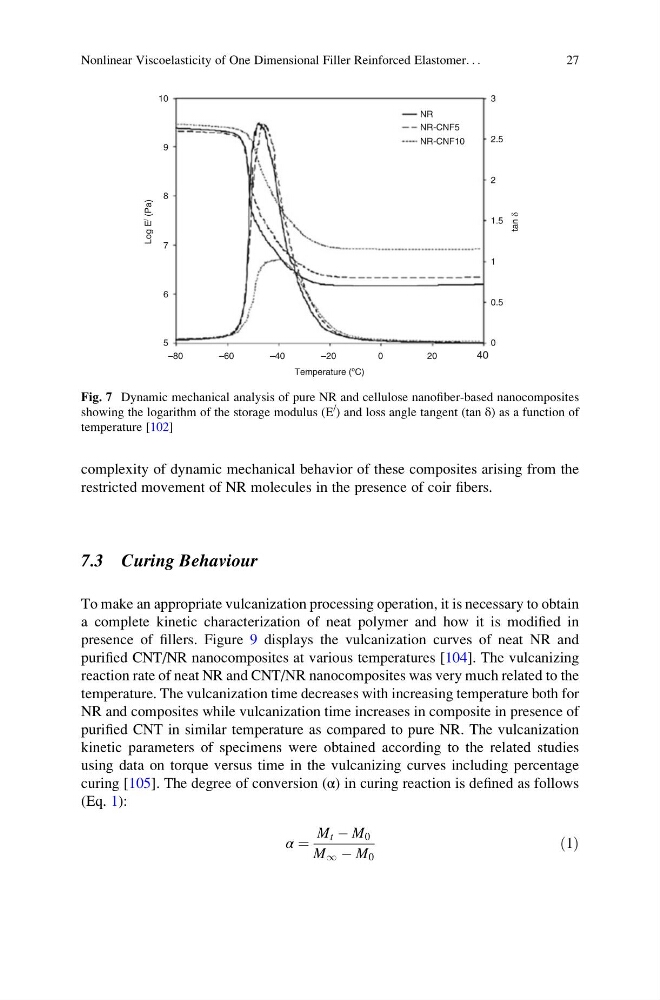
Fig. 7 Dynamic mechanical analysis of pure NR and cellulose nanofiber-based nanocomposites
showing the logarithm of the storage modulus (E
/
) and loss angle tangent (tan δ) as a function of
temperature [102]
Nonlinear Viscoelasticity of One Dimensional Filler Reinforced Elastomer. . .
27
restricted movement of NR molecules in the presence of coir fibers.
7.3 Curing Behaviour
To make an appropriate vulcanization processing operation, it is necessary to obtain
a complete kinetic characterization of neat polymer and how it is modified in
presence of fillers. Figure 9 displays the vulcanization curves of neat NR and
purified CNT/NR nanocomposites at various temperatures [104]. The vulcanizing
reaction rate of neat NR and CNT/NR nanocomposites was very much related to the
temperature. The vulcanization time decreases with increasing temperature both for
NR and composites while vulcanization time increases in composite in presence of
purified CNT in similar temperature as compared to pure NR. The vulcanization
kinetic parameters of specimens were obtained according to the related studies
using data on torque versus time in the vulcanizing curves including percentage
curing [105]. The degree of conversion (α) in curing reaction is defined as follows
(Eq. 1):
α ¼
M t À M 0
M 1 À M 0
ð1Þ
10
9
8
7
Log E /
(Pa)
5
Temperature (ºC)
2
tan
δ
NR-CNF10
NR-CNF5
NR
3
2.5
1.5
1
0
0.5
40
20
0
–20
–40
–60
–80
6
Fig. 7 Dynamic mechanical analysis of pure NR and cellulose nanofiber-based nanocomposites
showing the logarithm of the storage modulus (E
/
) and loss angle tangent (tan δ) as a function of
temperature [102]
Nonlinear Viscoelasticity of One Dimensional Filler Reinforced Elastomer. . .
27