

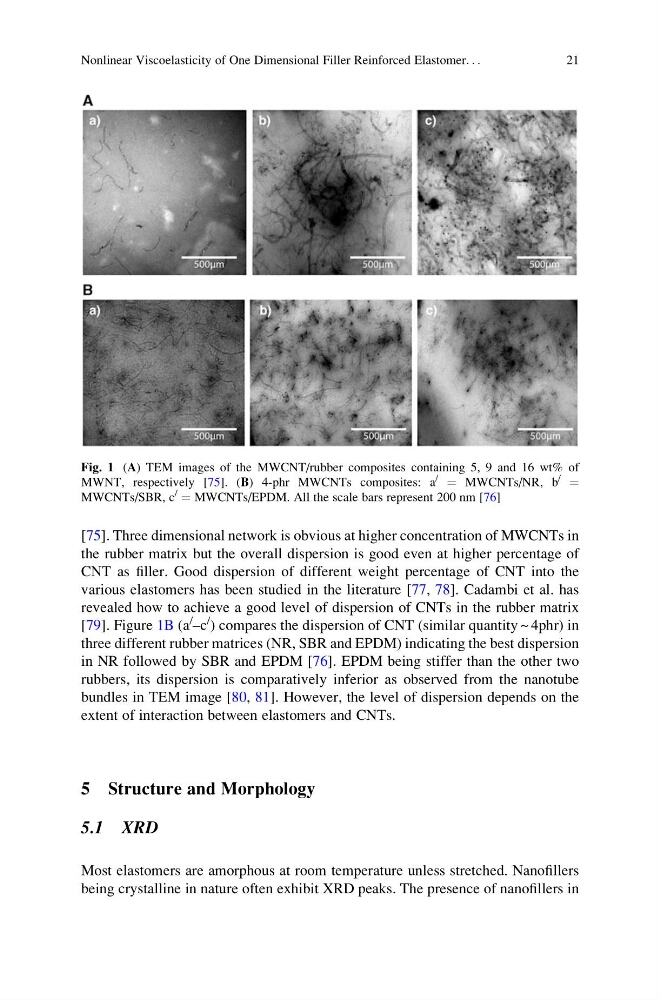
[75]. Three dimensional network is obvious at higher concentration of MWCNTs in
the rubber matrix but the overall dispersion is good even at higher percentage of
CNT as filler. Good dispersion of different weight percentage of CNT into the
various elastomers has been studied in the literature [77, 78]. Cadambi et al. has
revealed how to achieve a good level of dispersion of CNTs in the rubber matrix
[79]. Figure 1B (a
/ –c
/ ) compares the dispersion of CNT (similar quantity ~ 4phr) in
three different rubber matrices (NR, SBR and EPDM) indicating the best dispersion
in NR followed by SBR and EPDM [76]. EPDM being stiffer than the other two
rubbers, its dispersion is comparatively inferior as observed from the nanotube
bundles in TEM image [80, 81]. However, the level of dispersion depends on the
extent of interaction between elastomers and CNTs.
5 Structure and Morphology
5.1 XRD
Most elastomers are amorphous at room temperature unless stretched. Nanofillers
being crystalline in nature often exhibit XRD peaks. The presence of nanofillers in
Fig. 1 (A) TEM images of the MWCNT/rubber composites containing 5, 9 and 16 wt% of
MWNT, respectively [75]. (B) 4-phr MWCNTs composites: a
/ ¼ MWCNTs/NR, b
/ ¼
MWCNTs/SBR, c
/ ¼ MWCNTs/EPDM. All the scale bars represent 200 nm [76]
Nonlinear Viscoelasticity of One Dimensional Filler Reinforced Elastomer. . .
21
the rubber matrix but the overall dispersion is good even at higher percentage of
CNT as filler. Good dispersion of different weight percentage of CNT into the
various elastomers has been studied in the literature [77, 78]. Cadambi et al. has
revealed how to achieve a good level of dispersion of CNTs in the rubber matrix
[79]. Figure 1B (a
/ –c
/ ) compares the dispersion of CNT (similar quantity ~ 4phr) in
three different rubber matrices (NR, SBR and EPDM) indicating the best dispersion
in NR followed by SBR and EPDM [76]. EPDM being stiffer than the other two
rubbers, its dispersion is comparatively inferior as observed from the nanotube
bundles in TEM image [80, 81]. However, the level of dispersion depends on the
extent of interaction between elastomers and CNTs.
5 Structure and Morphology
5.1 XRD
Most elastomers are amorphous at room temperature unless stretched. Nanofillers
being crystalline in nature often exhibit XRD peaks. The presence of nanofillers in
Fig. 1 (A) TEM images of the MWCNT/rubber composites containing 5, 9 and 16 wt% of
MWNT, respectively [75]. (B) 4-phr MWCNTs composites: a
/ ¼ MWCNTs/NR, b
/ ¼
MWCNTs/SBR, c
/ ¼ MWCNTs/EPDM. All the scale bars represent 200 nm [76]
Nonlinear Viscoelasticity of One Dimensional Filler Reinforced Elastomer. . .
21