

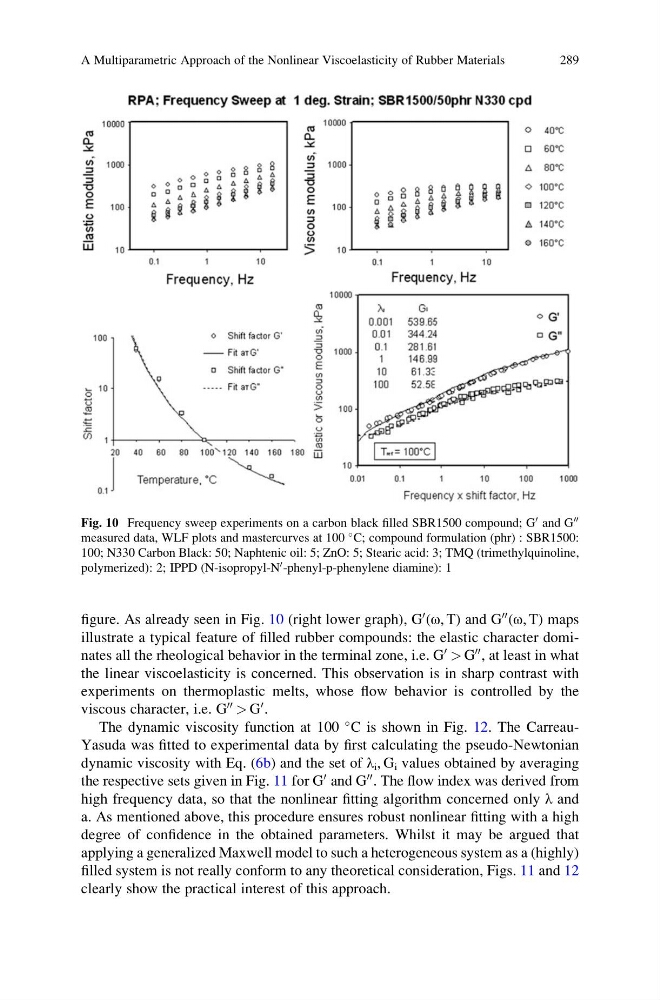
figure. As already seen in Fig. 10 (right lower graph), G
0 (ω, T) and G
00 (ω, T) maps
illustrate a typical feature of filled rubber compounds: the elastic character dominates all the rheological behavior in the terminal zone, i.e. G
0
> G
00 , at least in what
the linear viscoelasticity is concerned. This observation is in sharp contrast with
experiments on thermoplastic melts, whose flow behavior is controlled by the
viscous character, i.e. G
00
> G
0 .
The dynamic viscosity function at 100
C is shown in Fig. 12. The CarreauYasuda was fitted to experimental data by first calculating the pseudo-Newtonian
dynamic viscosity with Eq. (6b) and the set of λ i , G i values obtained by averaging
the respective sets given in Fig. 11 for G
0 and G
00 . The flow index was derived from
high frequency data, so that the nonlinear fitting algorithm concerned only λ and
a. As mentioned above, this procedure ensures robust nonlinear fitting with a high
degree of confidence in the obtained parameters. Whilst it may be argued that
applying a generalized Maxwell model to such a heterogeneous system as a (highly)
filled system is not really conform to any theoretical consideration, Figs. 11 and 12
clearly show the practical interest of this approach.
Fig. 10 Frequency sweep experiments on a carbon black filled SBR1500 compound; G
0 and G
00
measured data, WLF plots and mastercurves at 100
C; compound formulation (phr) : SBR1500:
100; N330 Carbon Black: 50; Naphtenic oil: 5; ZnO: 5; Stearic acid: 3; TMQ (trimethylquinoline,
polymerized): 2; IPPD (N-isopropyl-N
0 -phenyl-p-phenylene diamine): 1
A Multiparametric Approach of the Nonlinear Viscoelasticity of Rubber Materials
289
0 (ω, T) and G
00 (ω, T) maps
illustrate a typical feature of filled rubber compounds: the elastic character dominates all the rheological behavior in the terminal zone, i.e. G
0
> G
00 , at least in what
the linear viscoelasticity is concerned. This observation is in sharp contrast with
experiments on thermoplastic melts, whose flow behavior is controlled by the
viscous character, i.e. G
00
> G
0 .
The dynamic viscosity function at 100
C is shown in Fig. 12. The CarreauYasuda was fitted to experimental data by first calculating the pseudo-Newtonian
dynamic viscosity with Eq. (6b) and the set of λ i , G i values obtained by averaging
the respective sets given in Fig. 11 for G
0 and G
00 . The flow index was derived from
high frequency data, so that the nonlinear fitting algorithm concerned only λ and
a. As mentioned above, this procedure ensures robust nonlinear fitting with a high
degree of confidence in the obtained parameters. Whilst it may be argued that
applying a generalized Maxwell model to such a heterogeneous system as a (highly)
filled system is not really conform to any theoretical consideration, Figs. 11 and 12
clearly show the practical interest of this approach.
Fig. 10 Frequency sweep experiments on a carbon black filled SBR1500 compound; G
0 and G
00
measured data, WLF plots and mastercurves at 100
C; compound formulation (phr) : SBR1500:
100; N330 Carbon Black: 50; Naphtenic oil: 5; ZnO: 5; Stearic acid: 3; TMQ (trimethylquinoline,
polymerized): 2; IPPD (N-isopropyl-N
0 -phenyl-p-phenylene diamine): 1
A Multiparametric Approach of the Nonlinear Viscoelasticity of Rubber Materials
289