

however that the following Cox-Merz equality [21] applies to the material tested,
i.e.:
dσ _
γ
ð Þ
d_ γ
¼ η
0 ω
ð Þ _
γ ¼ ω
ð7Þ
Let us consider the same approach on a typical filled rubber compound. Figure 9
shows G
0 and G
00 data as measured at constant strain amplitude (1.0
; 13.96 %) on a
carbon black filled SBR1500 compound using a closed-cavity torsional rheometer
and a frequency-temperature sweep test protocol. It is worth underlining here that
such data could hardly be obtained with an open-gap rheometer because of the
stiffness of the material. The shift factors and the corresponding WLF curves are
given in the bottom left graphs with respect to the reference temperature of 100
C.
The (fitting) constants are: C 1 ¼ 2.78 and C 2 ¼ 151.7 for G
0 ; C 1 ¼ 2.71 and
C 2 ¼ 147.7 for G
00 . Mastercurves at 100
C are given in the bottom right graph, as
well as the λ i , G i set corresponding to a 6 elements generalized Maxwell model.
In principle, the time-temperature superposition principle applies only to materials that are said “thermo-rheologically simple” and therefore its use with filled
rubber compounds should give poor results. As seen in Fig. 10, this is not the case
and, in the author’s experience, it is common observation that good mastercurves
are obtained with many complex polymer materials through time-temperature
superposition, providing experimental data are of quality. In this respect, closedcavity rheometers offer obvious advantages over open-gap instruments.
The summarizing capabilities of the generalized Maxwell model combined with
the WLF approach are illustrated in Fig. 11 in the case of the filled compound.
Again well-established principles of linear viscoelasticity yield a precise characterization of filled rubber compounds in the room-to-processing temperature range,
and in a wide frequency range, likely encompassing the overall processing. Maps
were calculated with Eqs. (4a–c), using the λ i , G i set and the C 1 , C 2 given in the
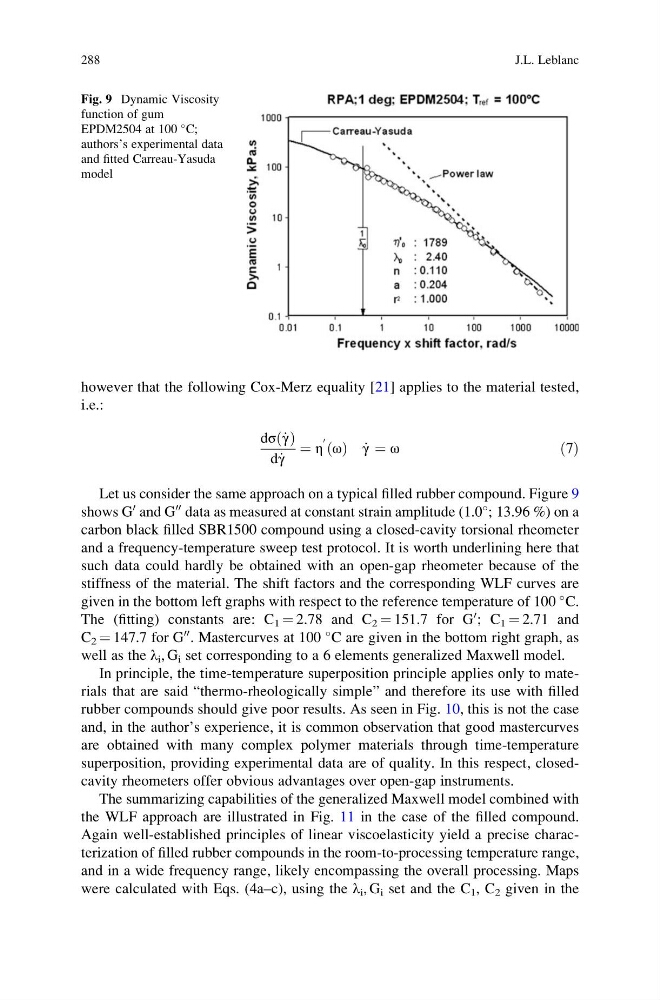
Fig. 9 Dynamic Viscosity
function of gum
EPDM2504 at 100
C;
authors’s experimental data
and fitted Carreau-Yasuda
model
288
J.L. Leblanc
i.e.:
dσ _
γ
ð Þ
d_ γ
¼ η
0 ω
ð Þ _
γ ¼ ω
ð7Þ
Let us consider the same approach on a typical filled rubber compound. Figure 9
shows G
0 and G
00 data as measured at constant strain amplitude (1.0
; 13.96 %) on a
carbon black filled SBR1500 compound using a closed-cavity torsional rheometer
and a frequency-temperature sweep test protocol. It is worth underlining here that
such data could hardly be obtained with an open-gap rheometer because of the
stiffness of the material. The shift factors and the corresponding WLF curves are
given in the bottom left graphs with respect to the reference temperature of 100
C.
The (fitting) constants are: C 1 ¼ 2.78 and C 2 ¼ 151.7 for G
0 ; C 1 ¼ 2.71 and
C 2 ¼ 147.7 for G
00 . Mastercurves at 100
C are given in the bottom right graph, as
well as the λ i , G i set corresponding to a 6 elements generalized Maxwell model.
In principle, the time-temperature superposition principle applies only to materials that are said “thermo-rheologically simple” and therefore its use with filled
rubber compounds should give poor results. As seen in Fig. 10, this is not the case
and, in the author’s experience, it is common observation that good mastercurves
are obtained with many complex polymer materials through time-temperature
superposition, providing experimental data are of quality. In this respect, closedcavity rheometers offer obvious advantages over open-gap instruments.
The summarizing capabilities of the generalized Maxwell model combined with
the WLF approach are illustrated in Fig. 11 in the case of the filled compound.
Again well-established principles of linear viscoelasticity yield a precise characterization of filled rubber compounds in the room-to-processing temperature range,
and in a wide frequency range, likely encompassing the overall processing. Maps
were calculated with Eqs. (4a–c), using the λ i , G i set and the C 1 , C 2 given in the
Fig. 9 Dynamic Viscosity
function of gum
EPDM2504 at 100
C;
authors’s experimental data
and fitted Carreau-Yasuda
model
288
J.L. Leblanc