

time-temperature superposition principle allows the dynamic properties of the
materials to be obtained over about five decades of frequency, encompassing thus
the terminal zone and a part of the rubbery plateau.
G
0 and G
00 mastercurves were fitted with a six elements generalized Maxwell
model whose characteristic relaxation times were arbitrarily selected in order to
correspond with logarithmic decades. As can be seen, fits are excellent within the
experimental frequency range. In summary, the overall linear viscoelastic behavior
of the material in the 0.01–1,000 Hz frequency range and the 40–160
C temperature range is known, using only 6 λ i , G i couples, 2 WLF coefficients (C 1 and C 2 )
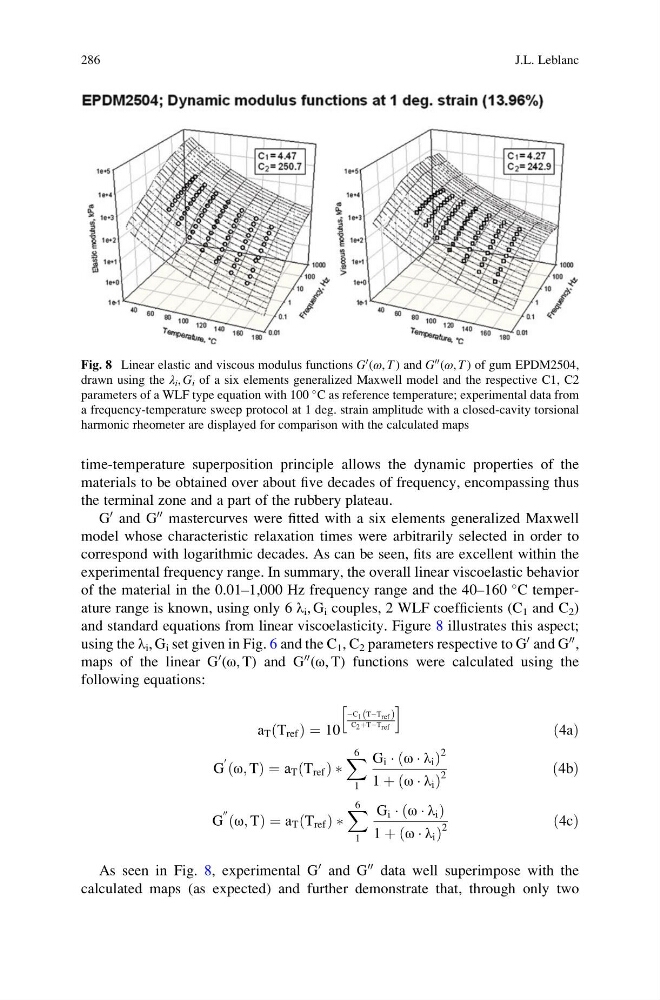
and standard equations from linear viscoelasticity. Figure 8 illustrates this aspect;
using the λ i , G i set given in Fig. 6 and the C 1 , C 2 parameters respective to G
0 and G
00 ,
maps of the linear G
0 (ω, T) and G
00 (ω, T) functions were calculated using the
following equations:
a T T ref
ð Þ ¼ 10
ÀC 1 TÀT ref
ð
Þ
C 2 þTÀT ref
h
i
ð4aÞ
G
0 ω; T
ð
Þ ¼ a T T ref
ð ÞÃ
X 6
1
G i Á ω Á λ i
ð
Þ
2
1 þ ω Á λ i
ð
Þ
2
ð4bÞ
G
00 ω; T
ð
Þ ¼ a T T ref
ð ÞÃ
X 6
1
G i Á ω Á λ i
ð
Þ
1 þ ω Á λ i
ð
Þ
2
ð4cÞ
As seen in Fig. 8, experimental G
0 and G
00 data well superimpose with the
calculated maps (as expected) and further demonstrate that, through only two
Fig. 8 Linear elastic and viscous modulus functions G
0 (ω, T ) and G
00 (ω, T ) of gum EPDM2504,
drawn using the λ i , G i of a six elements generalized Maxwell model and the respective C1, C2
parameters of a WLF type equation with 100
C as reference temperature; experimental data from
a frequency-temperature sweep protocol at 1 deg. strain amplitude with a closed-cavity torsional
harmonic rheometer are displayed for comparison with the calculated maps
286
J.L. Leblanc
materials to be obtained over about five decades of frequency, encompassing thus
the terminal zone and a part of the rubbery plateau.
G
0 and G
00 mastercurves were fitted with a six elements generalized Maxwell
model whose characteristic relaxation times were arbitrarily selected in order to
correspond with logarithmic decades. As can be seen, fits are excellent within the
experimental frequency range. In summary, the overall linear viscoelastic behavior
of the material in the 0.01–1,000 Hz frequency range and the 40–160
C temperature range is known, using only 6 λ i , G i couples, 2 WLF coefficients (C 1 and C 2 )
and standard equations from linear viscoelasticity. Figure 8 illustrates this aspect;
using the λ i , G i set given in Fig. 6 and the C 1 , C 2 parameters respective to G
0 and G
00 ,
maps of the linear G
0 (ω, T) and G
00 (ω, T) functions were calculated using the
following equations:
a T T ref
ð Þ ¼ 10
ÀC 1 TÀT ref
ð
Þ
C 2 þTÀT ref
h
i
ð4aÞ
G
0 ω; T
ð
Þ ¼ a T T ref
ð ÞÃ
X 6
1
G i Á ω Á λ i
ð
Þ
2
1 þ ω Á λ i
ð
Þ
2
ð4bÞ
G
00 ω; T
ð
Þ ¼ a T T ref
ð ÞÃ
X 6
1
G i Á ω Á λ i
ð
Þ
1 þ ω Á λ i
ð
Þ
2
ð4cÞ
As seen in Fig. 8, experimental G
0 and G
00 data well superimpose with the
calculated maps (as expected) and further demonstrate that, through only two
Fig. 8 Linear elastic and viscous modulus functions G
0 (ω, T ) and G
00 (ω, T ) of gum EPDM2504,
drawn using the λ i , G i of a six elements generalized Maxwell model and the respective C1, C2
parameters of a WLF type equation with 100
C as reference temperature; experimental data from
a frequency-temperature sweep protocol at 1 deg. strain amplitude with a closed-cavity torsional
harmonic rheometer are displayed for comparison with the calculated maps
286
J.L. Leblanc