

study of this effect—both experimental measurements and theoretical studies
based on mathematical modeling—would greatly simplify the characterization
process [9].
It was Green and Adkins who first derived the general non-linear theory for
membrane deformation [10]. Following this many authors addressed the viscoelastic effect and the deformation behavior in rubbers. In the 1960s, Hart-Smith and
Crisp [11] and Klingbeil and Shield [12] examined the axisymmetrical hyperelastic
membranes for investigating the large deformations in rubber. They have used
different hyperelastic non-linear constitutive equations to propose analytical solutions for the circular plane membrane deformation. The results obtained are compared with experimental data for rubber and found good agreement. In another
work, Oden and Sato [13] used the Galerkin finite element method (considering the
three-nodes triangular elements and corresponding nonlinear equations) to solve the
non-linear elastic membrane problems. Wineman and Feng [14, 15] used semianalytical time-discretization schemes to solve the time-dependent function of
non-linear viscoelastic rubber. Rubber-like materials obey non-linear integral viscoelastic constitutive equations such as Christensen’s model which describe the
material large strain time-dependent behaviour. It was Shrivastava and Tang [17]
who developed a three-dimensional method for such model based on the geometric
non-linearities and solved the non-linear equations of equilibrium. A review by
Jenkins and Leonard explains the dynamic deformation by considering the effect of
membrane inertia [18–20]. All the studies are done by applying internal pressure to
the membranes under large strains to create deformation and then checking the
dynamic responses. The results are then compared with the theoretical solutions of
hyperelastic and non-linear viscoelastic constitutive equations. The main advantage
of the numerical approach is that the fast processes such as thermoforming or blowmoulding can be better simulated.
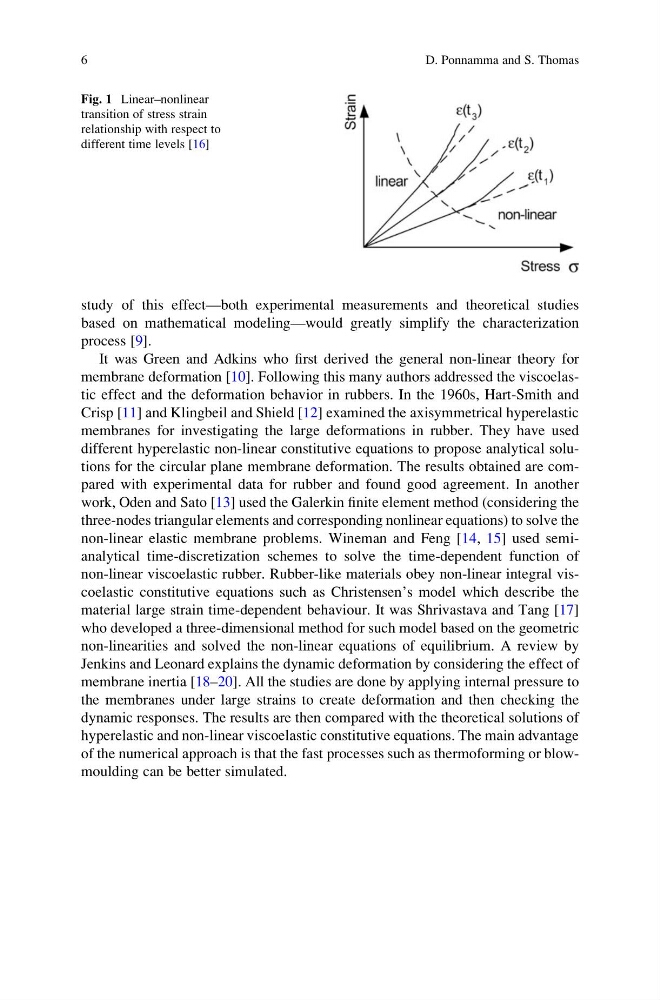
Fig. 1 Linear–nonlinear
transition of stress strain
relationship with respect to
different time levels [16]
6
D. Ponnamma and S. Thomas
based on mathematical modeling—would greatly simplify the characterization
process [9].
It was Green and Adkins who first derived the general non-linear theory for
membrane deformation [10]. Following this many authors addressed the viscoelastic effect and the deformation behavior in rubbers. In the 1960s, Hart-Smith and
Crisp [11] and Klingbeil and Shield [12] examined the axisymmetrical hyperelastic
membranes for investigating the large deformations in rubber. They have used
different hyperelastic non-linear constitutive equations to propose analytical solutions for the circular plane membrane deformation. The results obtained are compared with experimental data for rubber and found good agreement. In another
work, Oden and Sato [13] used the Galerkin finite element method (considering the
three-nodes triangular elements and corresponding nonlinear equations) to solve the
non-linear elastic membrane problems. Wineman and Feng [14, 15] used semianalytical time-discretization schemes to solve the time-dependent function of
non-linear viscoelastic rubber. Rubber-like materials obey non-linear integral viscoelastic constitutive equations such as Christensen’s model which describe the
material large strain time-dependent behaviour. It was Shrivastava and Tang [17]
who developed a three-dimensional method for such model based on the geometric
non-linearities and solved the non-linear equations of equilibrium. A review by
Jenkins and Leonard explains the dynamic deformation by considering the effect of
membrane inertia [18–20]. All the studies are done by applying internal pressure to
the membranes under large strains to create deformation and then checking the
dynamic responses. The results are then compared with the theoretical solutions of
hyperelastic and non-linear viscoelastic constitutive equations. The main advantage
of the numerical approach is that the fast processes such as thermoforming or blowmoulding can be better simulated.
Fig. 1 Linear–nonlinear
transition of stress strain
relationship with respect to
different time levels [16]
6
D. Ponnamma and S. Thomas