

2 Viscoelasticity
2.1 Non-linear Viscoelasticity
Material behavior can be time dependent or independent and the time dependent
behavior is often referred to as linear viscoelasticity. This can be explained based
on some equations. Suppose σ1 is the constant load applied to a viscoelastic
specimen, then ε1 gives the time dependent strain. After a particular time when
the load is removed the specimen tries to recover back and then ε2 becomes the time
dependence of the strain upon a larger stress σ2. If t1 and t2 represent the time after
loading, ε1 and ε2 are linear strains corresponding to the stresses, σ1 and σ2. Here
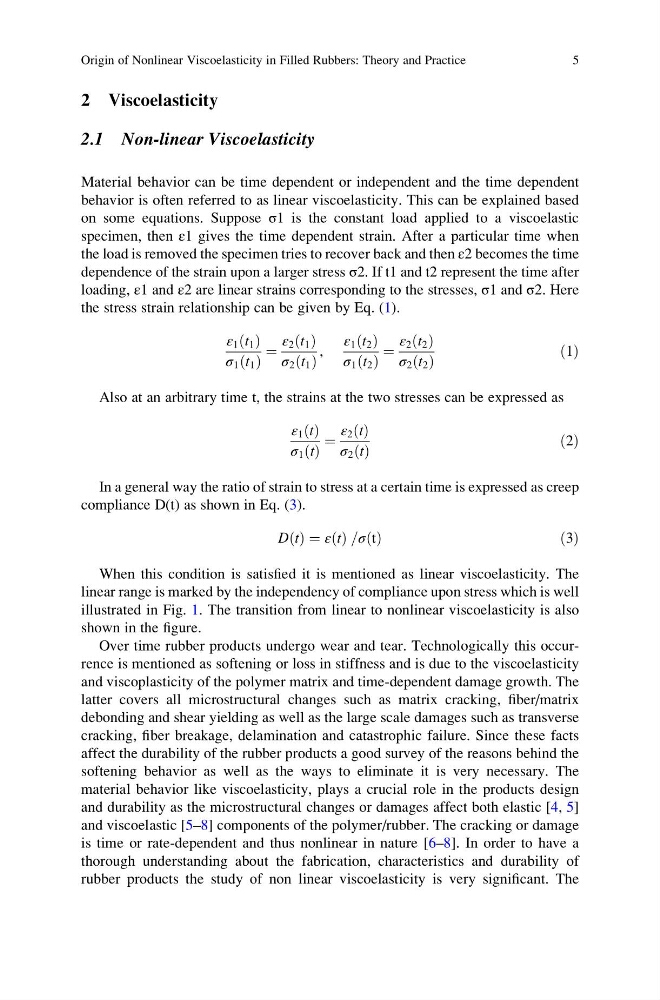
the stress strain relationship can be given by Eq. (1).
ε 1 t 1
ð Þ
σ 1 t 1
ð Þ
¼
ε 2 t 1
ð Þ
σ 2 t 1
ð Þ
,
ε 1 t 2
ð Þ
σ 1 t 2
ð Þ
¼
ε 2 t 2
ð Þ
σ 2 t 2
ð Þ
ð1Þ
Also at an arbitrary time t, the strains at the two stresses can be expressed as
ε 1 t
ð Þ
σ 1 t
ð Þ
¼
ε 2 t
ð Þ
σ 2 t
ð Þ
ð2Þ
In a general way the ratio of strain to stress at a certain time is expressed as creep
compliance D(t) as shown in Eq. (3).
D t
ð Þ ¼ ε t
ð Þ =σ t
ð Þ
ð3Þ
When this condition is satisfied it is mentioned as linear viscoelasticity. The
linear range is marked by the independency of compliance upon stress which is well
illustrated in Fig. 1. The transition from linear to nonlinear viscoelasticity is also
shown in the figure.
Over time rubber products undergo wear and tear. Technologically this occurrence is mentioned as softening or loss in stiffness and is due to the viscoelasticity
and viscoplasticity of the polymer matrix and time-dependent damage growth. The
latter covers all microstructural changes such as matrix cracking, fiber/matrix
debonding and shear yielding as well as the large scale damages such as transverse
cracking, fiber breakage, delamination and catastrophic failure. Since these facts
affect the durability of the rubber products a good survey of the reasons behind the
softening behavior as well as the ways to eliminate it is very necessary. The
material behavior like viscoelasticity, plays a crucial role in the products design
and durability as the microstructural changes or damages affect both elastic [4, 5]
and viscoelastic [5–8] components of the polymer/rubber. The cracking or damage
is time or rate-dependent and thus nonlinear in nature [6–8]. In order to have a
thorough understanding about the fabrication, characteristics and durability of
rubber products the study of non linear viscoelasticity is very significant. The
Origin of Nonlinear Viscoelasticity in Filled Rubbers: Theory and Practice
5
2.1 Non-linear Viscoelasticity
Material behavior can be time dependent or independent and the time dependent
behavior is often referred to as linear viscoelasticity. This can be explained based
on some equations. Suppose σ1 is the constant load applied to a viscoelastic
specimen, then ε1 gives the time dependent strain. After a particular time when
the load is removed the specimen tries to recover back and then ε2 becomes the time
dependence of the strain upon a larger stress σ2. If t1 and t2 represent the time after
loading, ε1 and ε2 are linear strains corresponding to the stresses, σ1 and σ2. Here
the stress strain relationship can be given by Eq. (1).
ε 1 t 1
ð Þ
σ 1 t 1
ð Þ
¼
ε 2 t 1
ð Þ
σ 2 t 1
ð Þ
,
ε 1 t 2
ð Þ
σ 1 t 2
ð Þ
¼
ε 2 t 2
ð Þ
σ 2 t 2
ð Þ
ð1Þ
Also at an arbitrary time t, the strains at the two stresses can be expressed as
ε 1 t
ð Þ
σ 1 t
ð Þ
¼
ε 2 t
ð Þ
σ 2 t
ð Þ
ð2Þ
In a general way the ratio of strain to stress at a certain time is expressed as creep
compliance D(t) as shown in Eq. (3).
D t
ð Þ ¼ ε t
ð Þ =σ t
ð Þ
ð3Þ
When this condition is satisfied it is mentioned as linear viscoelasticity. The
linear range is marked by the independency of compliance upon stress which is well
illustrated in Fig. 1. The transition from linear to nonlinear viscoelasticity is also
shown in the figure.
Over time rubber products undergo wear and tear. Technologically this occurrence is mentioned as softening or loss in stiffness and is due to the viscoelasticity
and viscoplasticity of the polymer matrix and time-dependent damage growth. The
latter covers all microstructural changes such as matrix cracking, fiber/matrix
debonding and shear yielding as well as the large scale damages such as transverse
cracking, fiber breakage, delamination and catastrophic failure. Since these facts
affect the durability of the rubber products a good survey of the reasons behind the
softening behavior as well as the ways to eliminate it is very necessary. The
material behavior like viscoelasticity, plays a crucial role in the products design
and durability as the microstructural changes or damages affect both elastic [4, 5]
and viscoelastic [5–8] components of the polymer/rubber. The cracking or damage
is time or rate-dependent and thus nonlinear in nature [6–8]. In order to have a
thorough understanding about the fabrication, characteristics and durability of
rubber products the study of non linear viscoelasticity is very significant. The
Origin of Nonlinear Viscoelasticity in Filled Rubbers: Theory and Practice
5