

significant changes in G
0 are observed with increasing strain amplitude, and a
pronounced Payne effect is observed for the composite containing 20 wt% or
more of CNTs [30].
2.4 Fibrous Nanofillers
Fibrous nanofillers are the materials used to reinforce the polymer/rubber matrix,
which are made from fibers, such as jute, polypropylene, cotton, glass, carbon
nanofibre, etc. In fact, these nanofillers are used in rubber matrix to improve the
properties of the composite material and in order to make them suitable for various
applications. B. Lively et al. have described the variation of storage modulus with
temperature of polycarbonate/carbon nanofibre (PC/CNF) composites. They have
prepared the PC/CNF composites via solution mixing at 1.5 wt% CNF in PC with
different preparation procedures and sonication exposures to control dispersion
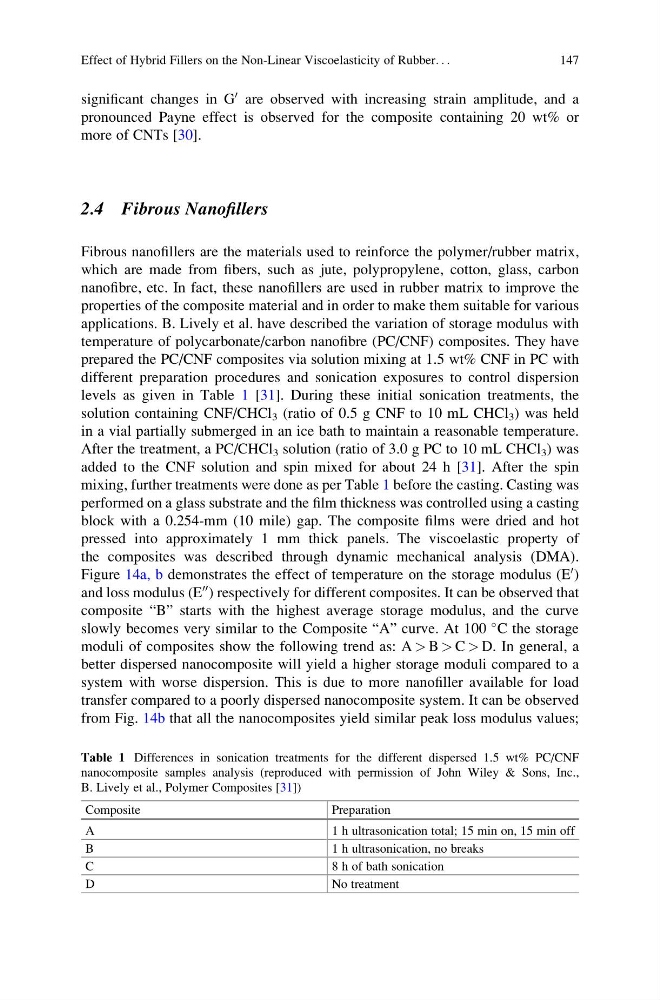
levels as given in Table 1 [31]. During these initial sonication treatments, the
solution containing CNF/CHCl 3 (ratio of 0.5 g CNF to 10 mL CHCl 3 ) was held
in a vial partially submerged in an ice bath to maintain a reasonable temperature.
After the treatment, a PC/CHCl 3 solution (ratio of 3.0 g PC to 10 mL CHCl 3 ) was
added to the CNF solution and spin mixed for about 24 h [31]. After the spin
mixing, further treatments were done as per Table 1 before the casting. Casting was
performed on a glass substrate and the film thickness was controlled using a casting
block with a 0.254-mm (10 mile) gap. The composite films were dried and hot
pressed into approximately 1 mm thick panels. The viscoelastic property of
the composites was described through dynamic mechanical analysis (DMA).
Figure 14a, b demonstrates the effect of temperature on the storage modulus (E
0 )
and loss modulus (E
00 ) respectively for different composites. It can be observed that
composite “B” starts with the highest average storage modulus, and the curve
slowly becomes very similar to the Composite “A” curve. At 100
C the storage
moduli of composites show the following trend as: A > B > C > D. In general, a
better dispersed nanocomposite will yield a higher storage moduli compared to a
system with worse dispersion. This is due to more nanofiller available for load
transfer compared to a poorly dispersed nanocomposite system. It can be observed
from Fig. 14b that all the nanocomposites yield similar peak loss modulus values;
Table 1 Differences in sonication treatments for the different dispersed 1.5 wt% PC/CNF
nanocomposite samples analysis (reproduced with permission of John Wiley & Sons, Inc.,
B. Lively et al., Polymer Composites [31])
Composite
Preparation
A
1 h ultrasonication total; 15 min on, 15 min off
B
1 h ultrasonication, no breaks
C
8 h of bath sonication
D
No treatment
Effect of Hybrid Fillers on the Non-Linear Viscoelasticity of Rubber. . .
147
0 are observed with increasing strain amplitude, and a
pronounced Payne effect is observed for the composite containing 20 wt% or
more of CNTs [30].
2.4 Fibrous Nanofillers
Fibrous nanofillers are the materials used to reinforce the polymer/rubber matrix,
which are made from fibers, such as jute, polypropylene, cotton, glass, carbon
nanofibre, etc. In fact, these nanofillers are used in rubber matrix to improve the
properties of the composite material and in order to make them suitable for various
applications. B. Lively et al. have described the variation of storage modulus with
temperature of polycarbonate/carbon nanofibre (PC/CNF) composites. They have
prepared the PC/CNF composites via solution mixing at 1.5 wt% CNF in PC with
different preparation procedures and sonication exposures to control dispersion
levels as given in Table 1 [31]. During these initial sonication treatments, the
solution containing CNF/CHCl 3 (ratio of 0.5 g CNF to 10 mL CHCl 3 ) was held
in a vial partially submerged in an ice bath to maintain a reasonable temperature.
After the treatment, a PC/CHCl 3 solution (ratio of 3.0 g PC to 10 mL CHCl 3 ) was
added to the CNF solution and spin mixed for about 24 h [31]. After the spin
mixing, further treatments were done as per Table 1 before the casting. Casting was
performed on a glass substrate and the film thickness was controlled using a casting
block with a 0.254-mm (10 mile) gap. The composite films were dried and hot
pressed into approximately 1 mm thick panels. The viscoelastic property of
the composites was described through dynamic mechanical analysis (DMA).
Figure 14a, b demonstrates the effect of temperature on the storage modulus (E
0 )
and loss modulus (E
00 ) respectively for different composites. It can be observed that
composite “B” starts with the highest average storage modulus, and the curve
slowly becomes very similar to the Composite “A” curve. At 100
C the storage
moduli of composites show the following trend as: A > B > C > D. In general, a
better dispersed nanocomposite will yield a higher storage moduli compared to a
system with worse dispersion. This is due to more nanofiller available for load
transfer compared to a poorly dispersed nanocomposite system. It can be observed
from Fig. 14b that all the nanocomposites yield similar peak loss modulus values;
Table 1 Differences in sonication treatments for the different dispersed 1.5 wt% PC/CNF
nanocomposite samples analysis (reproduced with permission of John Wiley & Sons, Inc.,
B. Lively et al., Polymer Composites [31])
Composite
Preparation
A
1 h ultrasonication total; 15 min on, 15 min off
B
1 h ultrasonication, no breaks
C
8 h of bath sonication
D
No treatment
Effect of Hybrid Fillers on the Non-Linear Viscoelasticity of Rubber. . .
147