

at 50
C and 133 % at 210
C was achieved in the composite incorporating 12 wt
% m-HNTs. The significant increased mechanical properties of the nanocomposites
were attributed to the unique nanostructure and property of the HNTs since HNTs
are rigid silicate nanotubes with high strength and stiffness [25].
In addition, the good compatibility between m-HNTs and the epoxy matrix may
also play an important role in the reinforcing effect where the good compatibility is
due to the interaction between the silica modified HNT and the epoxy resin. Therefore,
the nanocomposites exhibit higher modulus even at the elevated temperatures [25].
Figure 7 shows the tan δ vs. temperature plots of the nanocomposites. It is
observed that the tan δ value at glass transition temperature (T g ) of the
nanocomposites decrease by the incorporation of m-HNTs, although the trend is
not consistent. As the HNTs content increases the height of the loss peak decreases
gradually. The decreased tan δ value is due to the restricted mobility of the polymer
chains by the uniformly dispersed rigid nanotubes. However, overloading of the
m-HNTs (12 wt%) increases the tan δ value at T g , which may be attributed to the
aggregation of m-HNTs at relatively higher content in the epoxy resin [25].
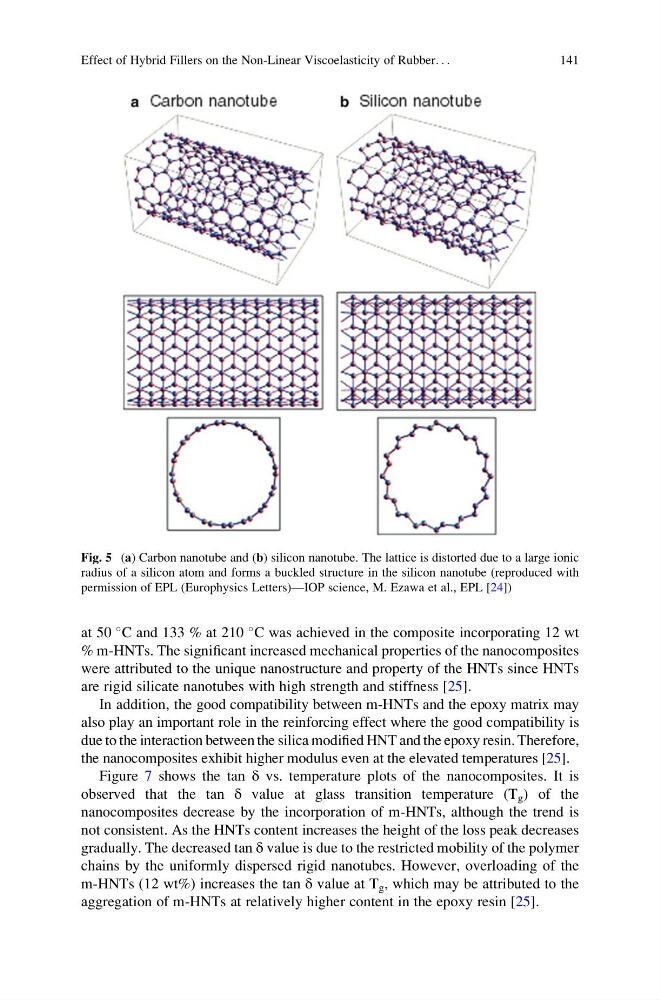
Fig. 5 (a) Carbon nanotube and (b) silicon nanotube. The lattice is distorted due to a large ionic
radius of a silicon atom and forms a buckled structure in the silicon nanotube (reproduced with
permission of EPL (Europhysics Letters)—IOP science, M. Ezawa et al., EPL [24])
Effect of Hybrid Fillers on the Non-Linear Viscoelasticity of Rubber. . .
141
C and 133 % at 210
C was achieved in the composite incorporating 12 wt
% m-HNTs. The significant increased mechanical properties of the nanocomposites
were attributed to the unique nanostructure and property of the HNTs since HNTs
are rigid silicate nanotubes with high strength and stiffness [25].
In addition, the good compatibility between m-HNTs and the epoxy matrix may
also play an important role in the reinforcing effect where the good compatibility is
due to the interaction between the silica modified HNT and the epoxy resin. Therefore,
the nanocomposites exhibit higher modulus even at the elevated temperatures [25].
Figure 7 shows the tan δ vs. temperature plots of the nanocomposites. It is
observed that the tan δ value at glass transition temperature (T g ) of the
nanocomposites decrease by the incorporation of m-HNTs, although the trend is
not consistent. As the HNTs content increases the height of the loss peak decreases
gradually. The decreased tan δ value is due to the restricted mobility of the polymer
chains by the uniformly dispersed rigid nanotubes. However, overloading of the
m-HNTs (12 wt%) increases the tan δ value at T g , which may be attributed to the
aggregation of m-HNTs at relatively higher content in the epoxy resin [25].
Fig. 5 (a) Carbon nanotube and (b) silicon nanotube. The lattice is distorted due to a large ionic
radius of a silicon atom and forms a buckled structure in the silicon nanotube (reproduced with
permission of EPL (Europhysics Letters)—IOP science, M. Ezawa et al., EPL [24])
Effect of Hybrid Fillers on the Non-Linear Viscoelasticity of Rubber. . .
141