

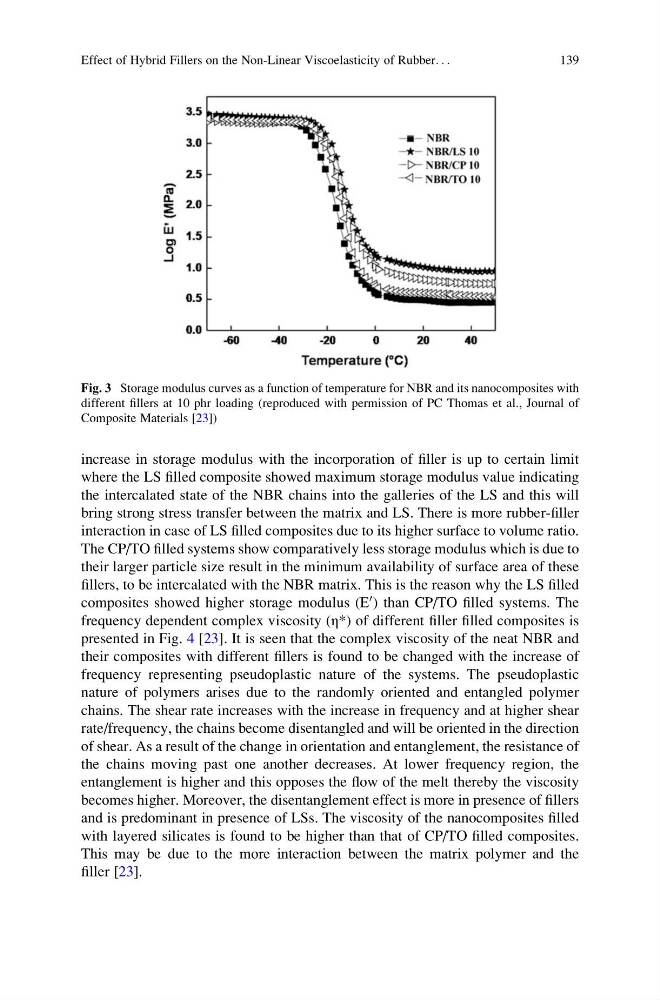
increase in storage modulus with the incorporation of filler is up to certain limit
where the LS filled composite showed maximum storage modulus value indicating
the intercalated state of the NBR chains into the galleries of the LS and this will
bring strong stress transfer between the matrix and LS. There is more rubber-filler
interaction in case of LS filled composites due to its higher surface to volume ratio.
The CP/TO filled systems show comparatively less storage modulus which is due to
their larger particle size result in the minimum availability of surface area of these
fillers, to be intercalated with the NBR matrix. This is the reason why the LS filled
composites showed higher storage modulus (E
0 ) than CP/TO filled systems. The
frequency dependent complex viscosity (η*) of different filler filled composites is
presented in Fig. 4 [23]. It is seen that the complex viscosity of the neat NBR and
their composites with different fillers is found to be changed with the increase of
frequency representing pseudoplastic nature of the systems. The pseudoplastic
nature of polymers arises due to the randomly oriented and entangled polymer
chains. The shear rate increases with the increase in frequency and at higher shear
rate/frequency, the chains become disentangled and will be oriented in the direction
of shear. As a result of the change in orientation and entanglement, the resistance of
the chains moving past one another decreases. At lower frequency region, the
entanglement is higher and this opposes the flow of the melt thereby the viscosity
becomes higher. Moreover, the disentanglement effect is more in presence of fillers
and is predominant in presence of LSs. The viscosity of the nanocomposites filled
with layered silicates is found to be higher than that of CP/TO filled composites.
This may be due to the more interaction between the matrix polymer and the
filler [23].
Fig. 3 Storage modulus curves as a function of temperature for NBR and its nanocomposites with
different fillers at 10 phr loading (reproduced with permission of PC Thomas et al., Journal of
Composite Materials [23])
Effect of Hybrid Fillers on the Non-Linear Viscoelasticity of Rubber. . .
139
where the LS filled composite showed maximum storage modulus value indicating
the intercalated state of the NBR chains into the galleries of the LS and this will
bring strong stress transfer between the matrix and LS. There is more rubber-filler
interaction in case of LS filled composites due to its higher surface to volume ratio.
The CP/TO filled systems show comparatively less storage modulus which is due to
their larger particle size result in the minimum availability of surface area of these
fillers, to be intercalated with the NBR matrix. This is the reason why the LS filled
composites showed higher storage modulus (E
0 ) than CP/TO filled systems. The
frequency dependent complex viscosity (η*) of different filler filled composites is
presented in Fig. 4 [23]. It is seen that the complex viscosity of the neat NBR and
their composites with different fillers is found to be changed with the increase of
frequency representing pseudoplastic nature of the systems. The pseudoplastic
nature of polymers arises due to the randomly oriented and entangled polymer
chains. The shear rate increases with the increase in frequency and at higher shear
rate/frequency, the chains become disentangled and will be oriented in the direction
of shear. As a result of the change in orientation and entanglement, the resistance of
the chains moving past one another decreases. At lower frequency region, the
entanglement is higher and this opposes the flow of the melt thereby the viscosity
becomes higher. Moreover, the disentanglement effect is more in presence of fillers
and is predominant in presence of LSs. The viscosity of the nanocomposites filled
with layered silicates is found to be higher than that of CP/TO filled composites.
This may be due to the more interaction between the matrix polymer and the
filler [23].
Fig. 3 Storage modulus curves as a function of temperature for NBR and its nanocomposites with
different fillers at 10 phr loading (reproduced with permission of PC Thomas et al., Journal of
Composite Materials [23])
Effect of Hybrid Fillers on the Non-Linear Viscoelasticity of Rubber. . .
139