

The filler–filler network can be reformed again after a certain time interval.
Payne revealed that the value of E
0 is largely recoverable upon return to smaller
amplitudes in the linear regime. So, flexible rubber chains allow the filler particles
to rearrange again to form a three-dimensional filler network in the rubber matrix
[99]. In order to investigate the ability to recover the strain sweep experiments were
also carried out in the reverse direction from higher to lower strain amplitudes for
the samples with unmodified CNT dispersed by ethanolic suspension.
It is observed that the values do not reach its initial position within the relaxation
time of the experiment, but a recovery of the E
0 values have been attained (Fig. 18).
This behaviour of a rubber can be explained by the stress softening effect during the
dynamic strain. Nevertheless, a high extent of recovery in the reverse amplitude
sweep indicates that a good filler–filler network has been re-established at a low
loading of tubes in the S-SBR–BR matrix. So, at least it can be said that rather than
damage or permanent break of the tubes, the amplitude sweep disrupted the filler–
filler network in the rubber matrix. It is noted that the absolute values of E
0 at small
amplitudes are somewhat differed from each other as compared with the value
obtained from the phr CNT-filled compound. The difference may be developed
from ageing of the samples.
Figures 19 and 20 show the temperature dependencies of the storage moduli, the
loss moduli and the loss factor tan δ of the CNT–rubber nanocomposites. Figure 19
illustrates that with an increase in temperature the storage modulus of all samples
decreases which is associated with the glass transition phenomenon of the elastomer chains. Above room temperature the value of E
0 increases as well with
increasing filler loading. As seen in Fig. 20, the glass transition temperature at the
maxima of the tan δ plot does not change with the tube content in the rubber matrix.
However, the peak height reduces considerably with higher CNT content. This
behaviour also indicates the strong reinforcement efficiency with only low content
of CNT.
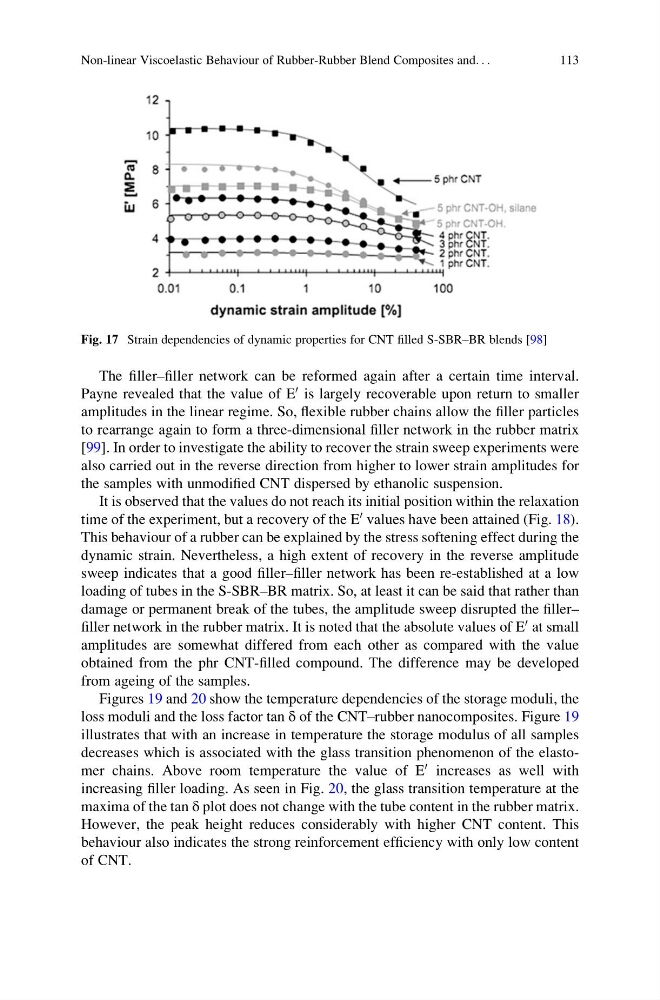
Fig. 17 Strain dependencies of dynamic properties for CNT filled S-SBR–BR blends [98]
Non-linear Viscoelastic Behaviour of Rubber-Rubber Blend Composites and. . .
113
Payne revealed that the value of E
0 is largely recoverable upon return to smaller
amplitudes in the linear regime. So, flexible rubber chains allow the filler particles
to rearrange again to form a three-dimensional filler network in the rubber matrix
[99]. In order to investigate the ability to recover the strain sweep experiments were
also carried out in the reverse direction from higher to lower strain amplitudes for
the samples with unmodified CNT dispersed by ethanolic suspension.
It is observed that the values do not reach its initial position within the relaxation
time of the experiment, but a recovery of the E
0 values have been attained (Fig. 18).
This behaviour of a rubber can be explained by the stress softening effect during the
dynamic strain. Nevertheless, a high extent of recovery in the reverse amplitude
sweep indicates that a good filler–filler network has been re-established at a low
loading of tubes in the S-SBR–BR matrix. So, at least it can be said that rather than
damage or permanent break of the tubes, the amplitude sweep disrupted the filler–
filler network in the rubber matrix. It is noted that the absolute values of E
0 at small
amplitudes are somewhat differed from each other as compared with the value
obtained from the phr CNT-filled compound. The difference may be developed
from ageing of the samples.
Figures 19 and 20 show the temperature dependencies of the storage moduli, the
loss moduli and the loss factor tan δ of the CNT–rubber nanocomposites. Figure 19
illustrates that with an increase in temperature the storage modulus of all samples
decreases which is associated with the glass transition phenomenon of the elastomer chains. Above room temperature the value of E
0 increases as well with
increasing filler loading. As seen in Fig. 20, the glass transition temperature at the
maxima of the tan δ plot does not change with the tube content in the rubber matrix.
However, the peak height reduces considerably with higher CNT content. This
behaviour also indicates the strong reinforcement efficiency with only low content
of CNT.
Fig. 17 Strain dependencies of dynamic properties for CNT filled S-SBR–BR blends [98]
Non-linear Viscoelastic Behaviour of Rubber-Rubber Blend Composites and. . .
113