

through energy dissipation. Finally, the damping ratio is the ratio of loss modulus to
storage modulus and describes the relative level of viscosity to elasticity, where an
ideal elastic material is zero and an ideal viscous fluid would be infinite.
The addition of fillers to rubber compounds has a strong impact on the static and
dynamic behavior of rubber samples. Generally, the polymer network contribution
depends on the crosslink density of the matrix and the nature of the polymer. The
hydrodynamic effect in this model is nothing else than the effect of strain amplification, resulting from the fact that the filler is the rigid phase, which cannot be
deformed. As a consequence, the intrinsic strain of the polymer matrix is higher
than the external strain yielding a strain-independent contribution to the modulus.
The effect of the structure is attributed to the ‘in-rubber structure’, which can be
understood as a combination of the structure of the filler in the in-rubber state and
the extent of filler–polymer interaction. The in-rubber structure is the measure for
the occluded rubber, which is shielded from deformation and therefore increases the
effective filler content leading also to a strain-independent contribution to the
modulus. The filler–polymer interaction can be attributed to physical (van der
Waals) as well as to chemical linkages or a mixture of both. In the case of the
silica–silane system this interaction is formed by chemical linkages. The stress
softening at small amplitudes is attributed to the breakdown of the inter-aggregate
association respectively to the breakdown of the filler network. This stress softening
at small deformations, called Payne-effect [68, 69], plays an important role in the
understanding of reinforcement mechanism of filled rubber samples [70].
Most of the rubbers are deformed dynamically and specified dynamic properties
are required. Therefore the effect of strain amplitude on the dynamic modulus was
observed very intensively. The modulus of filled rubbers decreases with increasing
applied dynamic strain up to intermediate amplitudes. A detailed study of the low
frequency dynamic properties of filled natural rubber was carried out by Fletcher
and Gent [71] and was later extended by Payne [72, 73]. In cyclic strain tests the
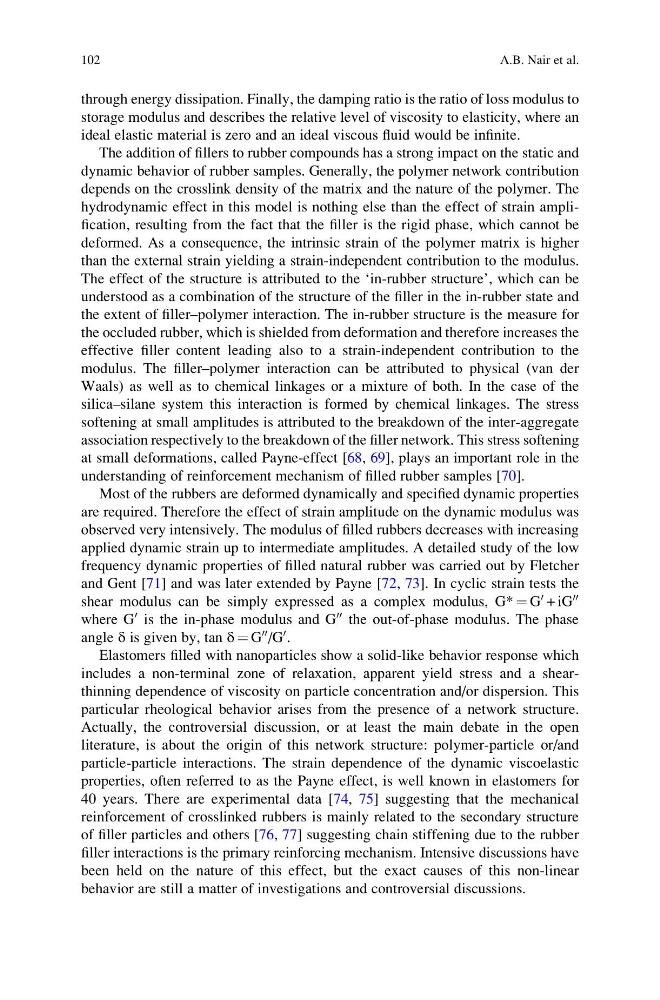
shear modulus can be simply expressed as a complex modulus, G* ¼ G
0 + iG
00
where G
0 is the in-phase modulus and G
00 the out-of-phase modulus. The phase
angle δ is given by, tan δ ¼ G
00 /G
0 .
Elastomers filled with nanoparticles show a solid-like behavior response which
includes a non-terminal zone of relaxation, apparent yield stress and a shearthinning dependence of viscosity on particle concentration and/or dispersion. This
particular rheological behavior arises from the presence of a network structure.
Actually, the controversial discussion, or at least the main debate in the open
literature, is about the origin of this network structure: polymer-particle or/and
particle-particle interactions. The strain dependence of the dynamic viscoelastic
properties, often referred to as the Payne effect, is well known in elastomers for
40 years. There are experimental data [74, 75] suggesting that the mechanical
reinforcement of crosslinked rubbers is mainly related to the secondary structure
of filler particles and others [76, 77] suggesting chain stiffening due to the rubber
filler interactions is the primary reinforcing mechanism. Intensive discussions have
been held on the nature of this effect, but the exact causes of this non-linear
behavior are still a matter of investigations and controversial discussions.
102
A.B. Nair et al.
storage modulus and describes the relative level of viscosity to elasticity, where an
ideal elastic material is zero and an ideal viscous fluid would be infinite.
The addition of fillers to rubber compounds has a strong impact on the static and
dynamic behavior of rubber samples. Generally, the polymer network contribution
depends on the crosslink density of the matrix and the nature of the polymer. The
hydrodynamic effect in this model is nothing else than the effect of strain amplification, resulting from the fact that the filler is the rigid phase, which cannot be
deformed. As a consequence, the intrinsic strain of the polymer matrix is higher
than the external strain yielding a strain-independent contribution to the modulus.
The effect of the structure is attributed to the ‘in-rubber structure’, which can be
understood as a combination of the structure of the filler in the in-rubber state and
the extent of filler–polymer interaction. The in-rubber structure is the measure for
the occluded rubber, which is shielded from deformation and therefore increases the
effective filler content leading also to a strain-independent contribution to the
modulus. The filler–polymer interaction can be attributed to physical (van der
Waals) as well as to chemical linkages or a mixture of both. In the case of the
silica–silane system this interaction is formed by chemical linkages. The stress
softening at small amplitudes is attributed to the breakdown of the inter-aggregate
association respectively to the breakdown of the filler network. This stress softening
at small deformations, called Payne-effect [68, 69], plays an important role in the
understanding of reinforcement mechanism of filled rubber samples [70].
Most of the rubbers are deformed dynamically and specified dynamic properties
are required. Therefore the effect of strain amplitude on the dynamic modulus was
observed very intensively. The modulus of filled rubbers decreases with increasing
applied dynamic strain up to intermediate amplitudes. A detailed study of the low
frequency dynamic properties of filled natural rubber was carried out by Fletcher
and Gent [71] and was later extended by Payne [72, 73]. In cyclic strain tests the
shear modulus can be simply expressed as a complex modulus, G* ¼ G
0 + iG
00
where G
0 is the in-phase modulus and G
00 the out-of-phase modulus. The phase
angle δ is given by, tan δ ¼ G
00 /G
0 .
Elastomers filled with nanoparticles show a solid-like behavior response which
includes a non-terminal zone of relaxation, apparent yield stress and a shearthinning dependence of viscosity on particle concentration and/or dispersion. This
particular rheological behavior arises from the presence of a network structure.
Actually, the controversial discussion, or at least the main debate in the open
literature, is about the origin of this network structure: polymer-particle or/and
particle-particle interactions. The strain dependence of the dynamic viscoelastic
properties, often referred to as the Payne effect, is well known in elastomers for
40 years. There are experimental data [74, 75] suggesting that the mechanical
reinforcement of crosslinked rubbers is mainly related to the secondary structure
of filler particles and others [76, 77] suggesting chain stiffening due to the rubber
filler interactions is the primary reinforcing mechanism. Intensive discussions have
been held on the nature of this effect, but the exact causes of this non-linear
behavior are still a matter of investigations and controversial discussions.
102
A.B. Nair et al.