

lower concentrations, the filler-filler interactions influence the material characteristics, as expressed by the Payne effect. Figure 10 illustrates the strain dependence
of the Payne effect and the strain-independent contributions to the shear modulus
for carbon black filled compounds and silica filled compounds.
The main contributions to the complex shear modulus are the hydrodynamic
effect, the polymer network, the filler-polymer and the filler-filler interaction.
The strain-dependent contribution to the modulus is caused by filler-filler interactions. This effect was first brought into focus by Payne, and he interpreted the
sigmoidal decrease of the storage modulus versus the double strain amplitude in
logarithmic scale from a limiting zero-amplitude value to a high amplitude plateau
as the result of the breakage of physical bonds between filler particles, for example
van der Waals or London forces. This effect is largely reversible once the strain is
released and is independent of the type of polymer, but is dependent on the type of
filler. Figure 10 shows the key difference between carbon black and silica. The
Payne-effect is stronger for silica, as a consequence of the strong interparticle
forces between the filler particles.
A most important problem is the dispersibility of the filler particles in the rubber
matrix. An often ignored issue in rubber technology is the surface energy of the
filler particle surface, which is determining the wetting of the filler by the rubber
150
100
50
0
60
40
20
0
0
400
600
100
80
40
30
20
10
0
Filler Content [phr]
Filler Content [phr]
Filler Content [phr]
Filler Content [phr]
Filler Content [phr]
Filler Content [phr]
Tensile strength [MPa]
Hardness [Shore A]
Compound viscosity ML (1+4) [ME]
Compression Set [%]
Abrasion [mm
3
]
Elongation at break [%]
0
500
1000
60
200
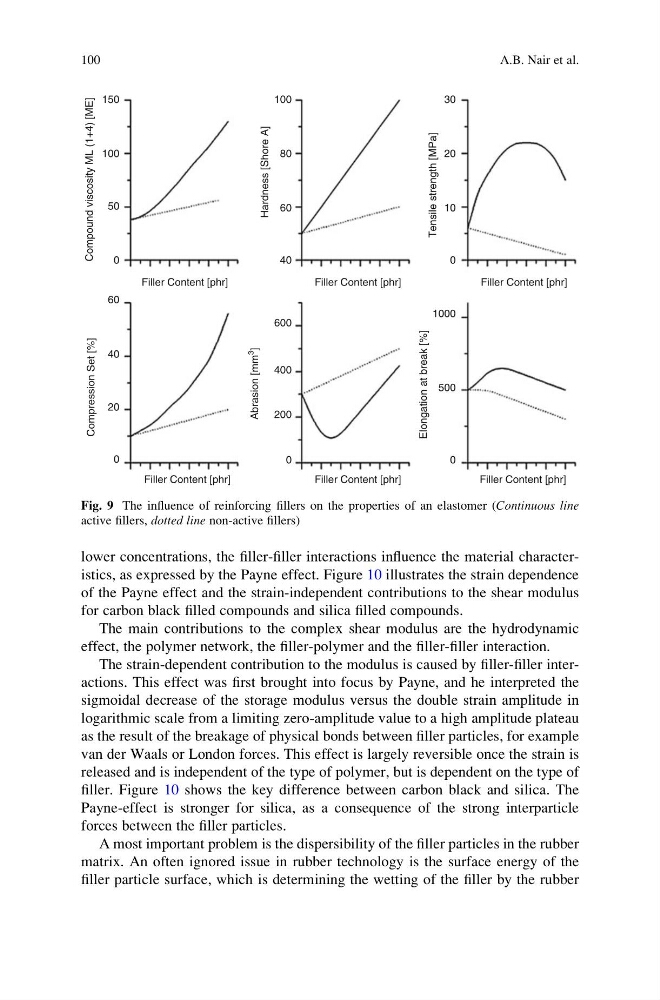
Fig. 9 The influence of reinforcing fillers on the properties of an elastomer (Continuous line
active fillers, dotted line non-active fillers)
100
A.B. Nair et al.
of the Payne effect and the strain-independent contributions to the shear modulus
for carbon black filled compounds and silica filled compounds.
The main contributions to the complex shear modulus are the hydrodynamic
effect, the polymer network, the filler-polymer and the filler-filler interaction.
The strain-dependent contribution to the modulus is caused by filler-filler interactions. This effect was first brought into focus by Payne, and he interpreted the
sigmoidal decrease of the storage modulus versus the double strain amplitude in
logarithmic scale from a limiting zero-amplitude value to a high amplitude plateau
as the result of the breakage of physical bonds between filler particles, for example
van der Waals or London forces. This effect is largely reversible once the strain is
released and is independent of the type of polymer, but is dependent on the type of
filler. Figure 10 shows the key difference between carbon black and silica. The
Payne-effect is stronger for silica, as a consequence of the strong interparticle
forces between the filler particles.
A most important problem is the dispersibility of the filler particles in the rubber
matrix. An often ignored issue in rubber technology is the surface energy of the
filler particle surface, which is determining the wetting of the filler by the rubber
150
100
50
0
60
40
20
0
0
400
600
100
80
40
30
20
10
0
Filler Content [phr]
Filler Content [phr]
Filler Content [phr]
Filler Content [phr]
Filler Content [phr]
Filler Content [phr]
Tensile strength [MPa]
Hardness [Shore A]
Compound viscosity ML (1+4) [ME]
Compression Set [%]
Abrasion [mm
3
]
Elongation at break [%]
0
500
1000
60
200
Fig. 9 The influence of reinforcing fillers on the properties of an elastomer (Continuous line
active fillers, dotted line non-active fillers)
100
A.B. Nair et al.