

homogeneous dispersion of the inorganic fillers inside the polymer matrix plays a
very important role in this area of research. For this purpose, layered silicates and
various other nanoparticles, including magnesium oxide, magnesium hydroxide,
etc., have generally been attempted following the necessary pre-treatment. LDHs
have evolved as a multifunctional material. LDHs possess a high anion exchange
capacity and a large surface area because of their structural configuration, qualifying their use as anionic exchangers. These properties are why these materials are
very useful as adsorbents for ecologically alarming anions that evolve from dilute
aqueous waste streams. Therefore, with the help of LDHs, significant progress has
been made toward removing organic, inorganic and nuclear wastes from contaminated water [59].
2.3.3 Graphene
Graphene, considered as the thinnest material in the Universe, is the mother of all
graphitic materials like graphite, carbon nanotubes and fullerenes. Graphene as
nanofiller has tremendous potential applications owing to its high surface area,
aspect ratio, tensile strength, EMI shielding, thermal and electrical conductivity
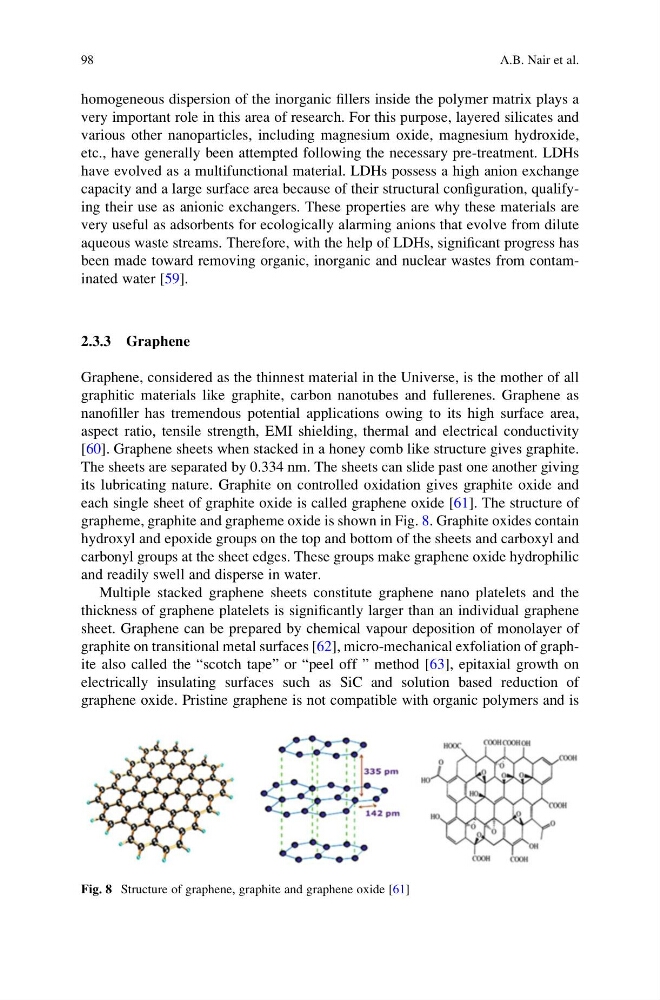
[60]. Graphene sheets when stacked in a honey comb like structure gives graphite.
The sheets are separated by 0.334 nm. The sheets can slide past one another giving
its lubricating nature. Graphite on controlled oxidation gives graphite oxide and
each single sheet of graphite oxide is called graphene oxide [61]. The structure of
grapheme, graphite and grapheme oxide is shown in Fig. 8. Graphite oxides contain
hydroxyl and epoxide groups on the top and bottom of the sheets and carboxyl and
carbonyl groups at the sheet edges. These groups make graphene oxide hydrophilic
and readily swell and disperse in water.
Multiple stacked graphene sheets constitute graphene nano platelets and the
thickness of graphene platelets is significantly larger than an individual graphene
sheet. Graphene can be prepared by chemical vapour deposition of monolayer of
graphite on transitional metal surfaces [62], micro-mechanical exfoliation of graphite also called the “scotch tape” or “peel off ” method [63], epitaxial growth on
electrically insulating surfaces such as SiC and solution based reduction of
graphene oxide. Pristine graphene is not compatible with organic polymers and is
Fig. 8 Structure of graphene, graphite and graphene oxide [61]
98
A.B. Nair et al.
very important role in this area of research. For this purpose, layered silicates and
various other nanoparticles, including magnesium oxide, magnesium hydroxide,
etc., have generally been attempted following the necessary pre-treatment. LDHs
have evolved as a multifunctional material. LDHs possess a high anion exchange
capacity and a large surface area because of their structural configuration, qualifying their use as anionic exchangers. These properties are why these materials are
very useful as adsorbents for ecologically alarming anions that evolve from dilute
aqueous waste streams. Therefore, with the help of LDHs, significant progress has
been made toward removing organic, inorganic and nuclear wastes from contaminated water [59].
2.3.3 Graphene
Graphene, considered as the thinnest material in the Universe, is the mother of all
graphitic materials like graphite, carbon nanotubes and fullerenes. Graphene as
nanofiller has tremendous potential applications owing to its high surface area,
aspect ratio, tensile strength, EMI shielding, thermal and electrical conductivity
[60]. Graphene sheets when stacked in a honey comb like structure gives graphite.
The sheets are separated by 0.334 nm. The sheets can slide past one another giving
its lubricating nature. Graphite on controlled oxidation gives graphite oxide and
each single sheet of graphite oxide is called graphene oxide [61]. The structure of
grapheme, graphite and grapheme oxide is shown in Fig. 8. Graphite oxides contain
hydroxyl and epoxide groups on the top and bottom of the sheets and carboxyl and
carbonyl groups at the sheet edges. These groups make graphene oxide hydrophilic
and readily swell and disperse in water.
Multiple stacked graphene sheets constitute graphene nano platelets and the
thickness of graphene platelets is significantly larger than an individual graphene
sheet. Graphene can be prepared by chemical vapour deposition of monolayer of
graphite on transitional metal surfaces [62], micro-mechanical exfoliation of graphite also called the “scotch tape” or “peel off ” method [63], epitaxial growth on
electrically insulating surfaces such as SiC and solution based reduction of
graphene oxide. Pristine graphene is not compatible with organic polymers and is
Fig. 8 Structure of graphene, graphite and graphene oxide [61]
98
A.B. Nair et al.