

2.3 Layered (Two Dimensional, 2D) Nanofillers
2.3.1 Nanoclay
Clays are chemically hydrous silicates of Al, Mg, Fe and other less abundant
elements [54]. The most important structural feature of clay mineral is that it is
layered. An enhancement in the properties of the composite is achieved only when
there is a good dispersion of particles in the matrix and there is adequate interaction
between the nanoparticle and the matrix. Montmorillonite and other layered silicates are hydrophilic. To make the hydrophilic layered silicates compatible with the
hydrophobic polymer matrices, they have to be modified. A popular and easy
method of modifying the clay surface is by ion-exchange. Most popular organic
cation used for ion exchanging includes quaternary ammonium salts, alkyl imidazoles and phosphorous ionic compounds. Figure 6 is a schematic representation
showing the hydrolysis of functional silanes and its reaction with OH groups on the
clay surface.
Based on the interaction between the polymer matrix and layered silicate
polymer layered silicate nanocomposites are classified into intercalated and exfoliated nanocomposites [56–58]. Figure 7 represents the intercalated and exfoliated
nanocomposites along with the conventionally filled microcomposite.
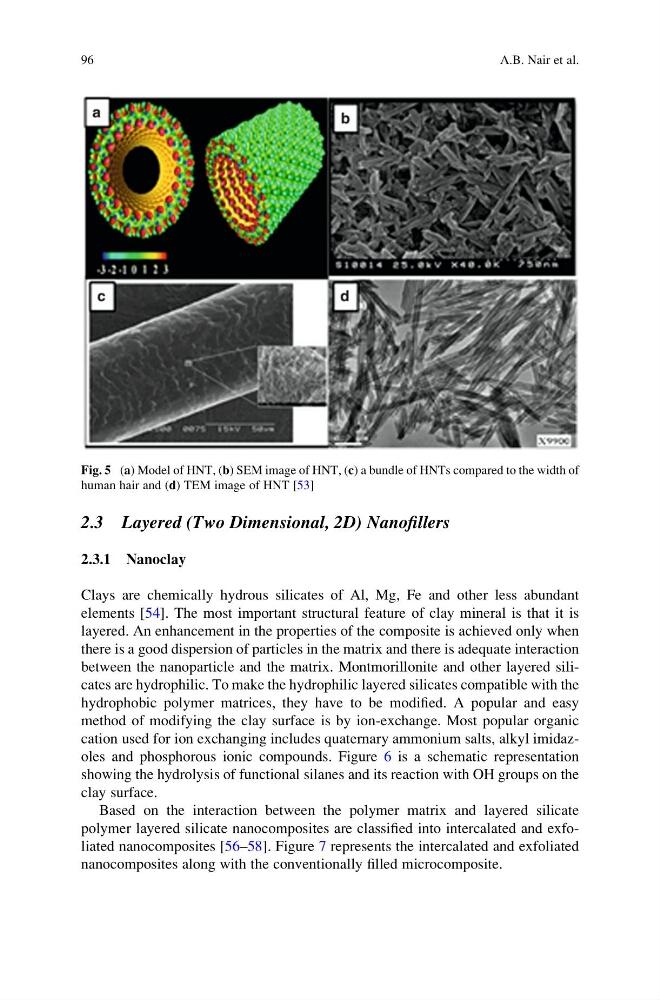
Fig. 5 (a) Model of HNT, (b) SEM image of HNT, (c) a bundle of HNTs compared to the width of
human hair and (d) TEM image of HNT [53]
96
A.B. Nair et al.
2.3.1 Nanoclay
Clays are chemically hydrous silicates of Al, Mg, Fe and other less abundant
elements [54]. The most important structural feature of clay mineral is that it is
layered. An enhancement in the properties of the composite is achieved only when
there is a good dispersion of particles in the matrix and there is adequate interaction
between the nanoparticle and the matrix. Montmorillonite and other layered silicates are hydrophilic. To make the hydrophilic layered silicates compatible with the
hydrophobic polymer matrices, they have to be modified. A popular and easy
method of modifying the clay surface is by ion-exchange. Most popular organic
cation used for ion exchanging includes quaternary ammonium salts, alkyl imidazoles and phosphorous ionic compounds. Figure 6 is a schematic representation
showing the hydrolysis of functional silanes and its reaction with OH groups on the
clay surface.
Based on the interaction between the polymer matrix and layered silicate
polymer layered silicate nanocomposites are classified into intercalated and exfoliated nanocomposites [56–58]. Figure 7 represents the intercalated and exfoliated
nanocomposites along with the conventionally filled microcomposite.
Fig. 5 (a) Model of HNT, (b) SEM image of HNT, (c) a bundle of HNTs compared to the width of
human hair and (d) TEM image of HNT [53]
96
A.B. Nair et al.