

particles size greater than 10,000 nm are therefore generally avoided because they
can reduce performance rather than reinforce or extend. Fillers with particles size
between 1,000 and 10,000 nm are used primarily as diluents and usually have no
significant effect, positive or negative, on rubber properties. Semi-reinforcing filler,
which range from 100 to 1,000 nm, improve strength and modulus properties, the
truly reinforcing fillers, which range 10–100 nm significantly, improve rubber
properties.
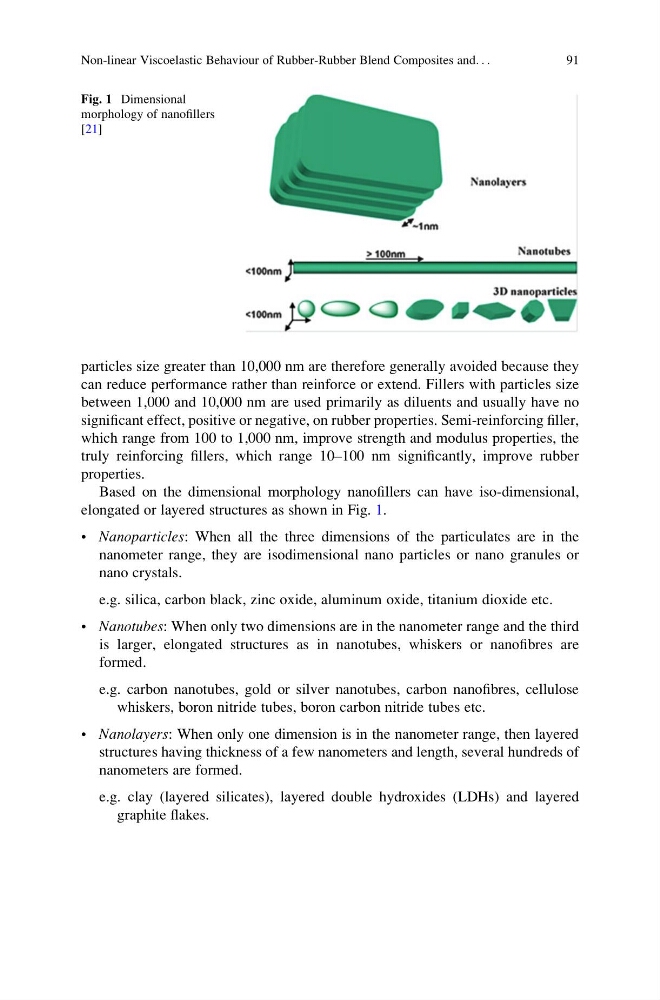
Based on the dimensional morphology nanofillers can have iso-dimensional,
elongated or layered structures as shown in Fig. 1.
• Nanoparticles: When all the three dimensions of the particulates are in the
nanometer range, they are isodimensional nano particles or nano granules or
nano crystals.
e.g. silica, carbon black, zinc oxide, aluminum oxide, titanium dioxide etc.
• Nanotubes: When only two dimensions are in the nanometer range and the third
is larger, elongated structures as in nanotubes, whiskers or nanofibres are
formed.
e.g. carbon nanotubes, gold or silver nanotubes, carbon nanofibres, cellulose
whiskers, boron nitride tubes, boron carbon nitride tubes etc.
• Nanolayers: When only one dimension is in the nanometer range, then layered
structures having thickness of a few nanometers and length, several hundreds of
nanometers are formed.
e.g. clay (layered silicates), layered double hydroxides (LDHs) and layered
graphite flakes.
Fig. 1 Dimensional
morphology of nanofillers
[21]
Non-linear Viscoelastic Behaviour of Rubber-Rubber Blend Composites and. . .
91
can reduce performance rather than reinforce or extend. Fillers with particles size
between 1,000 and 10,000 nm are used primarily as diluents and usually have no
significant effect, positive or negative, on rubber properties. Semi-reinforcing filler,
which range from 100 to 1,000 nm, improve strength and modulus properties, the
truly reinforcing fillers, which range 10–100 nm significantly, improve rubber
properties.
Based on the dimensional morphology nanofillers can have iso-dimensional,
elongated or layered structures as shown in Fig. 1.
• Nanoparticles: When all the three dimensions of the particulates are in the
nanometer range, they are isodimensional nano particles or nano granules or
nano crystals.
e.g. silica, carbon black, zinc oxide, aluminum oxide, titanium dioxide etc.
• Nanotubes: When only two dimensions are in the nanometer range and the third
is larger, elongated structures as in nanotubes, whiskers or nanofibres are
formed.
e.g. carbon nanotubes, gold or silver nanotubes, carbon nanofibres, cellulose
whiskers, boron nitride tubes, boron carbon nitride tubes etc.
• Nanolayers: When only one dimension is in the nanometer range, then layered
structures having thickness of a few nanometers and length, several hundreds of
nanometers are formed.
e.g. clay (layered silicates), layered double hydroxides (LDHs) and layered
graphite flakes.
Fig. 1 Dimensional
morphology of nanofillers
[21]
Non-linear Viscoelastic Behaviour of Rubber-Rubber Blend Composites and. . .
91