

Carbon Footprint Assessment with LCA Methodology
19
sinter production is 220 kg CO 2 equivalent. Similarly, the same sinter production
quantity releases 0.59 kg and 2.02 kg of NOx and SOx, respectively [48].
The emission profile mentioned in the inventory is referred and further stoichiometric calculations have been performed by mass balancing. As previously discussed,
the carbon content of the fuel is solely responsible for generating the of COx emissions. In the experimental part of the study, coke had elemental carbon values of
around 82.44%, which while reacting with the oxygen content of the iron-bearing
phases, releases carbon emissions. If the carbon values are more, the discharge quantity will subsequently be higher. In the present case, coke’s 82.44% carbon releases
around 200 kg of CO 2 and 19.5 kg of CO, per tonne of traditional sinter produced.
On the other hand, raw biomass possesses a relatively lower carbon proportion,
which is around 45.73%. As the carbon proportions are low, their combustion will
deliver a lesser carbon footprint. However, the sole usage of biomass for energy
applications fails to provide the desired energy indices, still getting recommended
for partial substitution. Hence, a partial substitution-based experimental campaign
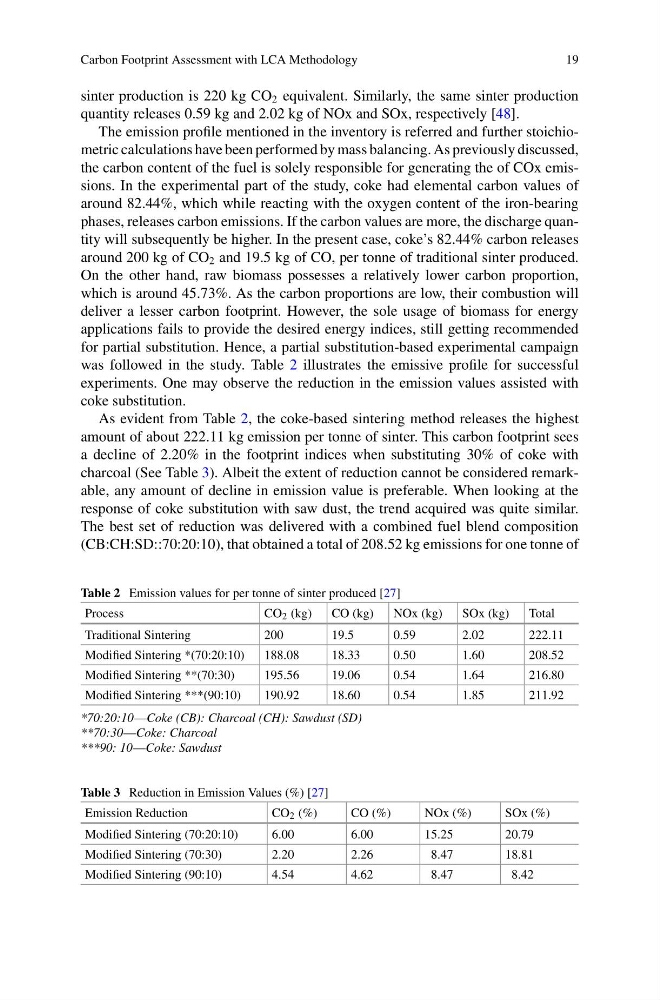
was followed in the study. Table 2 illustrates the emissive profile for successful
experiments. One may observe the reduction in the emission values assisted with
coke substitution.
As evident from Table 2, the coke-based sintering method releases the highest
amount of about 222.11 kg emission per tonne of sinter. This carbon footprint sees
a decline of 2.20% in the footprint indices when substituting 30% of coke with
charcoal (See Table 3). Albeit the extent of reduction cannot be considered remarkable, any amount of decline in emission value is preferable. When looking at the
response of coke substitution with saw dust, the trend acquired was quite similar.
The best set of reduction was delivered with a combined fuel blend composition
(CB:CH:SD::70:20:10), that obtained a total of 208.52 kg emissions for one tonne of
Table 2 Emission values for per tonne of sinter produced [27]
Process
CO 2 (kg)
CO (kg)
NOx (kg)
SOx (kg)
Total
Traditional Sintering
200
19.5
0.59
2.02
222.11
Modified Sintering *(70:20:10)
188.08
18.33
0.50
1.60
208.52
Modified Sintering **(70:30)
195.56
19.06
0.54
1.64
216.80
Modified Sintering ***(90:10)
190.92
18.60
0.54
1.85
211.92
*70:20:10—Coke (CB): Charcoal (CH): Sawdust (SD)
**70:30—Coke: Charcoal
***90: 10—Coke: Sawdust
Table 3 Reduction in Emission Values (%) [27]
Emission Reduction
CO 2 (%)
CO (%)
NOx (%)
SOx (%)
Modified Sintering (70:20:10)
6.00
6.00
15.25
20.79
Modified Sintering (70:30)
2.20
2.26
8.47
18.81
Modified Sintering (90:10)
4.54
4.62
8.47
8.42
19
sinter production is 220 kg CO 2 equivalent. Similarly, the same sinter production
quantity releases 0.59 kg and 2.02 kg of NOx and SOx, respectively [48].
The emission profile mentioned in the inventory is referred and further stoichiometric calculations have been performed by mass balancing. As previously discussed,
the carbon content of the fuel is solely responsible for generating the of COx emissions. In the experimental part of the study, coke had elemental carbon values of
around 82.44%, which while reacting with the oxygen content of the iron-bearing
phases, releases carbon emissions. If the carbon values are more, the discharge quantity will subsequently be higher. In the present case, coke’s 82.44% carbon releases
around 200 kg of CO 2 and 19.5 kg of CO, per tonne of traditional sinter produced.
On the other hand, raw biomass possesses a relatively lower carbon proportion,
which is around 45.73%. As the carbon proportions are low, their combustion will
deliver a lesser carbon footprint. However, the sole usage of biomass for energy
applications fails to provide the desired energy indices, still getting recommended
for partial substitution. Hence, a partial substitution-based experimental campaign
was followed in the study. Table 2 illustrates the emissive profile for successful
experiments. One may observe the reduction in the emission values assisted with
coke substitution.
As evident from Table 2, the coke-based sintering method releases the highest
amount of about 222.11 kg emission per tonne of sinter. This carbon footprint sees
a decline of 2.20% in the footprint indices when substituting 30% of coke with
charcoal (See Table 3). Albeit the extent of reduction cannot be considered remarkable, any amount of decline in emission value is preferable. When looking at the
response of coke substitution with saw dust, the trend acquired was quite similar.
The best set of reduction was delivered with a combined fuel blend composition
(CB:CH:SD::70:20:10), that obtained a total of 208.52 kg emissions for one tonne of
Table 2 Emission values for per tonne of sinter produced [27]
Process
CO 2 (kg)
CO (kg)
NOx (kg)
SOx (kg)
Total
Traditional Sintering
200
19.5
0.59
2.02
222.11
Modified Sintering *(70:20:10)
188.08
18.33
0.50
1.60
208.52
Modified Sintering **(70:30)
195.56
19.06
0.54
1.64
216.80
Modified Sintering ***(90:10)
190.92
18.60
0.54
1.85
211.92
*70:20:10—Coke (CB): Charcoal (CH): Sawdust (SD)
**70:30—Coke: Charcoal
***90: 10—Coke: Sawdust
Table 3 Reduction in Emission Values (%) [27]
Emission Reduction
CO 2 (%)
CO (%)
NOx (%)
SOx (%)
Modified Sintering (70:20:10)
6.00
6.00
15.25
20.79
Modified Sintering (70:30)
2.20
2.26
8.47
18.81
Modified Sintering (90:10)
4.54
4.62
8.47
8.42