

18
G. Jha et al.
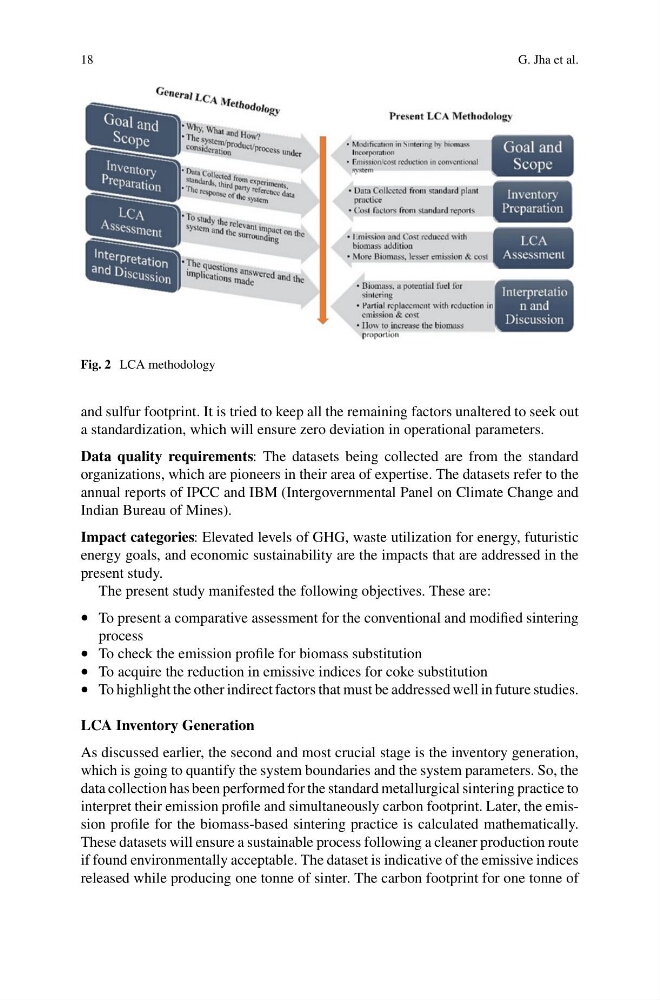
Fig. 2 LCA methodology
and sulfur footprint. It is tried to keep all the remaining factors unaltered to seek out
a standardization, which will ensure zero deviation in operational parameters.
Data quality requirements: The datasets being collected are from the standard
organizations, which are pioneers in their area of expertise. The datasets refer to the
annual reports of IPCC and IBM (Intergovernmental Panel on Climate Change and
Indian Bureau of Mines).
Impact categories: Elevated levels of GHG, waste utilization for energy, futuristic
energy goals, and economic sustainability are the impacts that are addressed in the
present study.
The present study manifested the following objectives. These are:
• To present a comparative assessment for the conventional and modified sintering
process
• To check the emission profile for biomass substitution
• To acquire the reduction in emissive indices for coke substitution
• To highlight the other indirect factors that must be addressed well in future studies.
LCA Inventory Generation
As discussed earlier, the second and most crucial stage is the inventory generation,
which is going to quantify the system boundaries and the system parameters. So, the
data collection has been performed for the standard metallurgical sintering practice to
interpret their emission profile and simultaneously carbon footprint. Later, the emission profile for the biomass-based sintering practice is calculated mathematically.
These datasets will ensure a sustainable process following a cleaner production route
if found environmentally acceptable. The dataset is indicative of the emissive indices
released while producing one tonne of sinter. The carbon footprint for one tonne of
G. Jha et al.
Fig. 2 LCA methodology
and sulfur footprint. It is tried to keep all the remaining factors unaltered to seek out
a standardization, which will ensure zero deviation in operational parameters.
Data quality requirements: The datasets being collected are from the standard
organizations, which are pioneers in their area of expertise. The datasets refer to the
annual reports of IPCC and IBM (Intergovernmental Panel on Climate Change and
Indian Bureau of Mines).
Impact categories: Elevated levels of GHG, waste utilization for energy, futuristic
energy goals, and economic sustainability are the impacts that are addressed in the
present study.
The present study manifested the following objectives. These are:
• To present a comparative assessment for the conventional and modified sintering
process
• To check the emission profile for biomass substitution
• To acquire the reduction in emissive indices for coke substitution
• To highlight the other indirect factors that must be addressed well in future studies.
LCA Inventory Generation
As discussed earlier, the second and most crucial stage is the inventory generation,
which is going to quantify the system boundaries and the system parameters. So, the
data collection has been performed for the standard metallurgical sintering practice to
interpret their emission profile and simultaneously carbon footprint. Later, the emission profile for the biomass-based sintering practice is calculated mathematically.
These datasets will ensure a sustainable process following a cleaner production route
if found environmentally acceptable. The dataset is indicative of the emissive indices
released while producing one tonne of sinter. The carbon footprint for one tonne of