

4
G. Jha et al.
27.2
15.6
6.3
4.6
3.9
2.3
1.8
1.7
1.7
1.5
33.4
Share of Carbon Footprint (%)
China
USA
India
Russia
Japan
Germany
Mexico
South Korea
UK
Brazil
Rest of the world
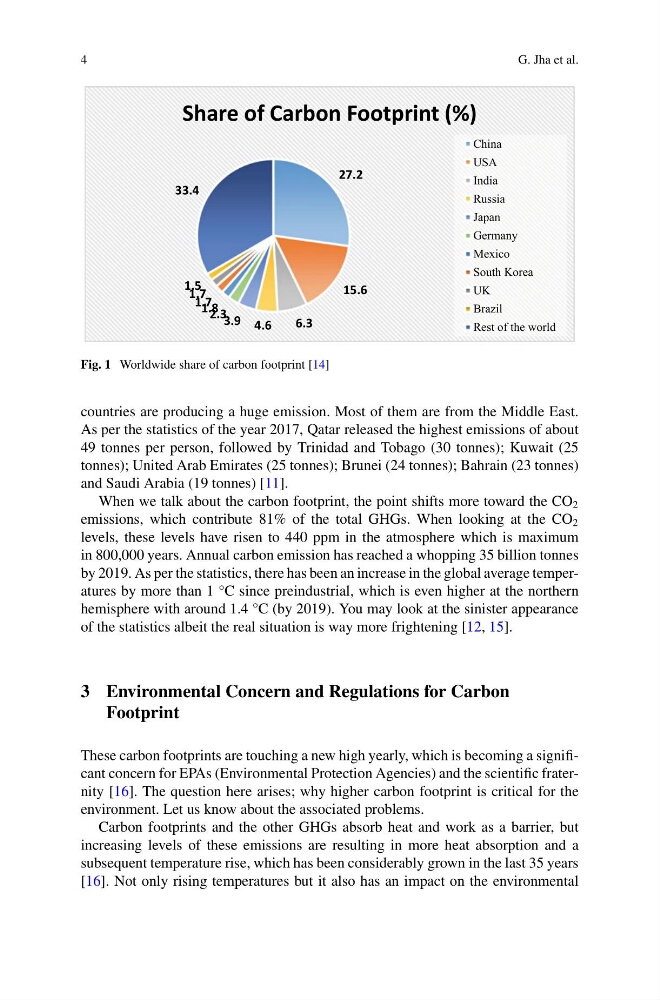
Fig. 1 Worldwide share of carbon footprint [14]
countries are producing a huge emission. Most of them are from the Middle East.
As per the statistics of the year 2017, Qatar released the highest emissions of about
49 tonnes per person, followed by Trinidad and Tobago (30 tonnes); Kuwait (25
tonnes); United Arab Emirates (25 tonnes); Brunei (24 tonnes); Bahrain (23 tonnes)
and Saudi Arabia (19 tonnes) [11].
When we talk about the carbon footprint, the point shifts more toward the CO 2
emissions, which contribute 81% of the total GHGs. When looking at the CO 2
levels, these levels have risen to 440 ppm in the atmosphere which is maximum
in 800,000 years. Annual carbon emission has reached a whopping 35 billion tonnes
by 2019. As per the statistics, there has been an increase in the global average temperatures by more than 1 °C since preindustrial, which is even higher at the northern
hemisphere with around 1.4 °C (by 2019). You may look at the sinister appearance
of the statistics albeit the real situation is way more frightening [12, 15].
3 Environmental Concern and Regulations for Carbon
Footprint
These carbon footprints are touching a new high yearly, which is becoming a significant concern for EPAs (Environmental Protection Agencies) and the scientific fraternity [16]. The question here arises; why higher carbon footprint is critical for the
environment. Let us know about the associated problems.
Carbon footprints and the other GHGs absorb heat and work as a barrier, but
increasing levels of these emissions are resulting in more heat absorption and a
subsequent temperature rise, which has been considerably grown in the last 35 years
[16]. Not only rising temperatures but it also has an impact on the environmental
G. Jha et al.
27.2
15.6
6.3
4.6
3.9
2.3
1.8
1.7
1.7
1.5
33.4
Share of Carbon Footprint (%)
China
USA
India
Russia
Japan
Germany
Mexico
South Korea
UK
Brazil
Rest of the world
Fig. 1 Worldwide share of carbon footprint [14]
countries are producing a huge emission. Most of them are from the Middle East.
As per the statistics of the year 2017, Qatar released the highest emissions of about
49 tonnes per person, followed by Trinidad and Tobago (30 tonnes); Kuwait (25
tonnes); United Arab Emirates (25 tonnes); Brunei (24 tonnes); Bahrain (23 tonnes)
and Saudi Arabia (19 tonnes) [11].
When we talk about the carbon footprint, the point shifts more toward the CO 2
emissions, which contribute 81% of the total GHGs. When looking at the CO 2
levels, these levels have risen to 440 ppm in the atmosphere which is maximum
in 800,000 years. Annual carbon emission has reached a whopping 35 billion tonnes
by 2019. As per the statistics, there has been an increase in the global average temperatures by more than 1 °C since preindustrial, which is even higher at the northern
hemisphere with around 1.4 °C (by 2019). You may look at the sinister appearance
of the statistics albeit the real situation is way more frightening [12, 15].
3 Environmental Concern and Regulations for Carbon
Footprint
These carbon footprints are touching a new high yearly, which is becoming a significant concern for EPAs (Environmental Protection Agencies) and the scientific fraternity [16]. The question here arises; why higher carbon footprint is critical for the
environment. Let us know about the associated problems.
Carbon footprints and the other GHGs absorb heat and work as a barrier, but
increasing levels of these emissions are resulting in more heat absorption and a
subsequent temperature rise, which has been considerably grown in the last 35 years
[16]. Not only rising temperatures but it also has an impact on the environmental