

showed that α-La self-assembles into long and tubular strands of 20 nm in diameter
upon limited proteolysis by a specific serine protease. The nanotube structure of
these tubular strands was further described in detail a few years later [1]. These
authors showed that the formation of nanotubes from hydrolysed α-La requires the
control of protein concentration, presence and concentration of specific divalent
cations such as calcium and hydrolysis conditions (for details see [2]). The presence
of a small percentage of other proteins as well as the use of certain divalent cations
such as magnesium inhibit the self-assembly process into nanotubes and lead
instead to random aggregates [2]. These nanotube structures are described to be
stable towards processing and could, for example, withstand conditions similar to
pasteurisation. Consequently, they exhibit some interesting futures for food and
non-food applications. As an example, because of their linearity, these nanotubes
form strong gels with a high storage modulus, even at a weight protein fraction as
low as 3% [1]. The reversibility and disassembly properties of these nanotubes
provide other potential applications such as encapsulation and controlled release of
nutritional and bioactive components [2].
4 Spontaneous Assemblies of Food Proteins
For self-assembly, proteins have to diffuse in the medium and establish specific
and/or non-specific interactions when meeting a counterpart. Interactions occur
through the protein surface (absence of denaturation step) and protein–protein
interactions are mainly of low energy, i.e. non-covalent (electrostatic interactions,
van der Waals bonds, hydrogen bonds, salt bridges). Protein–protein interaction
energy is only slightly higher than thermal energy kT (with k is the Boltzmann
constant and T the temperature), enabling the proteins to rearrange locally with
each other for adoption of preferential orientations. In the later stages, minimisation
of the free energy of the protein aggregates drives the assembly to ordered
supramolecular structures [110]; this mainly involves the surface energy of the
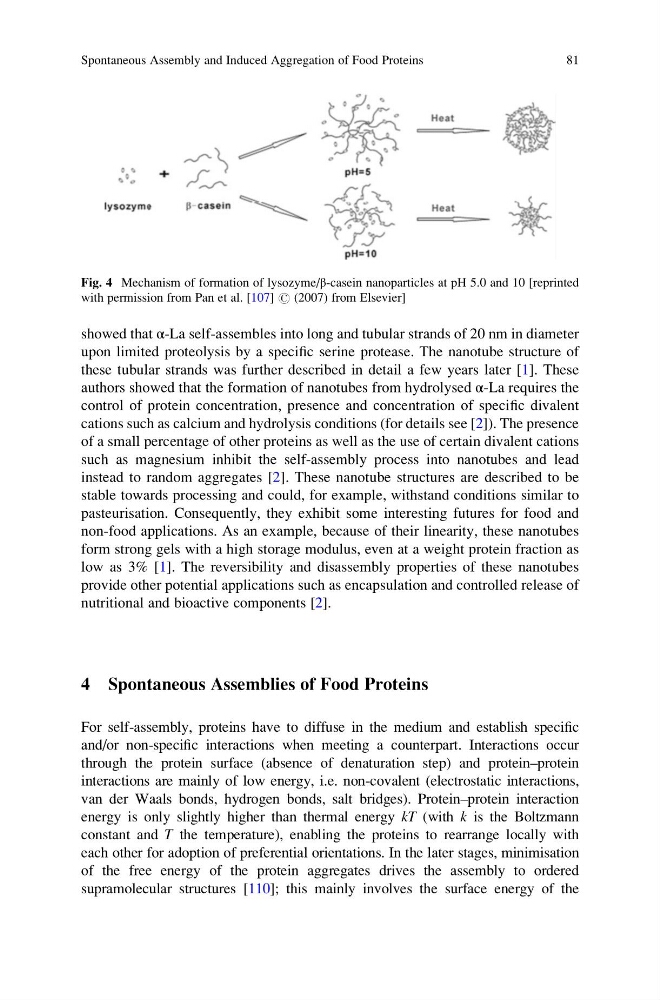
Fig. 4 Mechanism of formation of lysozyme/β-casein nanoparticles at pH 5.0 and 10 [reprinted
with permission from Pan et al. [107] # (2007) from Elsevier]
Spontaneous Assembly and Induced Aggregation of Food Proteins
81
upon limited proteolysis by a specific serine protease. The nanotube structure of
these tubular strands was further described in detail a few years later [1]. These
authors showed that the formation of nanotubes from hydrolysed α-La requires the
control of protein concentration, presence and concentration of specific divalent
cations such as calcium and hydrolysis conditions (for details see [2]). The presence
of a small percentage of other proteins as well as the use of certain divalent cations
such as magnesium inhibit the self-assembly process into nanotubes and lead
instead to random aggregates [2]. These nanotube structures are described to be
stable towards processing and could, for example, withstand conditions similar to
pasteurisation. Consequently, they exhibit some interesting futures for food and
non-food applications. As an example, because of their linearity, these nanotubes
form strong gels with a high storage modulus, even at a weight protein fraction as
low as 3% [1]. The reversibility and disassembly properties of these nanotubes
provide other potential applications such as encapsulation and controlled release of
nutritional and bioactive components [2].
4 Spontaneous Assemblies of Food Proteins
For self-assembly, proteins have to diffuse in the medium and establish specific
and/or non-specific interactions when meeting a counterpart. Interactions occur
through the protein surface (absence of denaturation step) and protein–protein
interactions are mainly of low energy, i.e. non-covalent (electrostatic interactions,
van der Waals bonds, hydrogen bonds, salt bridges). Protein–protein interaction
energy is only slightly higher than thermal energy kT (with k is the Boltzmann
constant and T the temperature), enabling the proteins to rearrange locally with
each other for adoption of preferential orientations. In the later stages, minimisation
of the free energy of the protein aggregates drives the assembly to ordered
supramolecular structures [110]; this mainly involves the surface energy of the
Fig. 4 Mechanism of formation of lysozyme/β-casein nanoparticles at pH 5.0 and 10 [reprinted
with permission from Pan et al. [107] # (2007) from Elsevier]
Spontaneous Assembly and Induced Aggregation of Food Proteins
81