

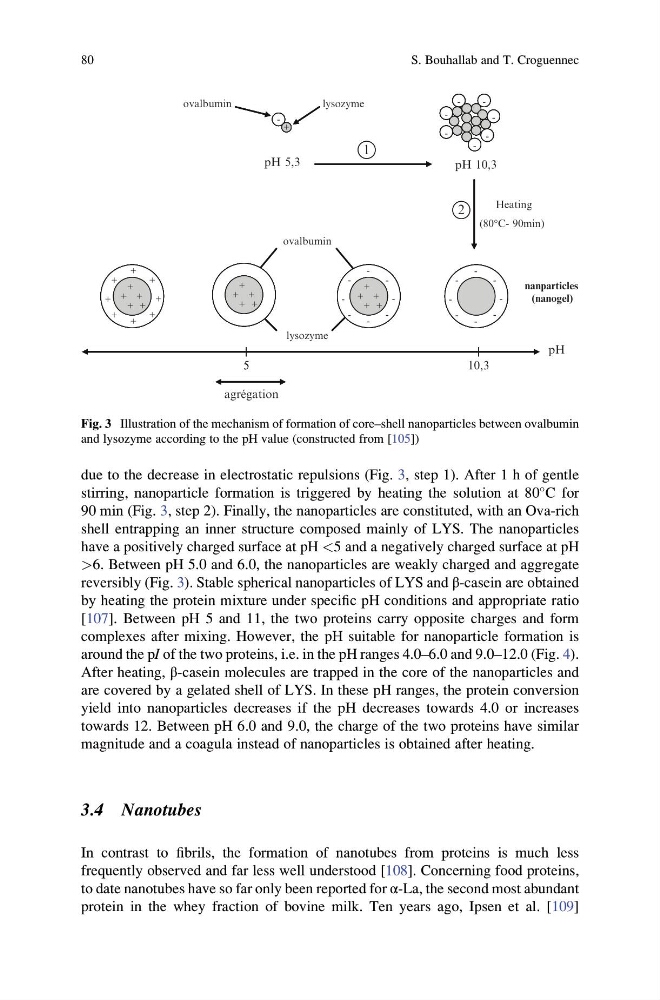
due to the decrease in electrostatic repulsions (Fig. 3, step 1). After 1 h of gentle
stirring, nanoparticle formation is triggered by heating the solution at 80
C for
90 min (Fig. 3, step 2). Finally, the nanoparticles are constituted, with an Ova-rich
shell entrapping an inner structure composed mainly of LYS. The nanoparticles
have a positively charged surface at pH <5 and a negatively charged surface at pH
>6. Between pH 5.0 and 6.0, the nanoparticles are weakly charged and aggregate
reversibly (Fig. 3). Stable spherical nanoparticles of LYS and β-casein are obtained
by heating the protein mixture under specific pH conditions and appropriate ratio
[107]. Between pH 5 and 11, the two proteins carry opposite charges and form
complexes after mixing. However, the pH suitable for nanoparticle formation is
around the pI of the two proteins, i.e. in the pH ranges 4.0–6.0 and 9.0–12.0 (Fig. 4).
After heating, β-casein molecules are trapped in the core of the nanoparticles and
are covered by a gelated shell of LYS. In these pH ranges, the protein conversion
yield into nanoparticles decreases if the pH decreases towards 4.0 or increases
towards 12. Between pH 6.0 and 9.0, the charge of the two proteins have similar
magnitude and a coagula instead of nanoparticles is obtained after heating.
3.4 Nanotubes
In contrast to fibrils, the formation of nanotubes from proteins is much less
frequently observed and far less well understood [108]. Concerning food proteins,
to date nanotubes have so far only been reported for α-La, the second most abundant
protein in the whey fraction of bovine milk. Ten years ago, Ipsen et al. [109]
pH 5,3
pH 10,3
(nanogel)
pH
5
1 0 , 3
1
2
agrégation
-
+
-
+
-
-
-
-
-
-
-
- -
-
-
-
-
-
-
-
-
-
-
-
-
-
-
-
-
-
-
-
-
-
-
-
-
-
-
-
-
-
-
+
+
+
+
+
-
-
-
-
-
-
-
-
+
+
+
+
+
+
+
+
+
+
+
+
+
+
+
+
+
+
+
+
+
+
+
+
+
+
+
+
+
+
+
+
+
+
+
+
+
+
+
+
+
(80°C- 90min)
Heating
nanparticles
5
1
2
ovalbumin
lysozyme
ovalbumin
lysozyme
-
+
-
+
-
+
-
+
-
-
-
-
-
-
-
- -
-
-
-
-
-
-
- -
-
-
-
-
-
-
- -
-
-
-
-
-
-
-
-
-
-
-
-
-
-
-
-
-
-
-
-
-
-
-
-
-
-
-
-
-
-
-
-
-
-
-
-
-
-
-
-
-
-
-
-
-
-
+
+
+
+
+
-
-
-
-
-
-
-
-
+
+
+
+
+
-
-
-
-
-
-
-
-
+
+
+
+
+
-
-
-
-
-
-
-
-
+
+
+
+
+
+
+
+
+
+
+
+
+
+
+
+
+
+
+
+
+
+
+
+
+
+
+
+
+
+
+
+
+
+
+
+
+
+
+
+
+
+
+
+
+
+
+
+
+
+
+
+
+
+
+
+
+
+
+
+
+
+
+
+
+
+
+
+
+
+
+
+
+
+
+
+
+
Fig. 3 Illustration of the mechanism of formation of core–shell nanoparticles between ovalbumin
and lysozyme according to the pH value (constructed from [105])
80
S. Bouhallab and T. Croguennec
stirring, nanoparticle formation is triggered by heating the solution at 80
C for
90 min (Fig. 3, step 2). Finally, the nanoparticles are constituted, with an Ova-rich
shell entrapping an inner structure composed mainly of LYS. The nanoparticles
have a positively charged surface at pH <5 and a negatively charged surface at pH
>6. Between pH 5.0 and 6.0, the nanoparticles are weakly charged and aggregate
reversibly (Fig. 3). Stable spherical nanoparticles of LYS and β-casein are obtained
by heating the protein mixture under specific pH conditions and appropriate ratio
[107]. Between pH 5 and 11, the two proteins carry opposite charges and form
complexes after mixing. However, the pH suitable for nanoparticle formation is
around the pI of the two proteins, i.e. in the pH ranges 4.0–6.0 and 9.0–12.0 (Fig. 4).
After heating, β-casein molecules are trapped in the core of the nanoparticles and
are covered by a gelated shell of LYS. In these pH ranges, the protein conversion
yield into nanoparticles decreases if the pH decreases towards 4.0 or increases
towards 12. Between pH 6.0 and 9.0, the charge of the two proteins have similar
magnitude and a coagula instead of nanoparticles is obtained after heating.
3.4 Nanotubes
In contrast to fibrils, the formation of nanotubes from proteins is much less
frequently observed and far less well understood [108]. Concerning food proteins,
to date nanotubes have so far only been reported for α-La, the second most abundant
protein in the whey fraction of bovine milk. Ten years ago, Ipsen et al. [109]
pH 5,3
pH 10,3
(nanogel)
pH
5
1 0 , 3
1
2
agrégation
-
+
-
+
-
-
-
-
-
-
-
- -
-
-
-
-
-
-
-
-
-
-
-
-
-
-
-
-
-
-
-
-
-
-
-
-
-
-
-
-
-
-
+
+
+
+
+
-
-
-
-
-
-
-
-
+
+
+
+
+
+
+
+
+
+
+
+
+
+
+
+
+
+
+
+
+
+
+
+
+
+
+
+
+
+
+
+
+
+
+
+
+
+
+
+
+
(80°C- 90min)
Heating
nanparticles
5
1
2
ovalbumin
lysozyme
ovalbumin
lysozyme
-
+
-
+
-
+
-
+
-
-
-
-
-
-
-
- -
-
-
-
-
-
-
- -
-
-
-
-
-
-
- -
-
-
-
-
-
-
-
-
-
-
-
-
-
-
-
-
-
-
-
-
-
-
-
-
-
-
-
-
-
-
-
-
-
-
-
-
-
-
-
-
-
-
-
-
-
-
+
+
+
+
+
-
-
-
-
-
-
-
-
+
+
+
+
+
-
-
-
-
-
-
-
-
+
+
+
+
+
-
-
-
-
-
-
-
-
+
+
+
+
+
+
+
+
+
+
+
+
+
+
+
+
+
+
+
+
+
+
+
+
+
+
+
+
+
+
+
+
+
+
+
+
+
+
+
+
+
+
+
+
+
+
+
+
+
+
+
+
+
+
+
+
+
+
+
+
+
+
+
+
+
+
+
+
+
+
+
+
+
+
+
+
+
Fig. 3 Illustration of the mechanism of formation of core–shell nanoparticles between ovalbumin
and lysozyme according to the pH value (constructed from [105])
80
S. Bouhallab and T. Croguennec