

ratio significantly influences the properties. Despite the fact that the turbidity
removal is good in most cases, differences in the surface tension were obtained.
The most effective composition (lowest TOC and highest surface tension) was
obtained at a mixing ratio were the system is neutral.
Sticky removal with different natural polymers has been compared [69]. Tailored starches, with benzyl as well as with ethyl substituents, from very low to high
cationic starch density, were investigated as well as benzylated chitosan.
In contrast to previous results [67, 68], the bubble pressure method, a relative
simple and time-saving test method, was used for the dynamic surface tension
measurement [69]. For comparison it was shown that the addition of unmodified
starch did not have any positive influence on sticky removal: neither for decreasing
the turbidity or TOC content, nor for the reduction of surface activity. In contrast,
the interaction between the functionalized starches and DCS, and therefore the
sticky removal, is significantly influenced by the main properties of the modified
starches, i.e., their cationic charge density and their hydrophobicity. As already
described, the stickies were removed due to complex formation between the
tailored modified starch and the colloidal substances in the suspension having
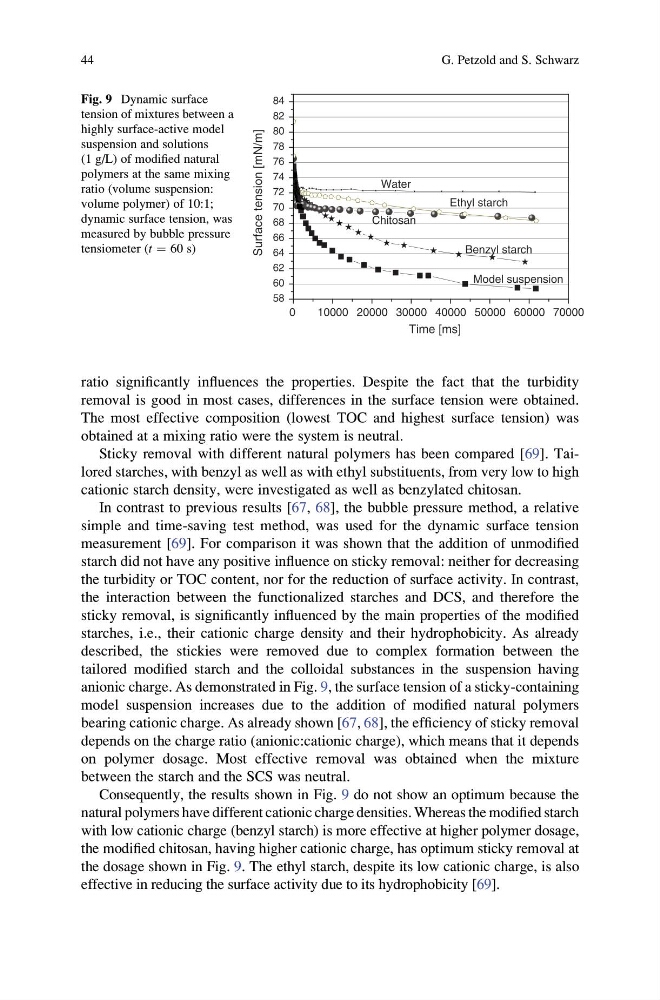
anionic charge. As demonstrated in Fig. 9, the surface tension of a sticky-containing
model suspension increases due to the addition of modified natural polymers
bearing cationic charge. As already shown [67, 68], the efficiency of sticky removal
depends on the charge ratio (anionic:cationic charge), which means that it depends
on polymer dosage. Most effective removal was obtained when the mixture
between the starch and the SCS was neutral.
Consequently, the results shown in Fig. 9 do not show an optimum because the
natural polymers have different cationic charge densities. Whereas the modified starch
with low cationic charge (benzyl starch) is more effective at higher polymer dosage,
the modified chitosan, having higher cationic charge, has optimum sticky removal at
the dosage shown in Fig. 9. The ethyl starch, despite its low cationic charge, is also
effective in reducing the surface activity due to its hydrophobicity [69].
0
10000 20000 30000 40000 50000 60000 70000
58
60
62
64
66
68
70
72
74
76
78
80
82
84
Surface tension [mN/m]
Time [ms]
Model suspension
Benzyl starch
Water
Chitosan
Ethyl starch
Fig. 9 Dynamic surface
tension of mixtures between a
highly surface-active model
suspension and solutions
(1 g/L) of modified natural
polymers at the same mixing
ratio (volume suspension:
volume polymer) of 10:1;
dynamic surface tension, was
measured by bubble pressure
tensiometer (t ¼ 60 s)
44
G. Petzold and S. Schwarz
removal is good in most cases, differences in the surface tension were obtained.
The most effective composition (lowest TOC and highest surface tension) was
obtained at a mixing ratio were the system is neutral.
Sticky removal with different natural polymers has been compared [69]. Tailored starches, with benzyl as well as with ethyl substituents, from very low to high
cationic starch density, were investigated as well as benzylated chitosan.
In contrast to previous results [67, 68], the bubble pressure method, a relative
simple and time-saving test method, was used for the dynamic surface tension
measurement [69]. For comparison it was shown that the addition of unmodified
starch did not have any positive influence on sticky removal: neither for decreasing
the turbidity or TOC content, nor for the reduction of surface activity. In contrast,
the interaction between the functionalized starches and DCS, and therefore the
sticky removal, is significantly influenced by the main properties of the modified
starches, i.e., their cationic charge density and their hydrophobicity. As already
described, the stickies were removed due to complex formation between the
tailored modified starch and the colloidal substances in the suspension having
anionic charge. As demonstrated in Fig. 9, the surface tension of a sticky-containing
model suspension increases due to the addition of modified natural polymers
bearing cationic charge. As already shown [67, 68], the efficiency of sticky removal
depends on the charge ratio (anionic:cationic charge), which means that it depends
on polymer dosage. Most effective removal was obtained when the mixture
between the starch and the SCS was neutral.
Consequently, the results shown in Fig. 9 do not show an optimum because the
natural polymers have different cationic charge densities. Whereas the modified starch
with low cationic charge (benzyl starch) is more effective at higher polymer dosage,
the modified chitosan, having higher cationic charge, has optimum sticky removal at
the dosage shown in Fig. 9. The ethyl starch, despite its low cationic charge, is also
effective in reducing the surface activity due to its hydrophobicity [69].
0
10000 20000 30000 40000 50000 60000 70000
58
60
62
64
66
68
70
72
74
76
78
80
82
84
Surface tension [mN/m]
Time [ms]
Model suspension
Benzyl starch
Water
Chitosan
Ethyl starch
Fig. 9 Dynamic surface
tension of mixtures between a
highly surface-active model
suspension and solutions
(1 g/L) of modified natural
polymers at the same mixing
ratio (volume suspension:
volume polymer) of 10:1;
dynamic surface tension, was
measured by bubble pressure
tensiometer (t ¼ 60 s)
44
G. Petzold and S. Schwarz