

PDADMAC with commercial cationic starch. The agglomeration of microstickies
with PDADMAC occurred mainly via a charge neutralization mechanism. In contrast,
the agglomeration of microstickies with cationic starch “had a more complicated
behavior” [64].
Luo and Wang [65] prepared highly cationic starches (HCS) with different branching
degrees and molar mass. The DCS controlling effects were investigated using zetapotential, cationic demand, drainage speed, and turbidity. The study indicated that the
degraded linear HCS had better performance in controlling microstickies than the
branched HCS, which had better performance in paper strengthening.
Recently, we have investigated the interaction between tailored cationic starches
wearing hydrophobic groups and model extracts of recycled newspaper and sticky
material [67–69]. The properties of the prepared extracts differed in turbidity, total
organic carbon (TOC), and charge. The surface tension was established as a useful
tool for characterizing the surface activity and, therefore, the sticky content of the
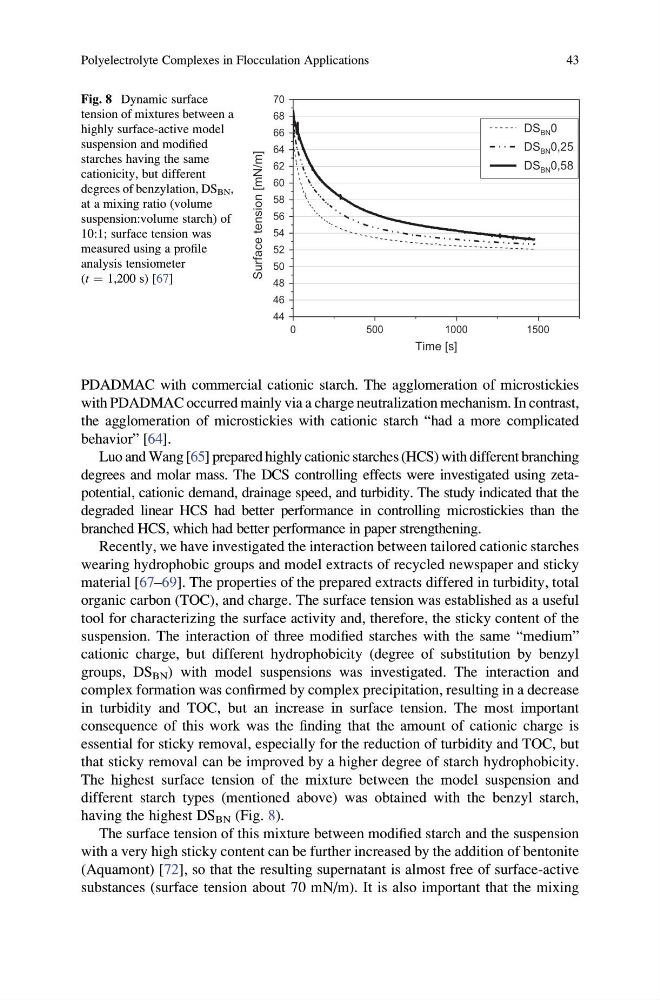
suspension. The interaction of three modified starches with the same “medium”
cationic charge, but different hydrophobicity (degree of substitution by benzyl
groups, DS BN ) with model suspensions was investigated. The interaction and
complex formation was confirmed by complex precipitation, resulting in a decrease
in turbidity and TOC, but an increase in surface tension. The most important
consequence of this work was the finding that the amount of cationic charge is
essential for sticky removal, especially for the reduction of turbidity and TOC, but
that sticky removal can be improved by a higher degree of starch hydrophobicity.
The highest surface tension of the mixture between the model suspension and
different starch types (mentioned above) was obtained with the benzyl starch,
having the highest DS BN (Fig. 8).
The surface tension of this mixture between modified starch and the suspension
with a very high sticky content can be further increased by the addition of bentonite
(Aquamont) [72], so that the resulting supernatant is almost free of surface-active
substances (surface tension about 70 mN/m). It is also important that the mixing
0
500
1000
1500
44
46
48
50
52
54
56
58
60
62
64
66
68
70
Surface tension [mN/m]
Time [s]
DS BN 0
DS BN 0,25
DS BN 0,58
Fig. 8 Dynamic surface
tension of mixtures between a
highly surface-active model
suspension and modified
starches having the same
cationicity, but different
degrees of benzylation, DS BN ,
at a mixing ratio (volume
suspension:volume starch) of
10:1; surface tension was
measured using a profile
analysis tensiometer
(t ¼ 1,200 s) [67]
Polyelectrolyte Complexes in Flocculation Applications
43
with PDADMAC occurred mainly via a charge neutralization mechanism. In contrast,
the agglomeration of microstickies with cationic starch “had a more complicated
behavior” [64].
Luo and Wang [65] prepared highly cationic starches (HCS) with different branching
degrees and molar mass. The DCS controlling effects were investigated using zetapotential, cationic demand, drainage speed, and turbidity. The study indicated that the
degraded linear HCS had better performance in controlling microstickies than the
branched HCS, which had better performance in paper strengthening.
Recently, we have investigated the interaction between tailored cationic starches
wearing hydrophobic groups and model extracts of recycled newspaper and sticky
material [67–69]. The properties of the prepared extracts differed in turbidity, total
organic carbon (TOC), and charge. The surface tension was established as a useful
tool for characterizing the surface activity and, therefore, the sticky content of the
suspension. The interaction of three modified starches with the same “medium”
cationic charge, but different hydrophobicity (degree of substitution by benzyl
groups, DS BN ) with model suspensions was investigated. The interaction and
complex formation was confirmed by complex precipitation, resulting in a decrease
in turbidity and TOC, but an increase in surface tension. The most important
consequence of this work was the finding that the amount of cationic charge is
essential for sticky removal, especially for the reduction of turbidity and TOC, but
that sticky removal can be improved by a higher degree of starch hydrophobicity.
The highest surface tension of the mixture between the model suspension and
different starch types (mentioned above) was obtained with the benzyl starch,
having the highest DS BN (Fig. 8).
The surface tension of this mixture between modified starch and the suspension
with a very high sticky content can be further increased by the addition of bentonite
(Aquamont) [72], so that the resulting supernatant is almost free of surface-active
substances (surface tension about 70 mN/m). It is also important that the mixing
0
500
1000
1500
44
46
48
50
52
54
56
58
60
62
64
66
68
70
Surface tension [mN/m]
Time [s]
DS BN 0
DS BN 0,25
DS BN 0,58
Fig. 8 Dynamic surface
tension of mixtures between a
highly surface-active model
suspension and modified
starches having the same
cationicity, but different
degrees of benzylation, DS BN ,
at a mixing ratio (volume
suspension:volume starch) of
10:1; surface tension was
measured using a profile
analysis tensiometer
(t ¼ 1,200 s) [67]
Polyelectrolyte Complexes in Flocculation Applications
43