

Recently, various drug/PEC particle systems have been reported using synthetic
PEL, with favorable toxicological and biotolerable properties. A combination
of synthetic cationic PDMAEMA and alginic acid (ALG) was used to form
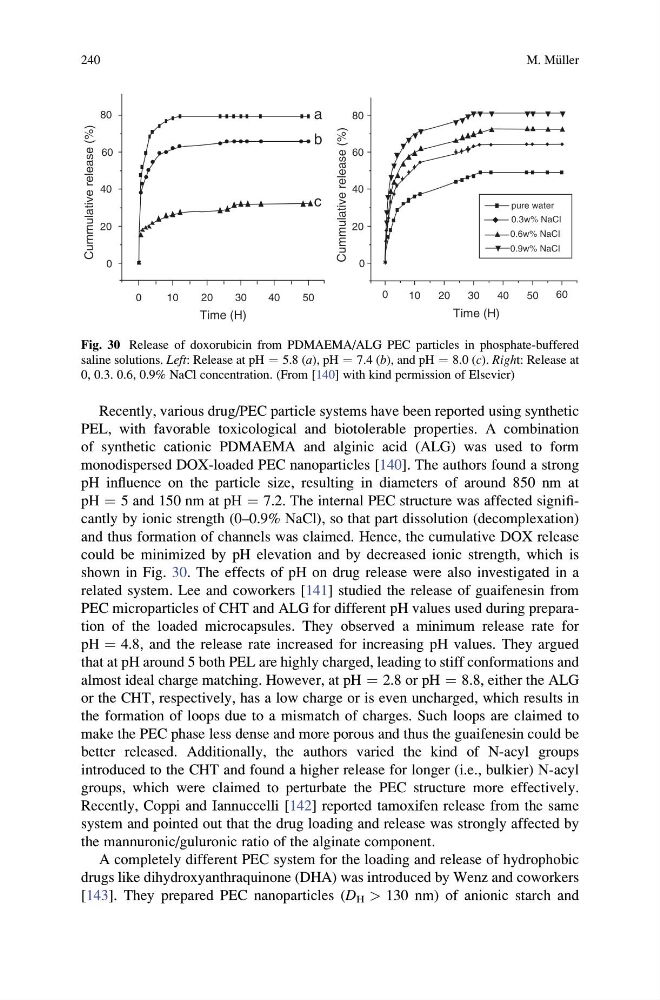
monodispersed DOX-loaded PEC nanoparticles [140]. The authors found a strong
pH influence on the particle size, resulting in diameters of around 850 nm at
pH ¼ 5 and 150 nm at pH ¼ 7.2. The internal PEC structure was affected significantly by ionic strength (0–0.9% NaCl), so that part dissolution (decomplexation)
and thus formation of channels was claimed. Hence, the cumulative DOX release
could be minimized by pH elevation and by decreased ionic strength, which is
shown in Fig. 30. The effects of pH on drug release were also investigated in a
related system. Lee and coworkers [141] studied the release of guaifenesin from
PEC microparticles of CHT and ALG for different pH values used during preparation of the loaded microcapsules. They observed a minimum release rate for
pH ¼ 4.8, and the release rate increased for increasing pH values. They argued
that at pH around 5 both PEL are highly charged, leading to stiff conformations and
almost ideal charge matching. However, at pH ¼ 2.8 or pH ¼ 8.8, either the ALG
or the CHT, respectively, has a low charge or is even uncharged, which results in
the formation of loops due to a mismatch of charges. Such loops are claimed to
make the PEC phase less dense and more porous and thus the guaifenesin could be
better released. Additionally, the authors varied the kind of N-acyl groups
introduced to the CHT and found a higher release for longer (i.e., bulkier) N-acyl
groups, which were claimed to perturbate the PEC structure more effectively.
Recently, Coppi and Iannuccelli [142] reported tamoxifen release from the same
system and pointed out that the drug loading and release was strongly affected by
the mannuronic/guluronic ratio of the alginate component.
A completely different PEC system for the loading and release of hydrophobic
drugs like dihydroxyanthraquinone (DHA) was introduced by Wenz and coworkers
[143]. They prepared PEC nanoparticles (D H > 130 nm) of anionic starch and
0
1 0
2 0
3 0
4 0
5 0
Time (H)
Cummulative release (%)
20
0
40
60
80
Cummulative release (%)
20
0
40
60
80
0
10
20
30
40
50
60
Time (H)
pure water
0.3w% NaCI
0.6w% NaCI
0.9w% NaCI
a
c
b
Fig. 30 Release of doxorubicin from PDMAEMA/ALG PEC particles in phosphate-buffered
saline solutions. Left: Release at pH ¼ 5.8 (a), pH ¼ 7.4 (b), and pH ¼ 8.0 (c). Right: Release at
0, 0.3. 0.6, 0.9% NaCl concentration. (From [140] with kind permission of Elsevier)
240
M. M€ uller
PEL, with favorable toxicological and biotolerable properties. A combination
of synthetic cationic PDMAEMA and alginic acid (ALG) was used to form
monodispersed DOX-loaded PEC nanoparticles [140]. The authors found a strong
pH influence on the particle size, resulting in diameters of around 850 nm at
pH ¼ 5 and 150 nm at pH ¼ 7.2. The internal PEC structure was affected significantly by ionic strength (0–0.9% NaCl), so that part dissolution (decomplexation)
and thus formation of channels was claimed. Hence, the cumulative DOX release
could be minimized by pH elevation and by decreased ionic strength, which is
shown in Fig. 30. The effects of pH on drug release were also investigated in a
related system. Lee and coworkers [141] studied the release of guaifenesin from
PEC microparticles of CHT and ALG for different pH values used during preparation of the loaded microcapsules. They observed a minimum release rate for
pH ¼ 4.8, and the release rate increased for increasing pH values. They argued
that at pH around 5 both PEL are highly charged, leading to stiff conformations and
almost ideal charge matching. However, at pH ¼ 2.8 or pH ¼ 8.8, either the ALG
or the CHT, respectively, has a low charge or is even uncharged, which results in
the formation of loops due to a mismatch of charges. Such loops are claimed to
make the PEC phase less dense and more porous and thus the guaifenesin could be
better released. Additionally, the authors varied the kind of N-acyl groups
introduced to the CHT and found a higher release for longer (i.e., bulkier) N-acyl
groups, which were claimed to perturbate the PEC structure more effectively.
Recently, Coppi and Iannuccelli [142] reported tamoxifen release from the same
system and pointed out that the drug loading and release was strongly affected by
the mannuronic/guluronic ratio of the alginate component.
A completely different PEC system for the loading and release of hydrophobic
drugs like dihydroxyanthraquinone (DHA) was introduced by Wenz and coworkers
[143]. They prepared PEC nanoparticles (D H > 130 nm) of anionic starch and
0
1 0
2 0
3 0
4 0
5 0
Time (H)
Cummulative release (%)
20
0
40
60
80
Cummulative release (%)
20
0
40
60
80
0
10
20
30
40
50
60
Time (H)
pure water
0.3w% NaCI
0.6w% NaCI
0.9w% NaCI
a
c
b
Fig. 30 Release of doxorubicin from PDMAEMA/ALG PEC particles in phosphate-buffered
saline solutions. Left: Release at pH ¼ 5.8 (a), pH ¼ 7.4 (b), and pH ¼ 8.0 (c). Right: Release at
0, 0.3. 0.6, 0.9% NaCl concentration. (From [140] with kind permission of Elsevier)
240
M. M€ uller