

and an initial rapid release followed by a slow release phase was obtained. DOXloaded CHT/DS nanoparticles maintained cytostatic activity relative to free DOX,
whereas DOX/CHT complexes showed reduced activity. Confocal laser scanning
microscopy (CLSM) studies showed that DOX entered the cells while remaining
associated to the nanoparticles and was not released before into the medium.
Recently, a similar PEC/DOX system was reported for osteosarcoma therapy [136].
The same PEC system but loaded with streptomycin, gentamicin, or tobramycin
was recently reported by Popescu and coworkers [137] and tested against mycobacterium tuberculosis in a mouse model. Particle sizes in the nanometer range
were obtained, and release studies showed residual drug amounts of > 60% in the
nanoparticle interior at low acidic pH after 6 h. Oral administration of
streptomycin-loaded particles reduced bacilli growth by a factor of 10, similarly
effective to subcutaneously injected aqueous streptomycin solution at a concentration of 0.1 mg/mL.
Escobar and coworkers reported studies on diltiazem release from CHT/ALG
and CHT/carrageenan complex particles and found that CHT/ALG provided a
prolonged drug release compared to CHT/carrageenan [138]. They argued that
the latter system allowed a higher amount of water to enter the PEC matrix, so
that no regular swelling but disintegration takes place, which liberates the drug
more quickly.
Also related to small drug-loaded PEC particles are the studies of Bohidar et al.
[139] on the entrapment of salbutamol (a bronchodilator) in PEC coacervate
particles (> 400 nm) prepared by mixing anionic and cationic gelatin in the
presence of the drug. They claim that salbutamol release from the coacervate
phase could not be described by known release models because too many factors
prevail, e.g., dissolution, permeation of solvent into the matrix, and non-Fickian
drug diffusion in a crowded environment.
80
120
Percent drug released
0
20
20
40
40
60
60
80
100
0
Time (minutes)
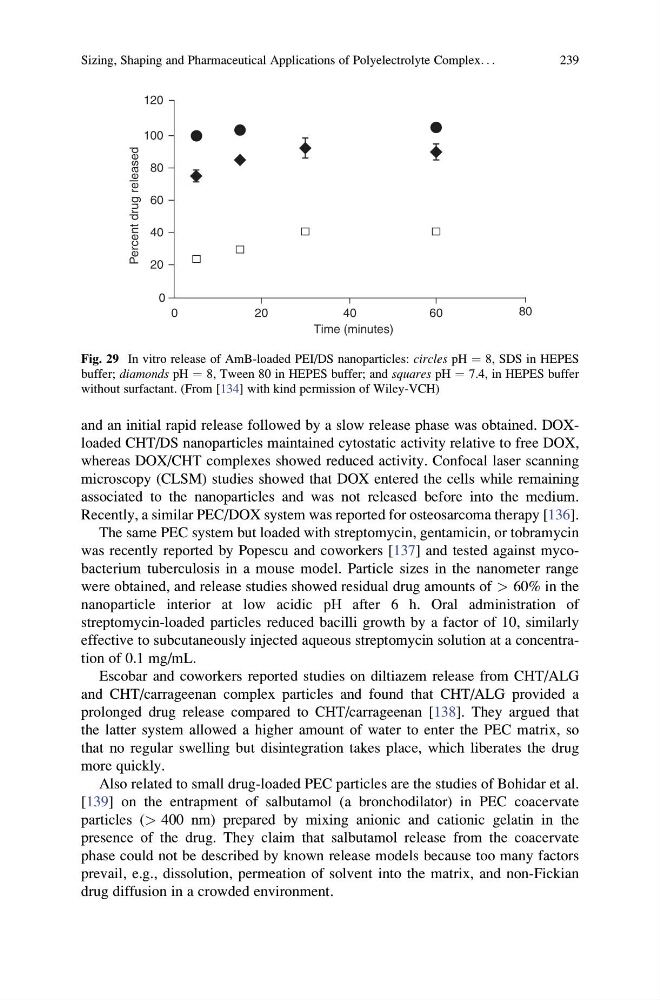
Fig. 29 In vitro release of AmB-loaded PEI/DS nanoparticles: circles pH ¼ 8, SDS in HEPES
buffer; diamonds pH ¼ 8, Tween 80 in HEPES buffer; and squares pH ¼ 7.4, in HEPES buffer
without surfactant. (From [134] with kind permission of Wiley-VCH)
Sizing, Shaping and Pharmaceutical Applications of Polyelectrolyte Complex. . .
239
whereas DOX/CHT complexes showed reduced activity. Confocal laser scanning
microscopy (CLSM) studies showed that DOX entered the cells while remaining
associated to the nanoparticles and was not released before into the medium.
Recently, a similar PEC/DOX system was reported for osteosarcoma therapy [136].
The same PEC system but loaded with streptomycin, gentamicin, or tobramycin
was recently reported by Popescu and coworkers [137] and tested against mycobacterium tuberculosis in a mouse model. Particle sizes in the nanometer range
were obtained, and release studies showed residual drug amounts of > 60% in the
nanoparticle interior at low acidic pH after 6 h. Oral administration of
streptomycin-loaded particles reduced bacilli growth by a factor of 10, similarly
effective to subcutaneously injected aqueous streptomycin solution at a concentration of 0.1 mg/mL.
Escobar and coworkers reported studies on diltiazem release from CHT/ALG
and CHT/carrageenan complex particles and found that CHT/ALG provided a
prolonged drug release compared to CHT/carrageenan [138]. They argued that
the latter system allowed a higher amount of water to enter the PEC matrix, so
that no regular swelling but disintegration takes place, which liberates the drug
more quickly.
Also related to small drug-loaded PEC particles are the studies of Bohidar et al.
[139] on the entrapment of salbutamol (a bronchodilator) in PEC coacervate
particles (> 400 nm) prepared by mixing anionic and cationic gelatin in the
presence of the drug. They claim that salbutamol release from the coacervate
phase could not be described by known release models because too many factors
prevail, e.g., dissolution, permeation of solvent into the matrix, and non-Fickian
drug diffusion in a crowded environment.
80
120
Percent drug released
0
20
20
40
40
60
60
80
100
0
Time (minutes)
Fig. 29 In vitro release of AmB-loaded PEI/DS nanoparticles: circles pH ¼ 8, SDS in HEPES
buffer; diamonds pH ¼ 8, Tween 80 in HEPES buffer; and squares pH ¼ 7.4, in HEPES buffer
without surfactant. (From [134] with kind permission of Wiley-VCH)
Sizing, Shaping and Pharmaceutical Applications of Polyelectrolyte Complex. . .
239