

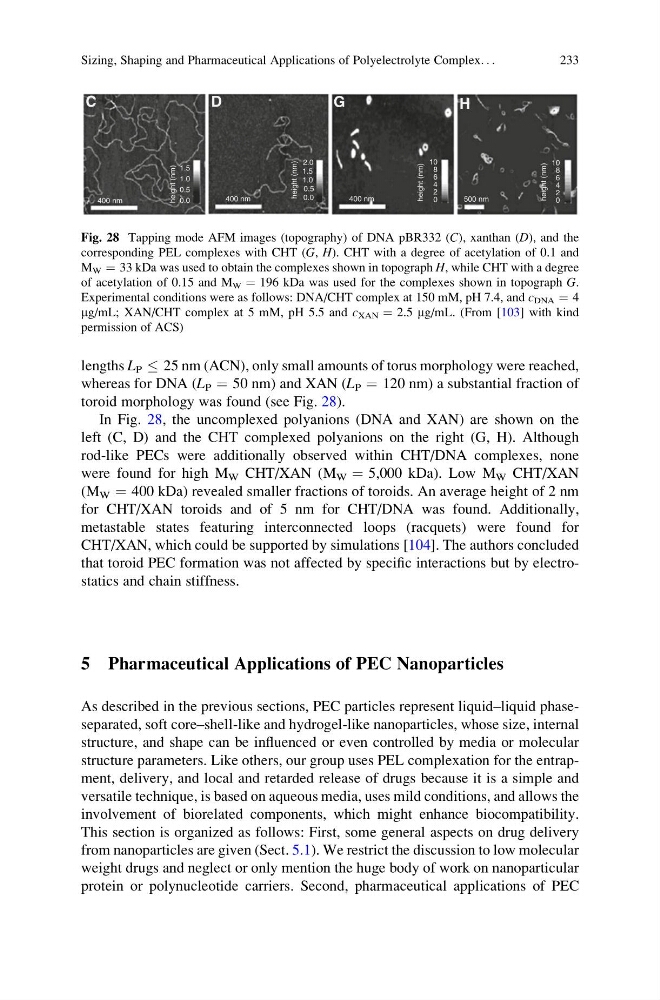
lengths L P 25 nm (ACN), only small amounts of torus morphology were reached,
whereas for DNA (L P ¼ 50 nm) and XAN (L P ¼ 120 nm) a substantial fraction of
toroid morphology was found (see Fig. 28).
In Fig. 28, the uncomplexed polyanions (DNA and XAN) are shown on the
left (C, D) and the CHT complexed polyanions on the right (G, H). Although
rod-like PECs were additionally observed within CHT/DNA complexes, none
were found for high M W CHT/XAN (M W ¼ 5,000 kDa). Low M W CHT/XAN
(M W ¼ 400 kDa) revealed smaller fractions of toroids. An average height of 2 nm
for CHT/XAN toroids and of 5 nm for CHT/DNA was found. Additionally,
metastable states featuring interconnected loops (racquets) were found for
CHT/XAN, which could be supported by simulations [104]. The authors concluded
that toroid PEC formation was not affected by specific interactions but by electrostatics and chain stiffness.
5 Pharmaceutical Applications of PEC Nanoparticles
As described in the previous sections, PEC particles represent liquid–liquid phaseseparated, soft core–shell-like and hydrogel-like nanoparticles, whose size, internal
structure, and shape can be influenced or even controlled by media or molecular
structure parameters. Like others, our group uses PEL complexation for the entrapment, delivery, and local and retarded release of drugs because it is a simple and
versatile technique, is based on aqueous media, uses mild conditions, and allows the
involvement of biorelated components, which might enhance biocompatibility.
This section is organized as follows: First, some general aspects on drug delivery
from nanoparticles are given (Sect. 5.1). We restrict the discussion to low molecular
weight drugs and neglect or only mention the huge body of work on nanoparticular
protein or polynucleotide carriers. Second, pharmaceutical applications of PEC
400 nm
400 nm
500 nm
400 nm
C
D
G
H
height (nm)
height (nm)
height (nm)
height (nm)
1.5
1.0
0.5
0.0
1.5
2.0
1.0
0.5
0.0
8
10
6
4
0
2
8
10
6
4
0
2
Fig. 28 Tapping mode AFM images (topography) of DNA pBR332 (C), xanthan (D), and the
corresponding PEL complexes with CHT (G, H). CHT with a degree of acetylation of 0.1 and
M W ¼ 33 kDa was used to obtain the complexes shown in topograph H, while CHT with a degree
of acetylation of 0.15 and M W ¼ 196 kDa was used for the complexes shown in topograph G.
Experimental conditions were as follows: DNA/CHT complex at 150 mM, pH 7.4, and c DNA ¼ 4
mg/mL; XAN/CHT complex at 5 mM, pH 5.5 and c XAN ¼ 2.5 mg/mL. (From [103] with kind
permission of ACS)
Sizing, Shaping and Pharmaceutical Applications of Polyelectrolyte Complex. . .
233
whereas for DNA (L P ¼ 50 nm) and XAN (L P ¼ 120 nm) a substantial fraction of
toroid morphology was found (see Fig. 28).
In Fig. 28, the uncomplexed polyanions (DNA and XAN) are shown on the
left (C, D) and the CHT complexed polyanions on the right (G, H). Although
rod-like PECs were additionally observed within CHT/DNA complexes, none
were found for high M W CHT/XAN (M W ¼ 5,000 kDa). Low M W CHT/XAN
(M W ¼ 400 kDa) revealed smaller fractions of toroids. An average height of 2 nm
for CHT/XAN toroids and of 5 nm for CHT/DNA was found. Additionally,
metastable states featuring interconnected loops (racquets) were found for
CHT/XAN, which could be supported by simulations [104]. The authors concluded
that toroid PEC formation was not affected by specific interactions but by electrostatics and chain stiffness.
5 Pharmaceutical Applications of PEC Nanoparticles
As described in the previous sections, PEC particles represent liquid–liquid phaseseparated, soft core–shell-like and hydrogel-like nanoparticles, whose size, internal
structure, and shape can be influenced or even controlled by media or molecular
structure parameters. Like others, our group uses PEL complexation for the entrapment, delivery, and local and retarded release of drugs because it is a simple and
versatile technique, is based on aqueous media, uses mild conditions, and allows the
involvement of biorelated components, which might enhance biocompatibility.
This section is organized as follows: First, some general aspects on drug delivery
from nanoparticles are given (Sect. 5.1). We restrict the discussion to low molecular
weight drugs and neglect or only mention the huge body of work on nanoparticular
protein or polynucleotide carriers. Second, pharmaceutical applications of PEC
400 nm
400 nm
500 nm
400 nm
C
D
G
H
height (nm)
height (nm)
height (nm)
height (nm)
1.5
1.0
0.5
0.0
1.5
2.0
1.0
0.5
0.0
8
10
6
4
0
2
8
10
6
4
0
2
Fig. 28 Tapping mode AFM images (topography) of DNA pBR332 (C), xanthan (D), and the
corresponding PEL complexes with CHT (G, H). CHT with a degree of acetylation of 0.1 and
M W ¼ 33 kDa was used to obtain the complexes shown in topograph H, while CHT with a degree
of acetylation of 0.15 and M W ¼ 196 kDa was used for the complexes shown in topograph G.
Experimental conditions were as follows: DNA/CHT complex at 150 mM, pH 7.4, and c DNA ¼ 4
mg/mL; XAN/CHT complex at 5 mM, pH 5.5 and c XAN ¼ 2.5 mg/mL. (From [103] with kind
permission of ACS)
Sizing, Shaping and Pharmaceutical Applications of Polyelectrolyte Complex. . .
233