

chains yielded toroids more frequently than rods, as compared with shorter chains,
but the size of toroids did not depend entirely on the chain length. The authors
concluded that the final structure of the toroids was highly dependent on the
intrinsic chain rigidity rather than on the electrostatic contributions.
Also in this line, Kunze and Netz [102] treated complexation between a stiff
charged cylinder and an oppositely charged semiflexible PEL using linear
Debye–H€ uckel theory, which is valid for weak electrostatic interactions mediated
by high salt concentration or weakly charged PEL. The phase diagram in dependence of salt concentration featured helical wrapping morphologies of the PEL
around the oppositely charged cylinder for lower PEL stiffness. Whereas higher
stiffness of the wrapping PEL resulted in straight wrapping morphologies, i.e., PEL
are adsorbed onto the cylinder and unidirectionally oriented with respect to the
cylinder axis. Moreover, the wrapping/binding process is thought to be associated
with counterion release effects.
4.3 Toroid PEC
As mentioned in the preceding section, PEC particles may also tend to adopt toroid
shapes. Interesting work in this sense was reported by Maurstadt and coworkers
[103]. They investigated morphologies of PEC particles (cast from very diluted
dispersions) consisting of CHT and the semiflexible biopolyanions ALG, acetan
(ACN), circular plasmid DNA, and xanthan (XAN), using AFM and quantitative
image analysis to classify various morphologies due to form factors. For persistence
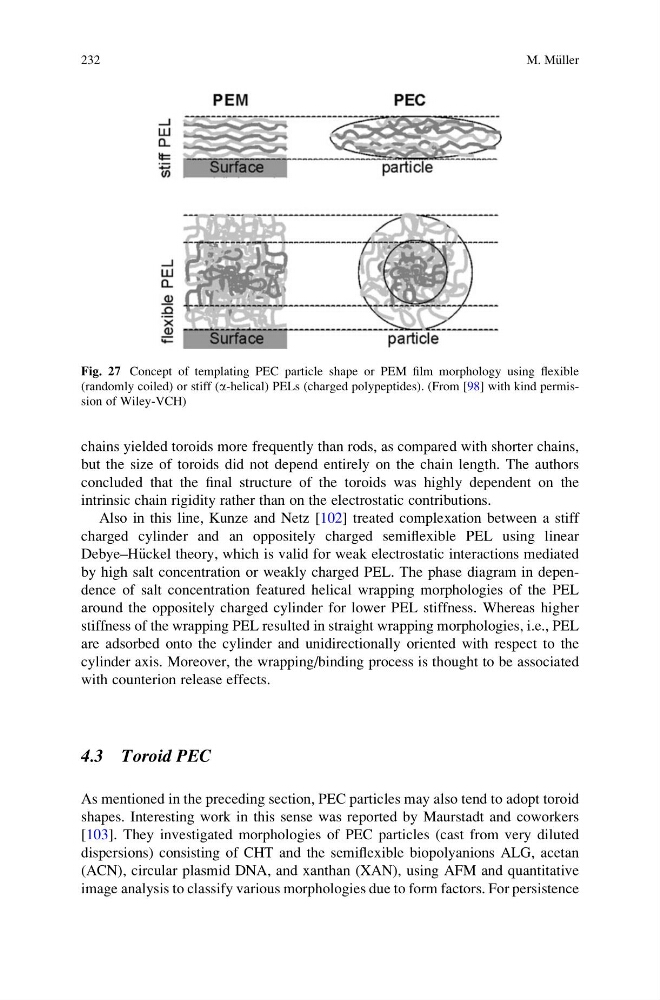
Fig. 27 Concept of templating PEC particle shape or PEM film morphology using flexible
(randomly coiled) or stiff (a-helical) PELs (charged polypeptides). (From [98] with kind permission of Wiley-VCH)
232
M. M€ uller
but the size of toroids did not depend entirely on the chain length. The authors
concluded that the final structure of the toroids was highly dependent on the
intrinsic chain rigidity rather than on the electrostatic contributions.
Also in this line, Kunze and Netz [102] treated complexation between a stiff
charged cylinder and an oppositely charged semiflexible PEL using linear
Debye–H€ uckel theory, which is valid for weak electrostatic interactions mediated
by high salt concentration or weakly charged PEL. The phase diagram in dependence of salt concentration featured helical wrapping morphologies of the PEL
around the oppositely charged cylinder for lower PEL stiffness. Whereas higher
stiffness of the wrapping PEL resulted in straight wrapping morphologies, i.e., PEL
are adsorbed onto the cylinder and unidirectionally oriented with respect to the
cylinder axis. Moreover, the wrapping/binding process is thought to be associated
with counterion release effects.
4.3 Toroid PEC
As mentioned in the preceding section, PEC particles may also tend to adopt toroid
shapes. Interesting work in this sense was reported by Maurstadt and coworkers
[103]. They investigated morphologies of PEC particles (cast from very diluted
dispersions) consisting of CHT and the semiflexible biopolyanions ALG, acetan
(ACN), circular plasmid DNA, and xanthan (XAN), using AFM and quantitative
image analysis to classify various morphologies due to form factors. For persistence
Fig. 27 Concept of templating PEC particle shape or PEM film morphology using flexible
(randomly coiled) or stiff (a-helical) PELs (charged polypeptides). (From [98] with kind permission of Wiley-VCH)
232
M. M€ uller