

In comparable experiments using PDADMAC/poly(maleic acid-co-propylene) at
c PEL ¼ 0.001–0.004 M, Pergushov and Buchhammer found an increase in the hydrodynamic radius R H from100 nm with no NaCl to 300 nm at 0.23 M NaCl [71]. In these
experiments, the resolution of the salt concentrations was lower. Presumably, at
c NaCl % 0.005 M a minimum of R H for PDADMAC/PSS would also have been found.
The influence of salt on biopolyelectrolyte complexes was also shown by Schatz
and coauthors [46]. These authors observed a decrease of particle size from around
450 nm to 250 nm by increasing salt concentration from 0.005 to 0.1 M. However,
they used rather high mixing ratios of n
+
/n
À ¼ 5.
These experimental findings were confirmed by recent simulation studies of
Starchenko et al. [22], supporting the idea that the PEC formation process can be
subdivided into an initial rapid formation of molecular or primary complex particles
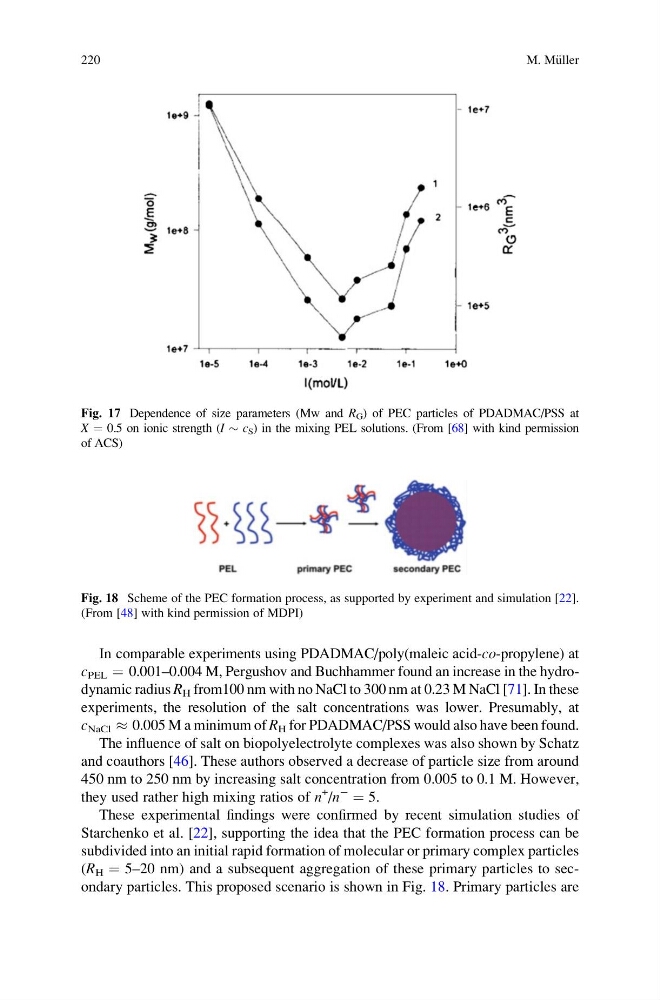
(R H ¼ 5–20 nm) and a subsequent aggregation of these primary particles to secondary particles. This proposed scenario is shown in Fig. 18. Primary particles are
Fig. 17 Dependence of size parameters (Mw and R G ) of PEC particles of PDADMAC/PSS at
X ¼ 0.5 on ionic strength (I $ c S ) in the mixing PEL solutions. (From [68] with kind permission
of ACS)
Fig. 18 Scheme of the PEC formation process, as supported by experiment and simulation [22].
(From [48] with kind permission of MDPI)
220
M. M€ uller
c PEL ¼ 0.001–0.004 M, Pergushov and Buchhammer found an increase in the hydrodynamic radius R H from100 nm with no NaCl to 300 nm at 0.23 M NaCl [71]. In these
experiments, the resolution of the salt concentrations was lower. Presumably, at
c NaCl % 0.005 M a minimum of R H for PDADMAC/PSS would also have been found.
The influence of salt on biopolyelectrolyte complexes was also shown by Schatz
and coauthors [46]. These authors observed a decrease of particle size from around
450 nm to 250 nm by increasing salt concentration from 0.005 to 0.1 M. However,
they used rather high mixing ratios of n
+
/n
À ¼ 5.
These experimental findings were confirmed by recent simulation studies of
Starchenko et al. [22], supporting the idea that the PEC formation process can be
subdivided into an initial rapid formation of molecular or primary complex particles
(R H ¼ 5–20 nm) and a subsequent aggregation of these primary particles to secondary particles. This proposed scenario is shown in Fig. 18. Primary particles are
Fig. 17 Dependence of size parameters (Mw and R G ) of PEC particles of PDADMAC/PSS at
X ¼ 0.5 on ionic strength (I $ c S ) in the mixing PEL solutions. (From [68] with kind permission
of ACS)
Fig. 18 Scheme of the PEC formation process, as supported by experiment and simulation [22].
(From [48] with kind permission of MDPI)
220
M. M€ uller