

3.2.3 Salt Concentration
The influence of salt on colloidal PEC parameters like size (and structural density)
can be divided into two scenarios: (1) salt addition during complexation, being
already present in the PEL solutions, and (2) salt addition after complexation to
already-formed PEC dispersions.
Salt Addition During Complexation
A classical paper on the effect of salt on PEL complexation has been given by
Dautzenberg [68]. PEC particles of the standard PDADMAC/PSS system were
prepared at a PEL concentration of c PEL ¼ 0.00025 M (PSS) and c PEL ¼ 0.0005 M
(PDADMAC) in the presence of no, 0.01 M and 0.1 M NaCl.
For no salt, the PEC particle size (R G ) dropped from around 300 nm at mixing
ratio X ¼ 0.1 to about 130 nm at X ¼ 0.95. For 0.01 M NaCl, R G kept constant at
about 40 nm at X ¼ 0.1–0.9. For 0.1 M NaCl, at X ¼ 0.1 R G ¼ 50 nm, which was
slightly higher than for 0.01 M, and increased to about 120 nm at X ¼ 0.95. For
X ¼ 0.5, the PDADMAC/PSS system was studied at a higher resolution of NaCl
concentration, resulting in a pronounced minimum at around 0.005 M, which is
shown in Fig. 17. This was explained by a double influence of ionic strength and
thus the charge screening on PEC particles, which is based on the hypothetical PEL
complexation scenario of rapidly formed primary molecular complexes prone to
secondary aggregation. In this picture, on the one hand increasing salt concentration
favors coagulation of PEC (primary) particles to larger (secondary) particles, while
on the other hand the PEL shells of the finally formed PEC aggregates shrink.
0
200
400
600
800
1000
0.000
0.004
0.008
0.012
Diameter / [nm]
0
50
100
150
200
Count rate / [KHz]
c PEL / [Mol/L]
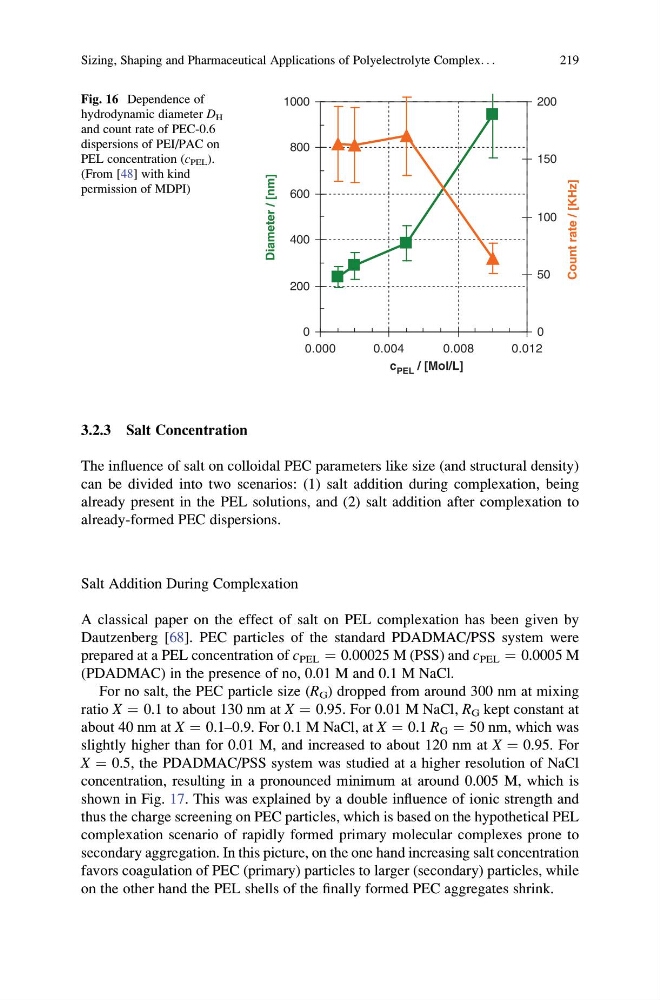
Fig. 16 Dependence of
hydrodynamic diameter D H
and count rate of PEC-0.6
dispersions of PEI/PAC on
PEL concentration (c PEL ).
(From [48] with kind
permission of MDPI)
Sizing, Shaping and Pharmaceutical Applications of Polyelectrolyte Complex. . .
219
The influence of salt on colloidal PEC parameters like size (and structural density)
can be divided into two scenarios: (1) salt addition during complexation, being
already present in the PEL solutions, and (2) salt addition after complexation to
already-formed PEC dispersions.
Salt Addition During Complexation
A classical paper on the effect of salt on PEL complexation has been given by
Dautzenberg [68]. PEC particles of the standard PDADMAC/PSS system were
prepared at a PEL concentration of c PEL ¼ 0.00025 M (PSS) and c PEL ¼ 0.0005 M
(PDADMAC) in the presence of no, 0.01 M and 0.1 M NaCl.
For no salt, the PEC particle size (R G ) dropped from around 300 nm at mixing
ratio X ¼ 0.1 to about 130 nm at X ¼ 0.95. For 0.01 M NaCl, R G kept constant at
about 40 nm at X ¼ 0.1–0.9. For 0.1 M NaCl, at X ¼ 0.1 R G ¼ 50 nm, which was
slightly higher than for 0.01 M, and increased to about 120 nm at X ¼ 0.95. For
X ¼ 0.5, the PDADMAC/PSS system was studied at a higher resolution of NaCl
concentration, resulting in a pronounced minimum at around 0.005 M, which is
shown in Fig. 17. This was explained by a double influence of ionic strength and
thus the charge screening on PEC particles, which is based on the hypothetical PEL
complexation scenario of rapidly formed primary molecular complexes prone to
secondary aggregation. In this picture, on the one hand increasing salt concentration
favors coagulation of PEC (primary) particles to larger (secondary) particles, while
on the other hand the PEL shells of the finally formed PEC aggregates shrink.
0
200
400
600
800
1000
0.000
0.004
0.008
0.012
Diameter / [nm]
0
50
100
150
200
Count rate / [KHz]
c PEL / [Mol/L]
Fig. 16 Dependence of
hydrodynamic diameter D H
and count rate of PEC-0.6
dispersions of PEI/PAC on
PEL concentration (c PEL ).
(From [48] with kind
permission of MDPI)
Sizing, Shaping and Pharmaceutical Applications of Polyelectrolyte Complex. . .
219