

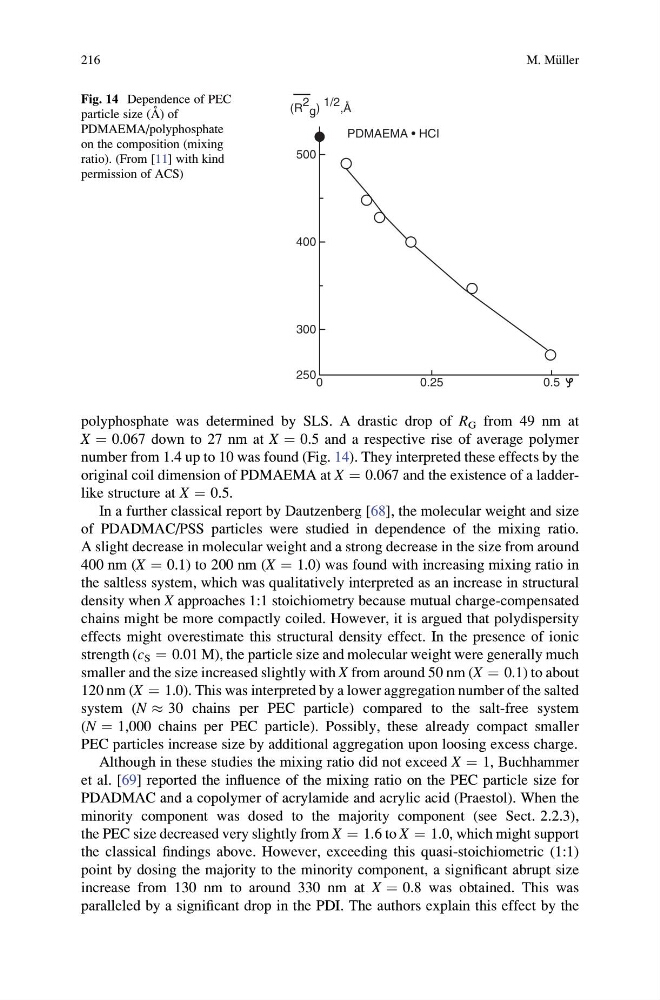
polyphosphate was determined by SLS. A drastic drop of R G from 49 nm at
X ¼ 0.067 down to 27 nm at X ¼ 0.5 and a respective rise of average polymer
number from 1.4 up to 10 was found (Fig. 14). They interpreted these effects by the
original coil dimension of PDMAEMA at X ¼ 0.067 and the existence of a ladderlike structure at X ¼ 0.5.
In a further classical report by Dautzenberg [68], the molecular weight and size
of PDADMAC/PSS particles were studied in dependence of the mixing ratio.
A slight decrease in molecular weight and a strong decrease in the size from around
400 nm (X ¼ 0.1) to 200 nm (X ¼ 1.0) was found with increasing mixing ratio in
the saltless system, which was qualitatively interpreted as an increase in structural
density when X approaches 1:1 stoichiometry because mutual charge-compensated
chains might be more compactly coiled. However, it is argued that polydispersity
effects might overestimate this structural density effect. In the presence of ionic
strength (c S ¼ 0.01 M), the particle size and molecular weight were generally much
smaller and the size increased slightly with X from around 50 nm (X ¼ 0.1) to about
120 nm (X ¼ 1.0). This was interpreted by a lower aggregation number of the salted
system (N % 30 chains per PEC particle) compared to the salt-free system
(N ¼ 1,000 chains per PEC particle). Possibly, these already compact smaller
PEC particles increase size by additional aggregation upon loosing excess charge.
Although in these studies the mixing ratio did not exceed X ¼ 1, Buchhammer
et al. [69] reported the influence of the mixing ratio on the PEC particle size for
PDADMAC and a copolymer of acrylamide and acrylic acid (Praestol). When the
minority component was dosed to the majority component (see Sect. 2.2.3),
the PEC size decreased very slightly from X ¼ 1.6 to X ¼ 1.0, which might support
the classical findings above. However, exceeding this quasi-stoichiometric (1:1)
point by dosing the majority to the minority component, a significant abrupt size
increase from 130 nm to around 330 nm at X ¼ 0.8 was obtained. This was
paralleled by a significant drop in the PDI. The authors explain this effect by the
500
400
300
250 0
0.25
0.5
PDMAEMA • HCI
(R
2
g )
1/2 ,Å
Fig. 14 Dependence of PEC
particle size (A ˚ ) of
PDMAEMA/polyphosphate
on the composition (mixing
ratio). (From [11] with kind
permission of ACS)
216
M. M€ uller
X ¼ 0.067 down to 27 nm at X ¼ 0.5 and a respective rise of average polymer
number from 1.4 up to 10 was found (Fig. 14). They interpreted these effects by the
original coil dimension of PDMAEMA at X ¼ 0.067 and the existence of a ladderlike structure at X ¼ 0.5.
In a further classical report by Dautzenberg [68], the molecular weight and size
of PDADMAC/PSS particles were studied in dependence of the mixing ratio.
A slight decrease in molecular weight and a strong decrease in the size from around
400 nm (X ¼ 0.1) to 200 nm (X ¼ 1.0) was found with increasing mixing ratio in
the saltless system, which was qualitatively interpreted as an increase in structural
density when X approaches 1:1 stoichiometry because mutual charge-compensated
chains might be more compactly coiled. However, it is argued that polydispersity
effects might overestimate this structural density effect. In the presence of ionic
strength (c S ¼ 0.01 M), the particle size and molecular weight were generally much
smaller and the size increased slightly with X from around 50 nm (X ¼ 0.1) to about
120 nm (X ¼ 1.0). This was interpreted by a lower aggregation number of the salted
system (N % 30 chains per PEC particle) compared to the salt-free system
(N ¼ 1,000 chains per PEC particle). Possibly, these already compact smaller
PEC particles increase size by additional aggregation upon loosing excess charge.
Although in these studies the mixing ratio did not exceed X ¼ 1, Buchhammer
et al. [69] reported the influence of the mixing ratio on the PEC particle size for
PDADMAC and a copolymer of acrylamide and acrylic acid (Praestol). When the
minority component was dosed to the majority component (see Sect. 2.2.3),
the PEC size decreased very slightly from X ¼ 1.6 to X ¼ 1.0, which might support
the classical findings above. However, exceeding this quasi-stoichiometric (1:1)
point by dosing the majority to the minority component, a significant abrupt size
increase from 130 nm to around 330 nm at X ¼ 0.8 was obtained. This was
paralleled by a significant drop in the PDI. The authors explain this effect by the
500
400
300
250 0
0.25
0.5
PDMAEMA • HCI
(R
2
g )
1/2 ,Å
Fig. 14 Dependence of PEC
particle size (A ˚ ) of
PDMAEMA/polyphosphate
on the composition (mixing
ratio). (From [11] with kind
permission of ACS)
216
M. M€ uller