

reported by the groups of Schacher and Pergushov [65, 66]. These PEC systems selfassemble to multicompartment micelles in aqueous media featuring a hydrophobic
PB core and complexed PMAA(À)/P2VPQ(+) domains on the PB core formed by
electrostatic interaction. In the corona of these micelles, excess portions of the
respective PEL block (PMAA or P2VPQ) with the higher polymerization degree
are located and provide their solubility and colloidal stability in water. Formation of
the multicompartment structure of these PEC micelles is highly dynamic, so that the
authors claim applications as temporal carriers for various compounds. More details
on these dynamic micellar PEC systems can be found in a dedicated article by
Pergushov [67].
3.2 Media Parameters
The influence of mixing ratio X ¼ n
À /n
+
, PEL concentration (c PEL ), and salt
concentration (c S ) on PEC particle size will be reviewed in this section.
3.2.1 Mixing Ratio
Mixing ratio is the parameter that is by far the most used and varied in experimental
studies on PEC particles, wherein the most frequent observable is turbidity. Mixing
ratio is also used to influence PEC particle size.
In a classical report by Kabanov and Zezin [11], the radius of gyration (R G ) as
well as the average number of polymers of PEC particles of PDMAEMA/
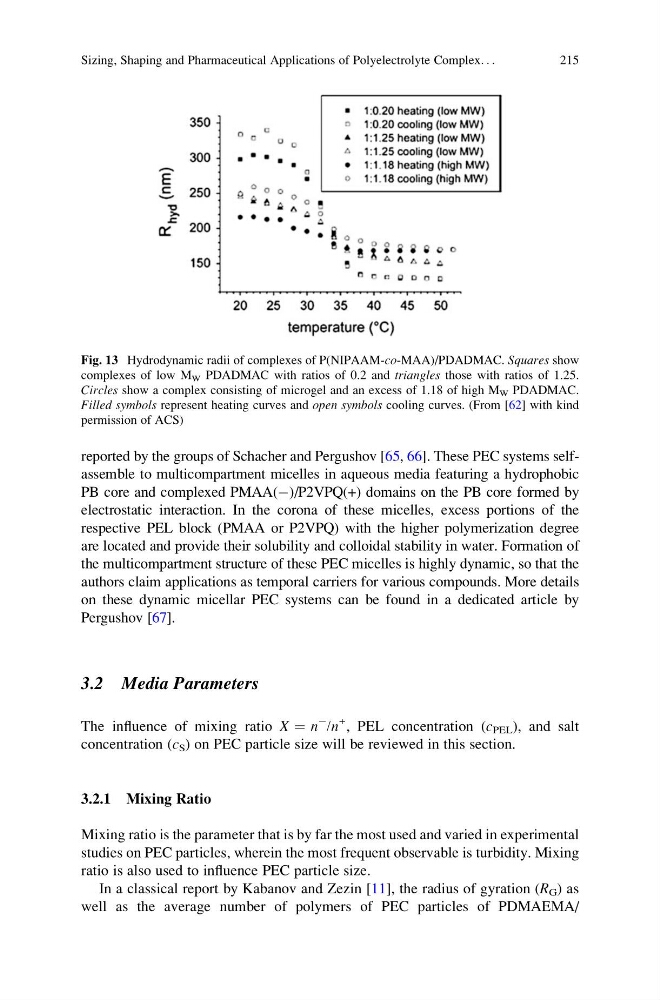
Fig. 13 Hydrodynamic radii of complexes of P(NIPAAM-co-MAA)/PDADMAC. Squares show
complexes of low M W PDADMAC with ratios of 0.2 and triangles those with ratios of 1.25.
Circles show a complex consisting of microgel and an excess of 1.18 of high M W PDADMAC.
Filled symbols represent heating curves and open symbols cooling curves. (From [62] with kind
permission of ACS)
Sizing, Shaping and Pharmaceutical Applications of Polyelectrolyte Complex. . .
215
PB core and complexed PMAA(À)/P2VPQ(+) domains on the PB core formed by
electrostatic interaction. In the corona of these micelles, excess portions of the
respective PEL block (PMAA or P2VPQ) with the higher polymerization degree
are located and provide their solubility and colloidal stability in water. Formation of
the multicompartment structure of these PEC micelles is highly dynamic, so that the
authors claim applications as temporal carriers for various compounds. More details
on these dynamic micellar PEC systems can be found in a dedicated article by
Pergushov [67].
3.2 Media Parameters
The influence of mixing ratio X ¼ n
À /n
+
, PEL concentration (c PEL ), and salt
concentration (c S ) on PEC particle size will be reviewed in this section.
3.2.1 Mixing Ratio
Mixing ratio is the parameter that is by far the most used and varied in experimental
studies on PEC particles, wherein the most frequent observable is turbidity. Mixing
ratio is also used to influence PEC particle size.
In a classical report by Kabanov and Zezin [11], the radius of gyration (R G ) as
well as the average number of polymers of PEC particles of PDMAEMA/
Fig. 13 Hydrodynamic radii of complexes of P(NIPAAM-co-MAA)/PDADMAC. Squares show
complexes of low M W PDADMAC with ratios of 0.2 and triangles those with ratios of 1.25.
Circles show a complex consisting of microgel and an excess of 1.18 of high M W PDADMAC.
Filled symbols represent heating curves and open symbols cooling curves. (From [62] with kind
permission of ACS)
Sizing, Shaping and Pharmaceutical Applications of Polyelectrolyte Complex. . .
215